August 27, 2025

Photos | U.S. Deputy Secretary of Energy James P. Danly visits SLAC

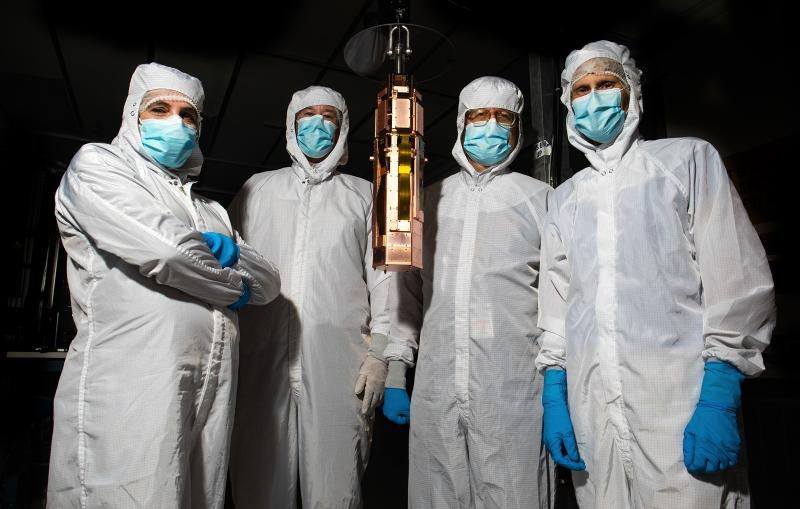
His visit highlighted the breadth of our world-class research and the people and collaborations that make it possible. A key theme of the day: how SLAC and the National Labs are advancing AI to accelerate discovery.

U.S. Deputy Secretary of Energy James P. Danly Visits SLAC, August 18, 2025

About SLAC

SLAC National Accelerator Laboratory explores how the universe works at the biggest, smallest and fastest scales and invents powerful tools used by researchers around the globe. As world leaders in ultrafast science and bold explorers of the physics of the universe, we forge new ground in understanding our origins and building a healthier and more sustainable future. Our discovery and innovation help develop new materials and chemical processes and open unprecedented views of the cosmos and life’s most delicate machinery. Building on more than 60 years of visionary research, we help shape the future by advancing areas such as quantum technology, scientific computing and the development of next-generation accelerators.

SLAC is operated by Stanford University for the U.S. Department of Energy’s Office of Science. The Office of Science is the single largest supporter of basic research in the physical sciences in the United States and is working to address some of the most pressing challenges of our time.

Dig Deeper

Related stories

News Brief

The latest results combined weak lensing and galaxy clustering and incorporated four dark energy probes from a single experiment for the first time.

Photo of the Cerro Tololo Inter-American Observatory (CTIO) in the Chilean Andes at night.
News Release

The state-of-the-art ‘big-data facility’ unveils its first images and video, bringing the night sky to life like never before.

This image combines 678 separate images taken by NSF–DOE Vera C. Rubin Observatory in just over seven hours of observing time. Combining many images in this way clearly reveals otherwise faint or invisible details, such as the clouds of gas and dust that comprise the Trifid nebula (top) and the Lagoon nebula, which are several thousand light-years away from Earth
Feature

NSF–DOE Vera C. Rubin Observatory is about to embark on its quest to capture the cosmos, marking the culmination of decades of work by...

A group photo in front of a large telescope mounting system.
News Brief

The latest results combined weak lensing and galaxy clustering and incorporated four dark energy probes from a single experiment for the first time.

Photo of the Cerro Tololo Inter-American Observatory (CTIO) in the Chilean Andes at night.
News Release

The state-of-the-art ‘big-data facility’ unveils its first images and video, bringing the night sky to life like never before.

This image combines 678 separate images taken by NSF–DOE Vera C. Rubin Observatory in just over seven hours of observing time. Combining many images in this way clearly reveals otherwise faint or invisible details, such as the clouds of gas and dust that comprise the Trifid nebula (top) and the Lagoon nebula, which are several thousand light-years away from Earth
Feature

NSF–DOE Vera C. Rubin Observatory is about to embark on its quest to capture the cosmos, marking the culmination of decades of work by...

A group photo in front of a large telescope mounting system.
Feature

NSF–DOE Vera C. Rubin Observatory will add an unprecedented amount of cosmological data to the study of the structure and expansion of the Universe.

An illustration of a woman holding a book is surrounded by photographic negatives showing pictures of the universe.
News Brief

Wechsler is one of seven Stanford researchers to join the scholarly society, which works to promote science for public good.

Risa Wechsler
Feature

Now that NSF–DOE Vera C. Rubin Observatory’s LSST Camera has been installed, what’s next?

A large black cylindrical camera is positioned in a telescope dome.