SLAC topics

Linac Coherent Light Source (LCLS) RSS feed

The Linac Coherent Light Source at SLAC, the world’s first hard X-ray free-electron laser, takes X-ray snapshots of atoms and molecules at work, revealing fundamental processes in materials, technology and living things.

Visit LCLS website

Browse tagged content

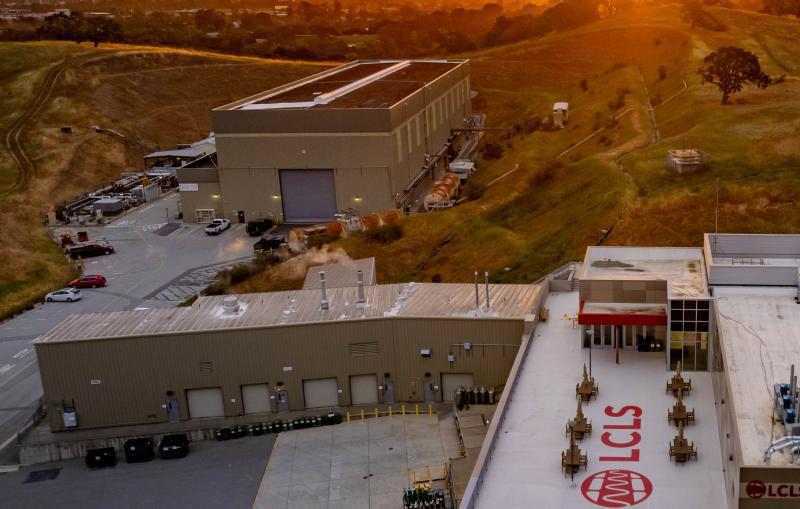
Rooftop view of Linac Coherent Light Source (LCLS)
Feature

Researchers at SLAC are developing experimental techniques to evaluate new candidates for inertial fusion energy targets. 

a graphic in the style of graphic novel depicts four lasers converging on a spherical target, which represents an inertial fusion energy reaction
Feature

The SLAC team is developing digital twins – powered by AI and high-performance computing – to help quickly shape high-quality particle beams for the...

hand pointing to digital twin
News Brief
Via Max Planck Institute for Nuclear Physics

Observing quantum footballs blown up by laser kicks

Laser-driven break up of "buckyballs" is recorded in real-time by X-ray imaging at LCLS. 

Buckyballs
News Brief

A new machine learning algorithm rapidly reconstructs 3D images from X-ray data. 

Schematic of a machine learning algorithm that reconstructs 3D images from X-ray data
News Release

SLAC and Stanford partner with Argonne National Laboratory and others toward a quantum-interconnected world.

A person in a bunny suit examines a wafer
Multimedia

After a major upgrade, SLAC's X-ray free-electron laser is 10,000 times brighter and thousands of times faster. Now, researchers are using LCLS to observe...

Detail of the TMO hutch at SLAC's X-ray laser
Past Event
Seminars and conferences

2025 SSRL/LCLS Users' Meeting

21-26 September 2025 at SLAC National Accelerator Laboratory

Users' Meeting 2025
Multimedia

His visit highlighted the breadth of our world-class research and the people and collaborations that make it possible. A key theme of the day...

U.S. Deputy Secretary of Energy Danly watches a simulation of dark matter.
Past Event
Electrons are tiny, charged particles with huge jobs: They hold all matter together, they drive the chemical reactions that power life, and they transport...
A headshot of Taran Driver next to the SLAC on Tap logo with the words "Home brewed science" surrounding the logo
Multimedia

Researchers used LCLS to capture the ultrafast motion of electrons inside molecules – at scales never before possible. 

Complex scientific machinery with metal components
Feature

They used SLAC’s ultrafast X-ray laser to follow the impact of a single electron moving within a molecule during an entire chemical reaction.

An illustration of X-rays scattering off the valence electrons surrounding ammonia molecules and getting captured on a detector.
Feature

With a suite of reimagined instruments, researchers take up scientific inquiries that were out of reach just one year ago. 

Large metallic machine in a lab, featuring valves, circular bolts, and digital displays with surrounding wires and tubing.