SLAC topics

Linac Coherent Light Source (LCLS) RSS feed

The Linac Coherent Light Source at SLAC, the world’s first hard X-ray free-electron laser, takes X-ray snapshots of atoms and molecules at work, revealing fundamental processes in materials, technology and living things.
Visit LCLS website

Browse tagged content

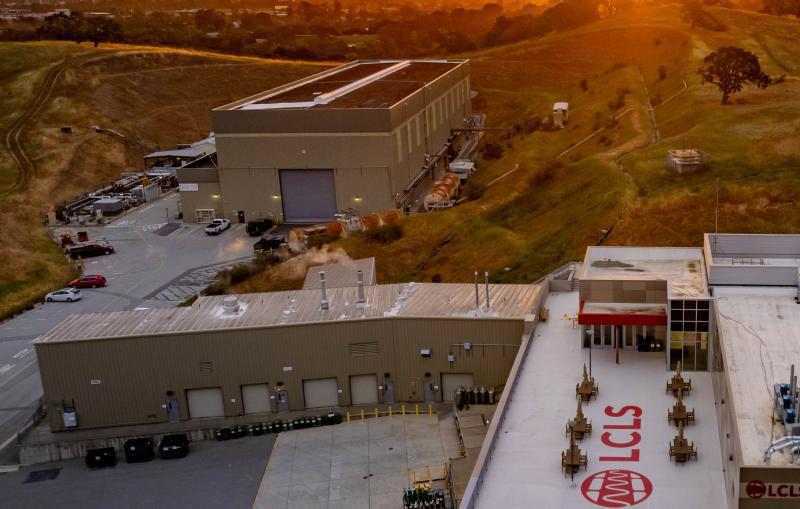
Rooftop view of Linac Coherent Light Source (LCLS)
Feature

They used SLAC’s ultrafast X-ray laser to follow the impact of a single electron moving within a molecule during an entire chemical reaction.

An illustration of X-rays scattering off the valence electrons surrounding ammonia molecules and getting captured on a detector.
Feature

With a suite of reimagined instruments, researchers take up scientific inquiries that were out of reach just one year ago. 

Large metallic machine in a lab, featuring valves, circular bolts, and digital displays with surrounding wires and tubing.
News Brief

Results obtained with SLAC’s X-ray laser show how tiny magnetic coils can align over a surprisingly broad timescale, inspiring new ideas for microelectronics. 

Vibrant 3D model with red and blue wave patterns on a layered surface, depicting magnetization points, set against blurry background.
Multimedia

Researchers used the upgraded LCLS to better understand what makes Xanthone – a powerful photocatalyst used in cancer therapies –  so efficient.  

close up of instrumentation in the TMO hutch
Feature

Researchers taking the first-ever direct measurement of atom temperature in extremely hot materials inadvertently disproved a decades-old theory and upended our understanding of superheating. 

Graphic representation shows a pulse of yellow light hitting a lattice and diffracting into a spectrum of color
Feature

Ultrafast electrons at SLAC’s LCLS facility resolved the structural changes in a light-activated molecule to determine which simulations work best. 

Graphic representation of several molecules floating through space, circle of papers representing scientific results
Multimedia

Now 10,000 times brighter and thousands of times faster, LCLS sheds light on the formation of free radicals in nature. 

a closeup of the target chamber of the RIXS experimental hutch
Feature

Shweta Saraf and her team work to ensure the LCLS beamline runs without interruption. 

A woman stands next to a large blue server rack filled with electronic control units, wiring, and monitoring equipment. She is smiling at the camera while using a stylus to interact with a touchscreen interface on one of the devices.
Feature

One-quintillionth of a second lasing breakthrough could lead to next-generation X-ray technologies, improving imaging in medical, material, and quantum science.

A purple blob with black streaks and a yellow center.
Feature

He met with SLAC staff and toured the lab’s cutting-edge facilities, diving into world-leading research in X-ray and ultrafast science, artificial intelligence, astrophysics and...

Secretary Wright Visit LCLS
Feature

Researchers aim to refine control room tools, improve training, and pave the way for smarter cooperation between humans and machines by studying how operators...

Human in the loop
Feature

Leading researchers met at SLAC on Pellegrini’s 90th birthday to honor his ongoing scientific legacy and to explore the future of X-ray free-electron laser...

An image of Claudio Pellegrini beside a schematic showing magnets in orange and an electron beam in green creating a blue beam of X-rays.