Researchers discover a new type of magnetic order
Results obtained with SLAC’s X-ray laser show how tiny magnetic coils can align over a surprisingly broad timescale, inspiring new ideas for microelectronics.
By Chris Patrick
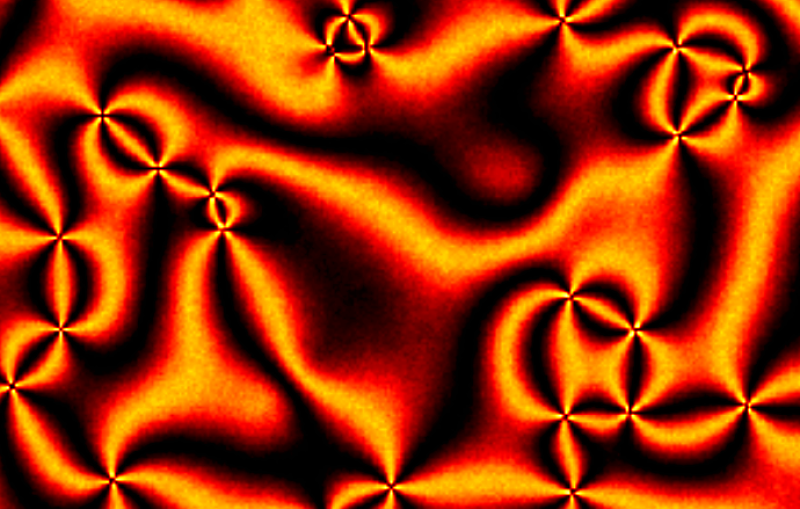
Nematic materials are made of elongated molecules that align in a preferred direction, but, like in a fluid, are spaced out irregularly. The best-known nematic materials are liquid crystals, which are used in liquid crystal display (LCD) screens. However, nematic order has been identified in a wide range of systems, including bacterial suspensions and superconductors.
Now, a team led by researchers at the Department of Energy’s Lawrence Berkeley National Laboratory (Berkeley Lab), SLAC National Accelerator Laboratory and University of California, Santa Cruz, has discovered a nematic order in a magnetic material, in which the magnetic spins of the material are arranged into coils pointing in the same general direction.
“If we think of these magnetic helices as the objects that are aligning, the magnetism follows expectations for nematic phases,” said Zoey Tumbleson, a graduate student at Berkeley Lab and the University of California, Santa Cruz, who led this work. “These phases were not previously known and it’s very exciting to see this generalized to a wider field of study.”
Stanford Institute for Materials & Energy Sciences (SIMES)
SIMES researchers study complex, novel materials that could transform the energy landscape.
While this new exotic order needs further study, the discovery could one day lead to future technology based on tiny magnetic helices rather than conventional liquid crystals.
“If you can control these weird helical nematic states, maybe you could build new materials with on-demand properties,” said co-author Joshua Turner, a lead scientist at SLAC and principal investigator at the Stanford Institute for Materials and Energy Sciences (SIMES). “I feel like this is just the beginning.”
The researchers reported their findings in Science Advances.
Two X-ray facilities probe two very different timescales of motion
The team found the magnetic nematic order in special films of iron germanide that were grown by the collaboration at the University of California, Berkeley, and Berkeley Lab. These films lacked the crystalline order typically seen in this material.

Linac Coherent Light Source (LCLS)
LCLS takes X-ray snapshots of atoms and molecules at work, revealing fundamental processes in materials, technology and living things.

“Our discovery of a magnetic nematic phase is an example of a new exotic phase in amorphous iron germanide,” said co-author Sujoy Roy, a staff scientist at Berkeley Lab. "This work is part of our group's broader research effort into understanding fluctuations in magnetic materials, which could lead to advancements in information storage and other microelectronic applications.”
To determine the arrangement and motions of the magnetic coils in the films, the researchers brought them to two different X-ray light sources – the Linac Coherent Light Source (LCLS) at SLAC and the Advanced Light Source (ALS) at Berkeley Lab – where they shot X-rays through the films and measured how they scattered.
Using both light sources’ unique capabilities, they discovered motions of the magnetic coils at two vastly different timescales, one being a trillion times faster than the other. At LCLS, they measured rapid motions occurring within billionths of a second, or nanoseconds. At ALS, they observed slower motions happening over hundreds of seconds.

“This work truly would not have come together without the collaboration between SLAC and Berkeley Lab,” Tumbleson said.
Together, the findings from both light sources give researchers a first glimpse of the complicated motions involved in this magnetic nematic order. Future measurements could investigate either the motion on timescales between the two investigated in this work, or at even faster timescales with the recent upgrade at LCLS.
“These measurements at very different timescales combine to provide us with this really interesting picture. It’s mysterious and points to much more occurring here than previously understood,” Turner said. “But we’re only capturing a narrow sliver of what’s happening.”
Additional contributions to this research came from DOE’s Argonne National Laboratory. Large parts of this work were funded by the DOE Office of Science. LCLS and ALS are Office of Science user facilities.
Citation: Z. Tumbleson et al., Science Advances, 20 June 2025 (10.1126/sciadv.adt5680)
For questions or comments, contact SLAC Strategic Communications & External Affairs at communications@slac.stanford.edu.
About SLAC
SLAC National Accelerator Laboratory explores how the universe works at the biggest, smallest and fastest scales and invents powerful tools used by researchers around the globe. As world leaders in ultrafast science and bold explorers of the physics of the universe, we forge new ground in understanding our origins and building a healthier and more sustainable future. Our discovery and innovation help develop new materials and chemical processes and open unprecedented views of the cosmos and life’s most delicate machinery. Building on more than 60 years of visionary research, we help shape the future by advancing areas such as quantum technology, scientific computing and the development of next-generation accelerators.
SLAC is operated by Stanford University for the U.S. Department of Energy’s Office of Science. The Office of Science is the single largest supporter of basic research in the physical sciences in the United States and is working to address some of the most pressing challenges of our time.