This month, Symmetry presents a series of articles on the past, present and future of quantum research—and its many connections to particle physics, astrophysics and computing.
A technique from the newest generation of quantum sensors is helping scientists to use the limitations of the Heisenberg uncertainty principle to their advantage.
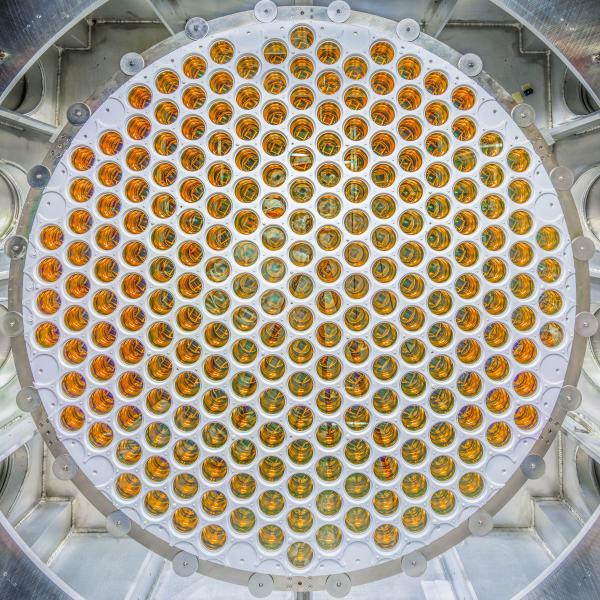
The LUX-ZEPLIN experiment observed a particle interaction that could be interpreted as a signal from WIMPs, a dark matter candidate – but researchers will need more data to confirm.
The deep-underground experiment could produce early-scientific results in the search for one of nature’s most elusive substances even, before reaching optimal sensitivity when the full search begins next year.
SLAC develops and deploys some of the world’s most advanced scientific tools for exploring how the universe works at the biggest, smallest and fastest scales. Here we explain how they work and the exciting discoveries they make possible.
In the largest dataset ever collected by a dark matter detector, LUX-ZEPLIN's latest results provide the strongest constraints on low-mass WIMPs and detect boron-8 solar neutrinos.