SLAC National Accelerator Laboratory
    • About

      Learn about our science, people, facilities and partners. Discover our history and vision for the future.

    • OUR STORY
      • Mission, vision, values
      • History
    • LAB OVERVIEW
      • SLAC at a glance
      • Lab organization
      • Our partnerships
    • OUR PEOPLE
      • Leadership
      • Meet our teams
      • Faculty
    • VISIT SLAC
      • Public tours
      • Contact us
    • Resources
      • Images, videos & more
      • Brochures & fact sheets
    • Connect With Us
      • Facebook
      • Flickr
      • Instagram
      • LinkedIn
      • Twitter
      • YouTube
    video

    Who we are

    We explore radically new ideas with an entrepreneurial mindset.

    Science and User Support Building to the left and Arrillaga Science Center building to the right from above the Main Quad at SLAC's campus.
    • Research

      Get an overview of research at SLAC: X-ray and ultrafast science, particle and astrophysics, cosmology, particle accelerators, biology, energy and technology.

    • X-ray and Ultrafast science icon X-ray & ultrafast science

      Revealing nature’s fastest processes with X-rays, lasers and electrons

    • Physics of the universe science icon Physics of the universe

      Studying the particles and forces that knit the cosmos together

    • Advanced Accelerators science icon Advanced accelerators

      Building smaller, faster, more powerful accelerators for all

    • Science of life science icon Science of life

      Understanding the machinery of life at its most basic level

    • New technologies science icon New technologies

      Inventing new tools for science and society

    • Energy sciences science icon Energy sciences

      Breaking new ground in securing abundant, affordable and reliable energy.

    Spotlight

    SLAC science explained

    Cut through the jargon while exploring our research.

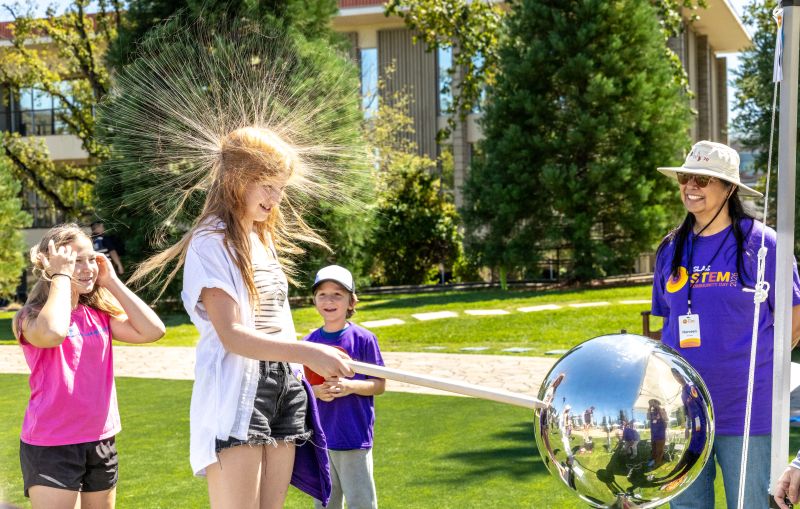
    A girl experiences static electricity from a Van de Graaff generator at a outdoor SLAC STEM Community Day event, making her hair stand on end.
    • Facilities & Centers

      Learn more about the places where science happens at SLAC: our major facilities, institutes and centers.

    • SCIENTIFIC FACILITIES
      • LCLS website

        Linac Coherent Light Source

      • SSRL website

        Stanford Synchrotron Radiation Lightsource

      • FACET-II website

        Facility for Advanced Accelerator Experimental Tests

      • CryoEM website

        Cryogenic Electron Microscopy

    • JOINT INSTITUTES & CENTERS
      • SIMES website

        Stanford Institute for Materials & Energy Science

      • KIPAC website

        Kavli Institute for Particle Astrophysics & Cosmology

      • PULSE website

        Stanford PULSE Institute

      • SUNCAT website

        Center for Interface Science & Catalysis

      • SLAC-Stanford Battery Center

    NSF-DOE Vera C. Rubin Observatory LSST

    SLAC & Stanford build the world’s largest digital camera for the Legacy Survey of Space and Time (LSST).

    A drone photo of Rubin Observatory while taking pictures during the First Look observing campaign
    • Work with Us

      Find a career, partner with us or apply to use our tools and facilities.

    • PARTNER WITH US
      • For industry partners
      • Research partnerships & tech transfer
      • Technology Innovation
    • CAREERS AT SLAC
      • Job openings
      • Internships
      • Life at SLAC
    • USE OUR FACILITIES

      Apply to become a user of our scientific research facilities and instruments.

    • COMING TO SLAC
    • BECOME A SUPPLIER

    Careers at SLAC

    Join our united workforce.

    SLAC staff in main quad
    • News & Events

      Get the latest news about the lab, our science and discoveries. Explore SLAC events and learn how to participate.

    • NEWS CENTER
      • News archive
      • Media resources
      • Images & videos
    • SLAC EVENTS
      • Public lectures
      • Scientific seminars
      • Community events
    • SYMMETRY MAGAZINE

      This joint publication of SLAC and Fermilab is your view into the world of particle physics.

    • EDUCATIONAL PROGRAMS
      • Educational tours
      • Resources for students & educators
    • Connect With Us
      • Facebook
      • Flickr
      • Instagram
      • LinkedIn
      • Twitter
      • YouTube
    Upcoming

    SLAC on Tap: Night of the Dark Matter

    Wednesday, October 28, 5:30pm

    SLAC on Tap
Filter search by
Staff portalStanford directoryComing to SLACResources for…
  1. Home
  2. …
Filter by research area
  • X-ray and ultrafast science (355)
  • Physics of the universe (287)
  • Energy sciences (104)
  • Science of life (89)
  • New technologies (61)
  • Advanced accelerators (40)
Filter by Type
  • News (1812)
  • Image (387)
  • Video (226)
  • Event (162)
  • Person (68)
  • Page (67)
  • resource (59)
  • News Collection (6)
Sort by
2787 results
Display Grid Display List
Feature
VIA Symmetry Magazine

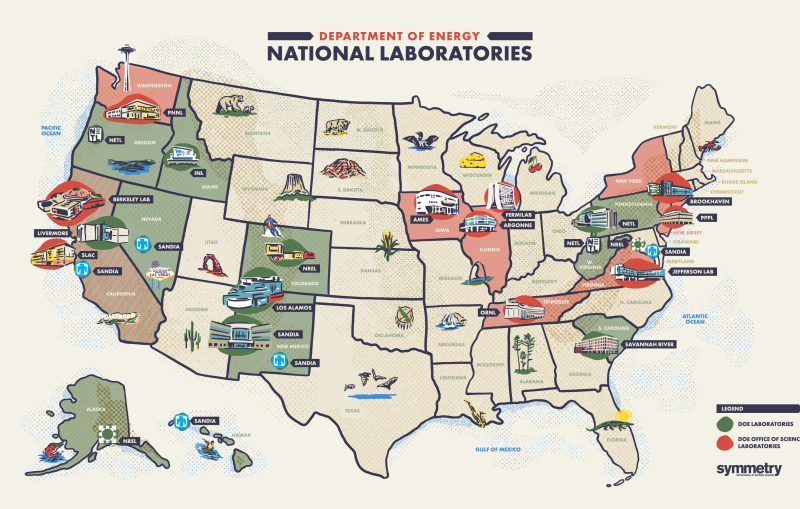
From sea to scientific sea

Take a tour of the 17 national laboratories across the United States.

October 22, 2024
Take a tour of the 17 national laboratories across the United States
Feature
VIA Symmetry Magazine

The potential of plasma wakefield acceleration

Scientists around the world are testing ways to further boost the power of particle accelerators while drastically shrinking their size.

March 14, 2019
Scientists around the world are testing ways to further boost the power of particle accelerators while drastically shrinking their size.
Feature
VIA Symmetry Magazine

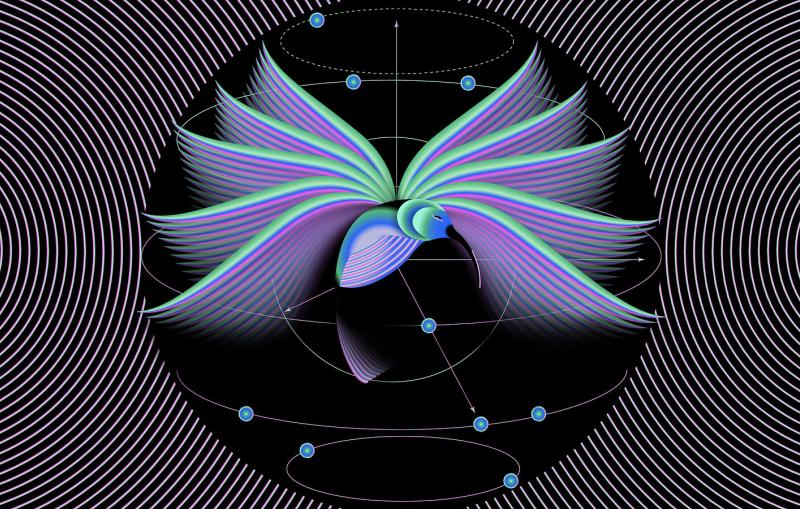
Symmetry: Looking at a new quantum revolution

This month, Symmetry presents a series of articles on the past, present and future of quantum research—and its many connections to particle physics, astrophysics...

January 11, 2022
Illustration of a hummingbird
Feature
VIA Symmetry Magazine

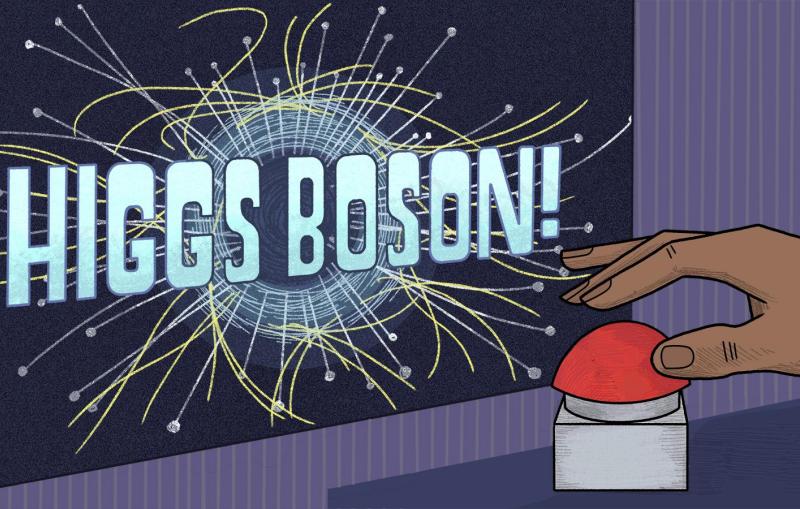
Symmetry: Are you a Higgs expert? Take this quiz to find out!

July 4 marks the 10th anniversary of the discovery of the Higgs boson.

June 28, 2022
Higgs Boson!
Feature
VIA Symmetry Magazine

The quantum squeeze

A technique from the newest generation of quantum sensors is helping scientists to use the limitations of the Heisenberg uncertainty principle to their advantage.

January 25, 2022
Illustration of a squid
Feature
VIA Symmetry Magazine

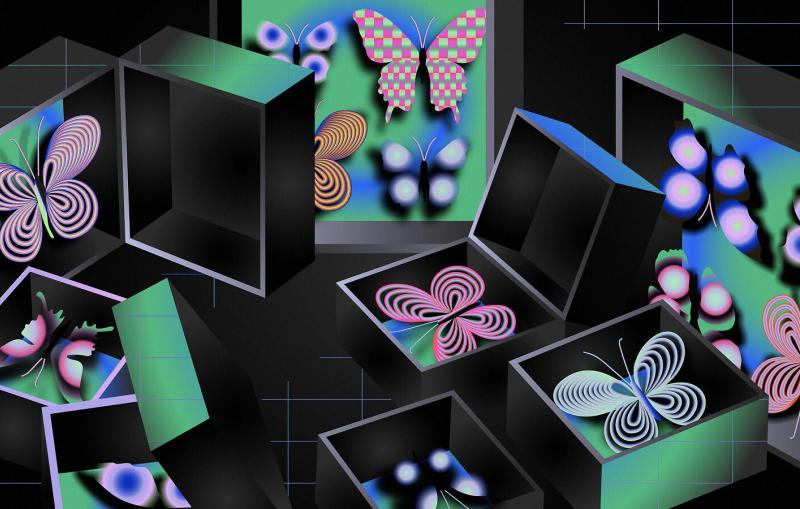
More than one way to make a qubit

Scientists are exploring a variety of ways to make quantum bits. We may not need to settle on a single one.

January 24, 2022
Illustration of butterfly collection
Feature
VIA Symmetry Magazine

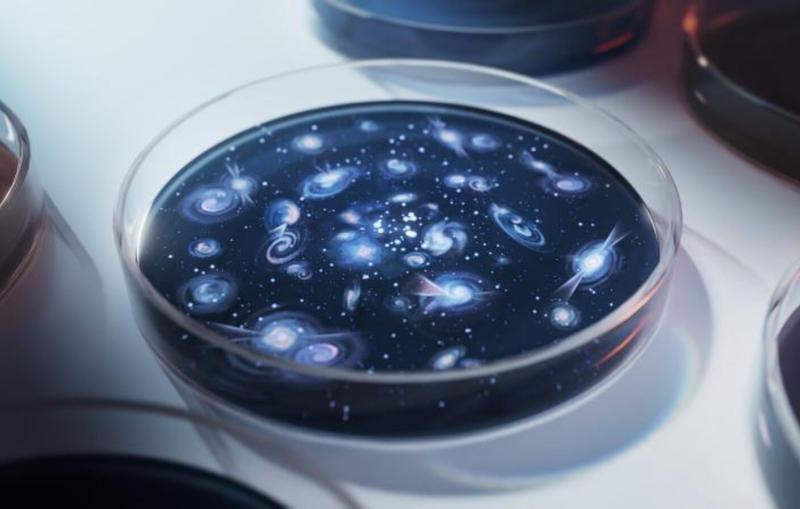
Imagining the future of gravitational-wave research

To understand why scientists are excited about detecting a new background, just look to the history of studies of the CMB.

September 12, 2023
Illustration of galaxies in a Petri dish
Feature
VIA Symmetry Magazine

What is a quantum network?

As we step into the quantum age, here are four things to know about quantum networks.

January 26, 2022
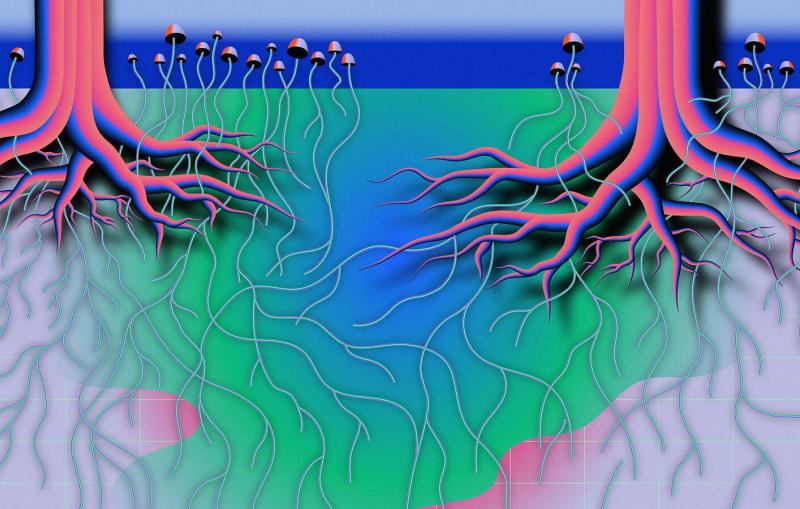
Illustration of tree roots and mushrooms
News Release

LZ sees surprising result in search for dark matter

The LUX-ZEPLIN experiment observed a particle interaction that could be interpreted as a signal from WIMPs, a dark matter candidate – but researchers will...

September 1, 2026  ·  7 min read
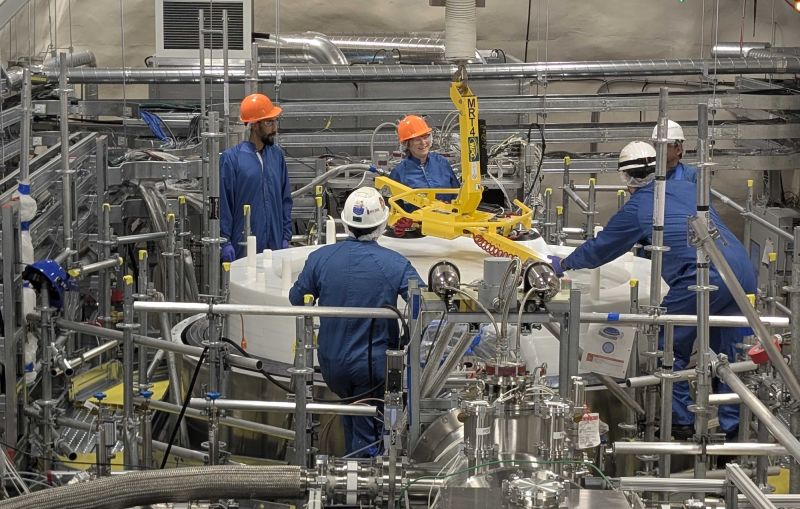
A researcher in protective gear works near a tall, cylindrical scientific instrument with visible wiring. The visible walls surrounding it are reflective Teflon.
News Brief

SuperCDMS SNOLAB begins preliminary phase of dark matter hunt

The deep-underground experiment could produce early-scientific results in the search for one of nature’s most elusive substances even, before reaching optimal sensitivity when the...

August 26, 2026  ·  4 min read
SuperCDMS shield
The basics

SLAC science explained

SLAC develops and deploys some of the world’s most advanced scientific tools for exploring how the universe works at the biggest, smallest and fastest scales. Here we explain how they work and the exciting discoveries they make possible.

A girl experiences static electricity from a Van de Graaff generator at a outdoor SLAC STEM Community Day event, making her hair stand on end.
News Release

LZ sets a world’s best in the hunt for galactic dark matter and gets a new look at neutrinos from the sun’s core

In the largest dataset ever collected by a dark matter detector, LUX-ZEPLIN's latest results provide the strongest constraints on low-mass WIMPs and detect boron-8...

December 8, 2025  ·  9 min read
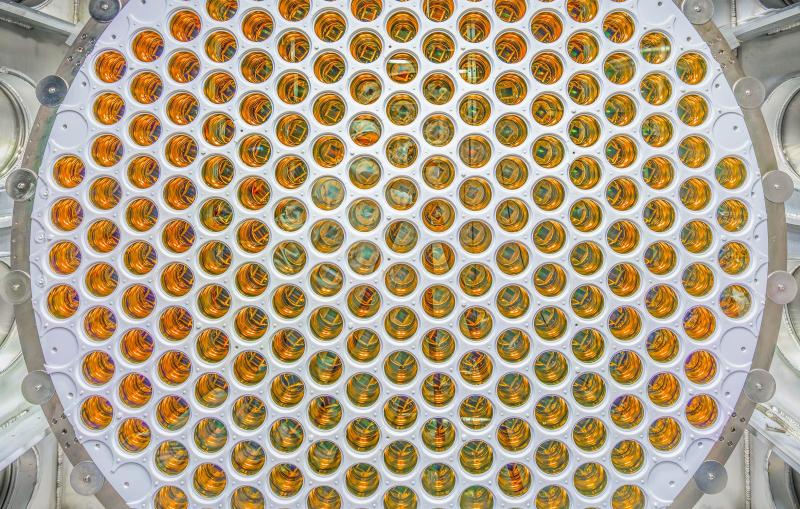
Overhead view looking down into a white structure with dozens of orange circular components arranged radially.
  • Go to previous page
  • Page 1
  • …
  • Page 225
  • Page 226
  • Page 227
  • Page 228
  • Page 229
  • Currently on page 230
  • Page 231
  • Page 232
  • Page 233
  • Go to next page

SLAC National Accelerator Laboratory 
2575 Sand Hill Road  
Menlo Park, CA 94025-7015  
650.926.3300

  • Coming to SLAC
  • Connect with us
  • Contact us
  • Facebook
  • Flickr
  • Instagram
  • LinkedIn
  • Twitter
  • YouTube

Sign up for our email

Monthly newsletter for cutting-edge science, SLAC milestones and events.

Sign up

Bold People
Visionary Science
Real Impact

We explore how the universe works at the biggest, smallest and fastest scales and invent powerful tools used by scientists around the globe.

  • About
    • Our story
    • Our people
    • Lab overview
    • Visit SLAC
    • Resources
    • Connect with us
  • Research
    • X-ray & ultrafast science
    • Advanced accelerators
    • New technologies
    • Physics of the universe
    • Science of life
    • SLAC science explained
  • Facilities & centers
    • Scientific facilities
    • Joint institutes & centers
  • Work with us
    • Partner with us
    • Become a supplier
    • Use our facilities
    • Careers at SLAC
  • News & events
    • News center
    • Symmetry Magazine
    • Media resources
    • Events
    • Educational programs
    • Connect with us
  • Staff portal
  • Privacy policy
  • Accessibility
  • Vulnerability disclosure
  • A–Z index
  • Website feedback
Home
  • SLAC home
  • Maps & directions
  • Emergency info
  • Careers

© 2026 SLAC National Accelerator Laboratory is operated by Stanford University for the U.S. Department of Energy Office of Science.

Stanford University U.S. Department of Energy
Top Top
Back to top Back to top