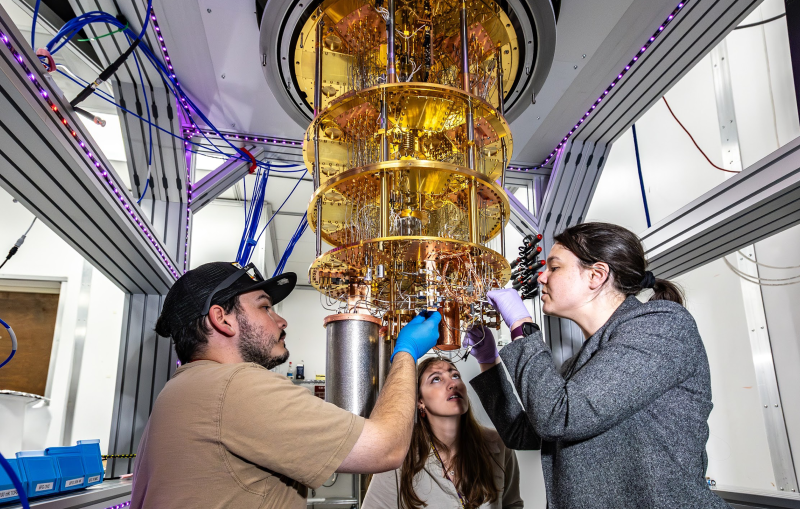
Q-NEXT quantum center renewed for five years
SLAC and Stanford partner with Argonne National Laboratory and others toward a quantum-interconnected world.
Key takeaways
- The U.S. Department of Energy has renewed funding for the DOE's Q-NEXT quantum research center, led by Argonne National Laboratory in partnership with SLAC National Accelerator Laboratory.
- Q-NEXT’s renewed efforts will focus on three scientific goals: Quantum communication networks, quantum sensing applications, and quantum materials.
- SLAC is partnering with Stanford to develop the first high-bandwidth quantum network that connects systems regardless of their qubit type.
Today the U.S. Department of Energy (DOE) announced that it has renewed funding for Q-NEXT for another five years. Q-NEXT is a National Quantum Information Science Research Center (NQISRC) led by Argonne National Laboratory in partnership with SLAC National Accelerator Laboratory, both DOE national labs.
The renewal ensures that Q-NEXT will continue to lead the charge in advancing quantum information science and technology, helping solidify the United States’ position as a global leader in this transformative field.
Q-NEXT will be funded by DOE at $125 million over the next five years, with $25 million in fiscal year 2026.
“Partnerships like Q-NEXT integrate expertise across the country and leverage the world-class facilities of the national labs. Together, we’re expediting the coming quantum technology revolution and bolstering the nation’s position as the international quantum leader,” said SLAC Director John Sarrao.
Q-NEXT’s mission is to unlock the future of quantum information by seamlessly integrating quantum and traditional information systems across optical networks. Building on its achievements over the past five years, the center will focus on demonstrating the potential of distributed quantum entanglement – a phenomenon where qubits, the fundamental unit of quantum information, remain connected even when separated by large distances.
SLAC DirectorPartnerships like Q-NEXT integrate expertise across the country and leverage the world-class facilities of the national labs. Together, we’re expediting the coming quantum technology revolution and bolstering the nation’s position as the international quantum leader.
A significant portion of this work is happening at SLAC in partnership with Stanford University. Among other priorities, this group is focusing on the development of the first high-bandwidth quantum network that connects systems regardless of their qubit type, whether atomic, superconducting or solid-state.
“We’re building on the strong foundation we’ve laid over the past five years to take on our renewed mission — harnessing distributed entanglement to show what’s possible with scalable quantum platforms,” said incoming Q-NEXT Director and Argonne scientist Martin Holt. “By uniting quantum technologies across optical networks, we will pave the way for systems capable of revolutionizing how we process, transmit and receive information.”
Quantum partnerships
Q-NEXT brings together a strong network of partners: two DOE national laboratories, 11 leading universities, and six tech companies. This cross-sector collaboration ensures that the center’s work is both innovative and practical, bridging the gap between scientific discovery and real-world application. Universities contribute expertise in quantum sensing and communication, while industry partners provide access to state-of-the-art prototypes and manufacturing capabilities. Together, Q-NEXT partners form a vibrant ecosystem that drives progress in quantum science.
“We envision quantum systems that work across chip-to-chip, lab-to-lab and city-to-city scales,” said Q-NEXT Deputy Director Jennifer Dionne, who is a professor of materials science and engineering and, by courtesy, of radiology at Stanford University and SLAC National Accelerator Laboratory. “We’re excited to advance a shared set of hardware, software and protocols to make quantum networks and sensors efficient and practical."
Quantum explained: The fascinating world unlocking new scientific breakthroughs
Check out our quantum explainers to learn more about the intriguing quantum realm and how researchers at the Department of Energy’s SLAC National Accelerator Laboratory are advancing this field.

Science goals
Q-NEXT’s renewed efforts will focus on three scientific goals:
- Communication – developing quantum communication networks that link devices across metropolitan areas. Q-NEXT aims to demonstrate algorithms that run across multiple remote, connected quantum processors.
- Sensing – using quantum entanglement to achieve unprecedented precision in sensing applications. Q-NEXT will demonstrate real-world uses, such as in medicine and navigation, as well as foundational scientific discoveries in gravitation and quantum mechanics where quantum entanglement gives a clear advantage in sensing and measurement.
- Materials – developing new approaches to integrating materials that can be scaled for industry use. Q-NEXT will tackle the most important challenges involved in merging distinct quantum materials systems with advanced functionality and integrating them into practical quantum devices.
Q-NEXT will pursue its goals through large-scale, team-based projects that combine materials science, device engineering and quantum physics theory. By leveraging world-class science facilities, Q-NEXT aims to deliver breakthroughs that will shape the future of quantum technology. These include the Argonne semiconductor and SLAC superconducting quantum foundries, SLAC’s Linac Coherent Light Source (LCLS) and Stanford Synchrotron Radiation Lightsource (SSRL), Argonne’s Advanced Photon Source (APS), and several other DOE Office of Science user facilities.
Associate lab director for SLAC’s Quantum Science and Technology InitiativeSLAC has the only superconducting quantum foundry that is co-located with light sources and experimental facilities that enable a better understanding of quantum materials at the time scales needed to understand their properties.
The planned quantum network development is being tested by connecting sites at SLAC and Stanford, using superconducting quantum devices like transducers at each of the fiber ends, fabricated at the SLAC-based quantum foundry.
“SLAC has the only superconducting quantum foundry that is co-located with light sources and experimental facilities that enable a better understanding of quantum materials at the time scales needed to understand their properties,” said associate lab director for SLAC’s Quantum Science and Technology Initiative Lisa Bonetti.
Read more from Argonne National Lab here.
This work was supported by the U.S. Department of Energy Office of Science National Quantum Information Science Research Centers as part of the Q-NEXT center.
For questions or comments, contact SLAC Strategic Communications & External Affairs at communications@slac.stanford.edu.
About SLAC
SLAC National Accelerator Laboratory explores how the universe works at the biggest, smallest and fastest scales and invents powerful tools used by researchers around the globe. As world leaders in ultrafast science and bold explorers of the physics of the universe, we forge new ground in understanding our origins and building a healthier and more sustainable future. Our discovery and innovation help develop new materials and chemical processes and open unprecedented views of the cosmos and life’s most delicate machinery. Building on more than 60 years of visionary research, we help shape the future by advancing areas such as quantum technology, scientific computing and the development of next-generation accelerators.
SLAC is operated by Stanford University for the U.S. Department of Energy’s Office of Science. The Office of Science is the single largest supporter of basic research in the physical sciences in the United States and is working to address some of the most pressing challenges of our time.
Related stories
Seagull Nebula through the eyes of NSF–DOE Vera C. Rubin Observatory Commissioning Camera


Seagull Nebula through the eyes of NSF–DOE Vera C. Rubin Observatory Commissioning Camera
Containing multitudes: SLAC scientist collaborates to create scalable qubits