August 21, 2025

Video | Upgraded X-ray laser science: capturing electrons

After a major upgrade, SLAC's X-ray free-electron laser is 10,000 times brighter and thousands of times faster. Now, researchers are using LCLS to capture the ultrafast motion of electrons inside molecules at scales never before possible. 
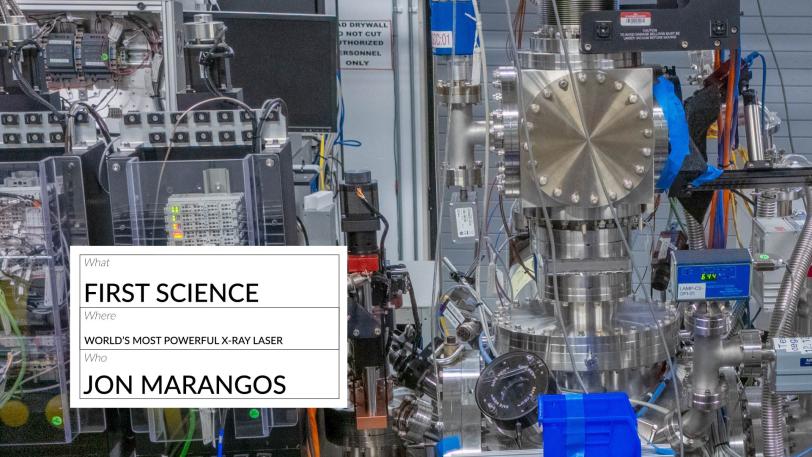
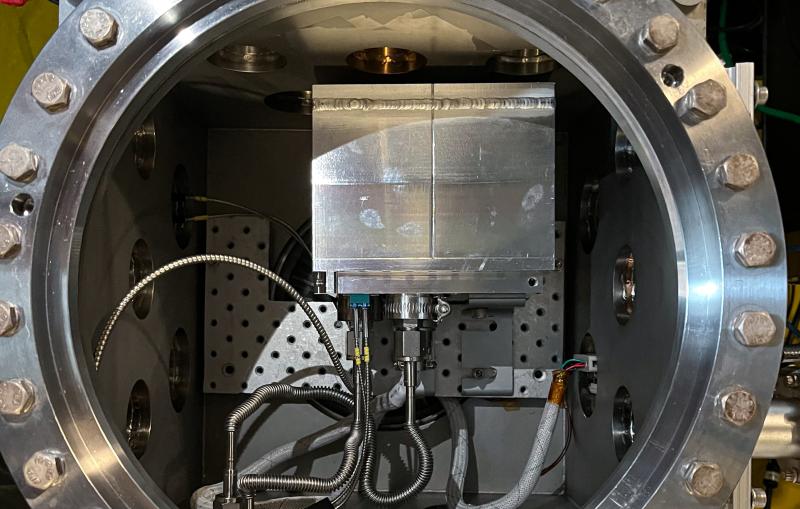
Complex scientific machinery with metal components. A text overlay reads "First Science at the World's Most Power X-Ray Laser" and "Jon Marangos."
Video
SLAC is home to the world’s most advanced X-ray laser, and following its recent upgrades, scientists are now able to see how molecules evolve at the smallest, fastest scales imaginable better than ever before. Physicist Jon Marangos came to SLAC’s LCLS—an X-ray free-electron laser and U.S. Department of Energy user facility—to capture the ultrafast motion of electrons inside molecules.  (Olivier Bonin and Sam Soon/SLAC National Accelerator Laboratory)

About SLAC

SLAC National Accelerator Laboratory explores how the universe works at the biggest, smallest and fastest scales and invents powerful tools used by researchers around the globe. As world leaders in ultrafast science and bold explorers of the physics of the universe, we forge new ground in understanding our origins and building a healthier and more sustainable future. Our discovery and innovation help develop new materials and chemical processes and open unprecedented views of the cosmos and life’s most delicate machinery. Building on more than 60 years of visionary research, we help shape the future by advancing areas such as quantum technology, scientific computing and the development of next-generation accelerators.

SLAC is operated by Stanford University for the U.S. Department of Energy’s Office of Science. The Office of Science is the single largest supporter of basic research in the physical sciences in the United States and is working to address some of the most pressing challenges of our time.

Dig Deeper

Related stories

Feature

SLAC experts discuss how microelectronics impacts our lives and where the future lies in this Q&A.

Angelo Dragone and Paul McIntyre
News Release

Surfing a plasma wave, electrons get an energy and brightness boost.

Illustration of electrons traveling through a plasma chamber
Feature

NLCTA staff helped undergraduates from Harvey Mudd College use the facility’s electron beam to test a detector they designed. 

A team from Harvey Mudd College inside the NLCTA accelerator housing at SLAC.
Feature

SLAC experts discuss how microelectronics impacts our lives and where the future lies in this Q&A.

Angelo Dragone and Paul McIntyre
News Release

Surfing a plasma wave, electrons get an energy and brightness boost.

Illustration of electrons traveling through a plasma chamber
Feature

NLCTA staff helped undergraduates from Harvey Mudd College use the facility’s electron beam to test a detector they designed. 

A team from Harvey Mudd College inside the NLCTA accelerator housing at SLAC.
News Release

Experiments running at these higher pulse rates will allow scientists to capture ultrafast processes with greater precision, collect data more efficiently and explore phenomena...

lcls ii milestone
Feature

Researchers at SLAC are developing experimental techniques to evaluate new candidates for inertial fusion energy targets. 

a graphic in the style of graphic novel depicts four lasers converging on a spherical target, which represents an inertial fusion energy reaction
Feature

The SLAC team is developing digital twins – powered by AI and high-performance computing – to help quickly shape high-quality particle beams for the...

hand pointing to digital twin