October 16, 2017

Slideshow: 2017 SSRL/LCLS Users’ Meeting

About 400 people attended the annual conference and workshops for scientists who conduct experiments at SLAC’s light sources.

By Dawn Harmer and Amanda Solliday

This year’s SSRL/LCLS Annual Users' Meeting brought together nearly 400 researchers who conduct experiments at Stanford Synchrotron Radiation Lightsource (SSRL) and the Linac Coherent Light Source (LCLS), including 90 participants in the concurrent High-Power Laser workshop.The meeting was held at the Department of Energy’s SLAC National Accelerator Laboratory Sept. 27-29.
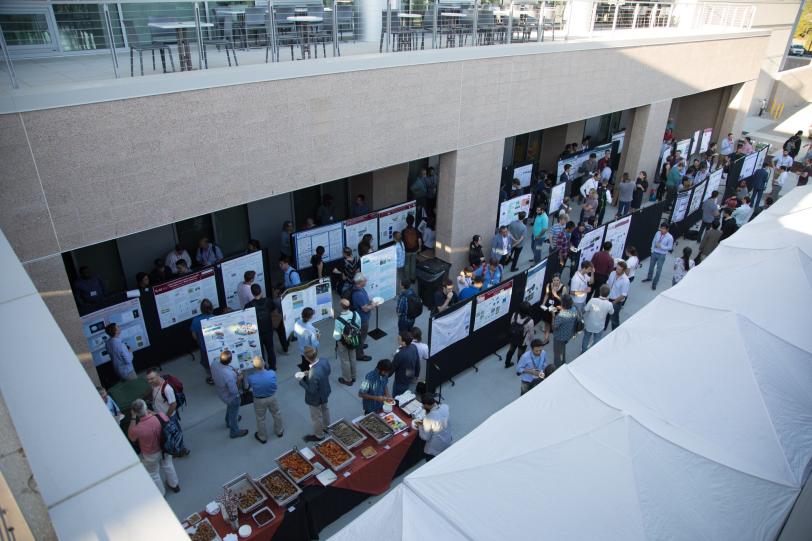
Birds-eye view of the poster session
The second annual Joe Wong Outstanding Poster Award Session was held at the 2017 SSRL/LCLS Users’ Meeting. (Dawn Harmer/SLAC National Accelerator Laboratory)

As DOE Office of Science User Facilities, SSRL and LCLS are open to scientists around the world for experiments that explore matter and processes with extremely bright X-rays.

The meeting consists of presentations and workshops where participants share and discuss facility capabilities and the latest areas of research. The Melvin P. Klein Scientific Development Award, Farrel W. Lytle Award, William E. and Diane M. Spicer Young Investigator Award and LCLS Young Investigator Award were presented at the meeting, as well as the second annual Joe Wong Outstanding Poster Awards.

The 2017 meeting organizers were Christoph Bostedt of Argonne National Laboratory, who is vice chair of the LCLS Users’ Executive Committee; David Bushnell of Stanford University, the SSRL Users’ Executive Committie vice chair; and SLAC scientists Axel Brachmann, Sergio Carbajo and Dimosthenis Sokaras.
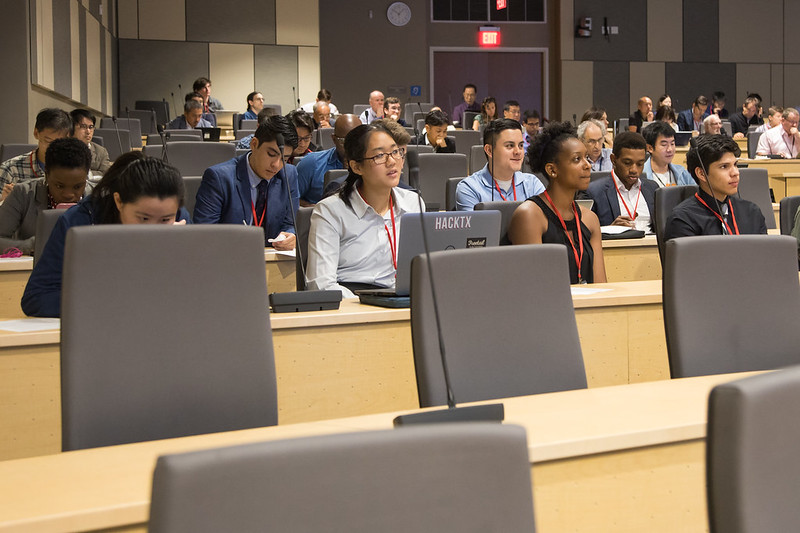
2017 Users’ Meeting


Contact

For questions or comments, contact the SLAC Office of Communications at communications@slac.stanford.edu.

Dig Deeper

Related stories

News Brief

The team developed a platform that uses powerful X-rays from the lab’s LCLS X-ray laser to resolve for the first time the evolution of...

Illustration of filament-like structures in plasma
News Brief

SLAC and Stanford researchers have developed a breakthrough technique that quantifies energy dissipation in complex, small systems, offering insights into energy use, efficiency, and...

Illustration with colorful dots
News Brief

With a new method that could be extended to study Earth’s core and nuclear fusion, they identify and explain jumps in the electrical conductivity...

Illustration of a short laser pulse heating a sheet of aluminum, causing it to melt and break up into droplets.
News Brief

The team developed a platform that uses powerful X-rays from the lab’s LCLS X-ray laser to resolve for the first time the evolution of...

Illustration of filament-like structures in plasma
News Brief

SLAC and Stanford researchers have developed a breakthrough technique that quantifies energy dissipation in complex, small systems, offering insights into energy use, efficiency, and...

Illustration with colorful dots
News Brief

With a new method that could be extended to study Earth’s core and nuclear fusion, they identify and explain jumps in the electrical conductivity...

Illustration of a short laser pulse heating a sheet of aluminum, causing it to melt and break up into droplets.
Feature

Researchers at SLAC are developing experimental techniques to evaluate new candidates for inertial fusion energy targets. 

a graphic in the style of graphic novel depicts four lasers converging on a spherical target, which represents an inertial fusion energy reaction
News Release

SLAC and Stanford scientists uncovered a quantum spin liquid, a state of matter that may have applications for quantum information.

An assembly of blue-green crystals
News Brief

He was honored for his work in ultrafast physics.

Portrait of Shambhu Ghimire