Rule-following molecules provide the first direct confirmation of a half-century-old theory
The results could lead to a better understanding of reactions with vital roles in chemistry and biology.
In 1965, scientists Robert Burns Woodward and Roald Hoffmann devised a set of rules to predict the outcome of electrocyclic reactions, an important class of reactions in organic chemistry. The Woodward-Hoffmann rules explain why certain compounds fail to form while others are easily produced and predict how the atoms will be arranged in products formed during ring-opening reactions. They provided the foundation for many chemical theories in the field and earned Roald Hoffmann the Nobel Prize in chemistry in 1981.
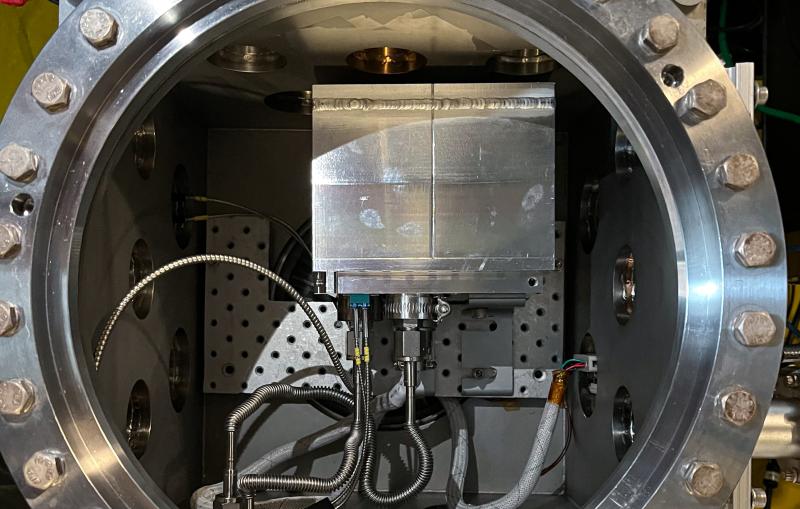
More than half a century after their formulation, scientists at the Department of Energy’s SLAC National Accelerator Laboratory have captured how a process predicted by these rules unfolds using MeV-UED, the lab’s ultrafast “electron camera.” The results, published last week in Science, are the first to directly confirm these rules and could lead to a better understanding of reactions with vital roles in chemistry and biology.
“Two generations of chemists have learned about the Woodward-Hoffmann rules, and there are a lot of conceptual ideas that originated from them,” said SLAC scientist Thomas Wolf, who led the study. “But until now, these were all basically predictions. Nobody had ever seen them unfold in real time. In our study, we found a way to image the reaction and observe how the molecule transforms into the product as predicted by these rules, directly confirming that they really work.”
Opening the ring
Ring-shaped molecules play key roles in many biological and chemical processes that are driven by the formation and breaking of chemical bonds. The researchers used MeV-UED to make a high-definition “movie” of ring-shaped gas molecules breaking open in response to light. Using a technique called ultrafast electron diffraction (UED), the researchers sent an electron beam with high energy, measured in millions of electronvolts (MeV), through a sample to precisely measure distances between pairs of atoms. Taking snapshots of these distances at different intervals after an initial laser flash and tracking how they change allows scientists to create a stop-motion movie of the light-induced atomic rearrangements in the sample.
Their investigation is the first to exploit the sensitivity of MeV-UED to study conformers, structures of the same molecule with slightly different shape that are integral in chemistry but are difficult to study using existing experimental methods.
The Woodward-Hoffmann rules predict different conformers of the study’s sample, α-phellandrene, will yield different products from the ring opening reaction. Using MeV-UED, the researchers were able to follow in real time how a specific conformer of α-phellandrene turned into the reaction product predicted by the Woodward-Hoffmann rules, settling a longstanding debate about the exact motion by which the molecule’s ring opened.
“This is the first time that anybody has ever directly observed this motion,” Wolf says. “We demonstrate that the molecules open exclusively in the way predicted by the Woodward-Hoffmann rules.”
An important shift
To follow up, Wolf hopes to investigate similar reactions at the molecular level to better understand the role conformers play in chemical reactions.
“The importance of different conformers has yet to be fully explored,” Wolf says. “With new imaging techniques and capabilities enabled by SLAC’s planned upgrade to its X-ray free-electron laser, it could become an important area of study that could really shift the way we look at the photochemistry of organic molecules.”
MeV-UED is an instrument of SLAC’s Linac Coherent Light Source (LCLS) X-ray laser facility. Currently underway, the upgrade to LCLS, known as LCLS-II, will come online in 2022. LCLS is a DOE Office of Science user facility.
Citation: E, Champenois et al., Science, 8 October 2021 (10.1126/science.abk3132)
For questions or comments, contact the SLAC Office of Communications at communications@slac.stanford.edu.
SLAC is a vibrant multiprogram laboratory that explores how the universe works at the biggest, smallest and fastest scales and invents powerful tools used by scientists around the globe. With research spanning particle physics, astrophysics and cosmology, materials, chemistry, bio- and energy sciences and scientific computing, we help solve real-world problems and advance the interests of the nation.
SLAC is operated by Stanford University for the U.S. Department of Energy’s Office of Science. The Office of Science is the single largest supporter of basic research in the physical sciences in the United States and is working to address some of the most pressing challenges of our time.
Related stories