SLAC topics

X-ray light sources and electron imaging RSS feed

X-ray light sources and electron imaging are advanced techniques used to study the structure and properties of materials. X-ray light sources use high-energy photons to produce X-rays, while electron imaging uses high-energy electrons to produce detailed images of samples. 

Browse tagged content

Aerial view of SLAC
Feature

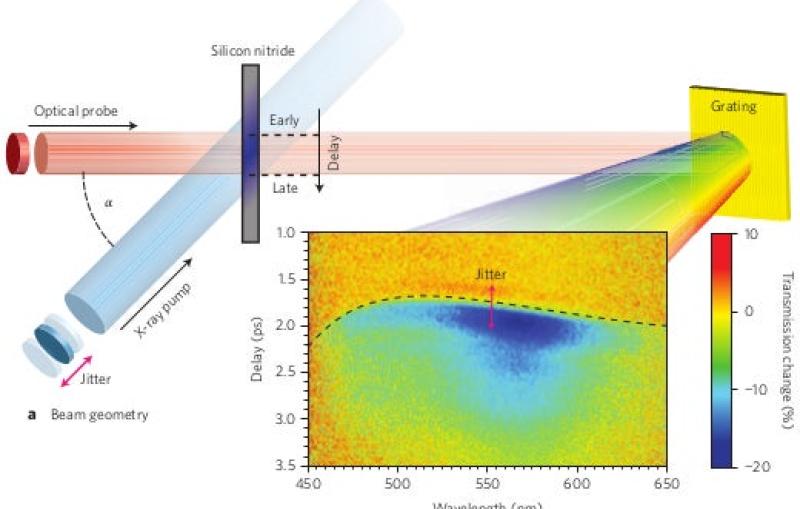
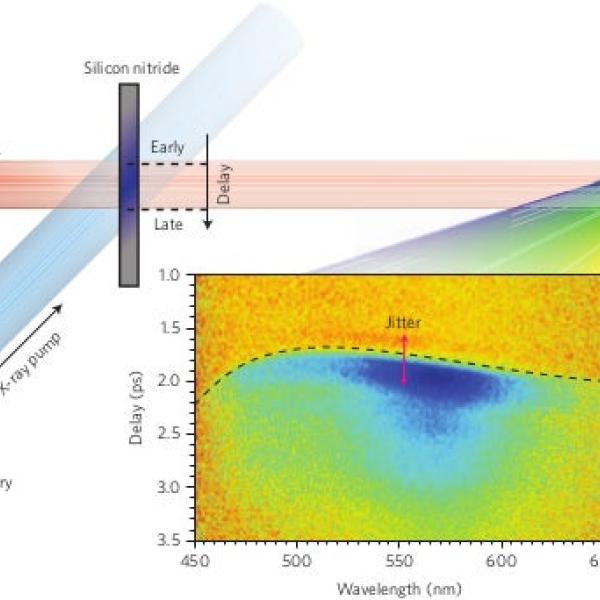
Laser-timing Tool Works at the Speed of Electrons

Image - An illustration of the setup used to test an "attosecond" timing tool at SLAC's Linac Coherent Light Source X-ray laser. The dashed line represents the arrival time of the X-ray laser.
Feature

Photon science, a spin-off of particle physics, has returned to its roots for help developing better, faster detectors.

Feature

SLAC-invented Etching Process Builds Custom Nanostructures for X-ray Optics

Image - This colorized scanning electron microscope image shows a top-down view of a spiral zone plate, an X-ray optical device, created using a chemical etching technique developed at SLAC. (Chieh Chang, Anne Sakdinawat)
Feature

SLAC Experiment Provides New Insight About How Electrons Move Across Molecules

Researchers used SLAC's LCLS X-ray laser to stimulate and measure the electron-transfer process inside a severed methyl iodide molecule.
News Release

SLAC Research Reveals Rapid DNA Changes that Act as Molecular Sunscreen

Illustration showing a thymine molecule, DNA helix and the sun.
Illustration

X-ray laser pulses probe water droplets like these to discover water’s hidden (and sometimes bizarre) properties. 

X-ray laser pulses probe water droplets like these to discover water’s hidden (and sometimes bizarre) properties.
News Release

Scientists at the Department of Energy's SLAC National Accelerator Laboratory have made the first structural observations of liquid water at temperatures down to minus...

Artist's concept - see caption
Feature

A sense of adventure and intellectual rigor led PULSE chemistry professor Kelly Gaffney to a successful career in science.

Image - PULSE chemistry professor Kelly Gaffney. (Brad Plummer/SLAC)
Feature

Even in their infancy, X-ray lasers such as SLAC's Linac Coherent Light Source are notching a list of important discoveries, and a special issue...

Image - This illustration represents data derived from 175,000 X-ray diffraction patterns of Trapanosoma brucei cathepsin B, a protein relevant to African sleeping sickness, measured with X-ray pulses at SLAC's Linac Coherent Light Source. (CFEL)
Feature

SLAC scientists have found a new way to produce bright pulses of light from accelerated electrons that could shrink "light source" technology used around...

A PhD student inspects the microwave undulator.
Feature

Researchers from Oxford, SIMES and Berkeley Lab say cadmium arsenide could yield practical devices with the same extraordinary electronic properties as 2-D graphene.

This illustration depicts fast-moving, massless electrons inside the material.
News Release

By finding surprising similarities in the way immune system defenders bind to disease-causing invaders, a new study may help scientists develop new treatments.

Conceptual art - see caption