
SLAC topics

Stanford PULSE Institute RSS feed

Researchers at the Stanford PULSE Institute watch ultrafast particle motions and chemical reactions to get a deeper understanding of matter in all its forms. Soon we’ll be able to watch even speedier electron movements that underlie all of chemistry, technology and life.

Visit PULSE website

Browse tagged content

XLEAP illustration
News Brief

With a new method that could be extended to study Earth’s core and nuclear fusion, they identify and explain jumps in the electrical conductivity...

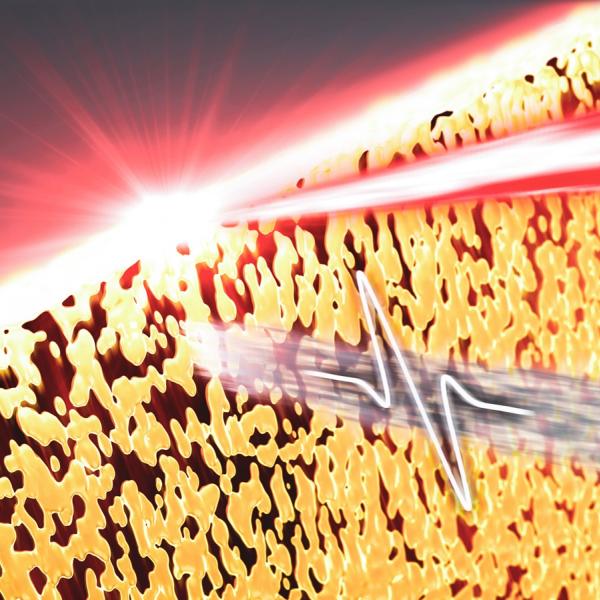
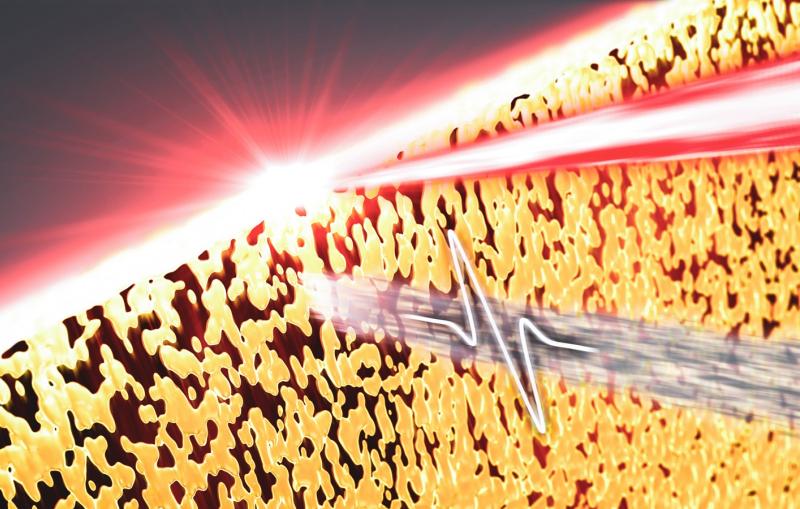
Illustration of a short laser pulse heating a sheet of aluminum, causing it to melt and break up into droplets.
News Brief

He was honored for his work in ultrafast physics.

Portrait of Shambhu Ghimire
Feature

They used SLAC’s ultrafast X-ray laser to follow the impact of a single electron moving within a molecule during an entire chemical reaction.

An illustration of X-rays scattering off the valence electrons surrounding ammonia molecules and getting captured on a detector.
Feature

Researchers taking the first-ever direct measurement of atom temperature in extremely hot materials inadvertently disproved a decades-old theory and upended our understanding of superheating. 

Graphic representation shows a pulse of yellow light hitting a lattice and diffracting into a spectrum of color
Feature

Ultrafast electrons at SLAC’s LCLS facility resolved the structural changes in a light-activated molecule to determine which simulations work best. 

Graphic representation of several molecules floating through space, circle of papers representing scientific results
Feature

Using SLAC’s X-ray laser, the method revealed atomic motions in a simple catalyst, opening the door to study more complex molecules key to chemical...

Three molecules on a streaky red and blue background.
Feature

SLAC, Stanford researchers estimate that reducing harmful chemical emissions could cut cancer risks from smoke exposure by over 50%.

A forestry worker performing a prescribed burn
News Brief

Using an advanced technique at SLAC’s Linac Coherent Light Source, researchers make surprising discoveries.

Image of a multicolored speckle pattern
News Brief

LCLS X-rays allowed researchers to connect the molecular dynamics of supercritical carbon dioxide, used in industrial and environmental applications, with its unique properties.

A figure showing atoms and blue blobs projecting an image onto a screen.
News Brief

The SLAC professor was elected to the American Physical Society in recognition of his research on ultrafast X-ray methods.

Kelly Gaffney
News Brief

Their method provides a new tool to study electron-electron interactions, which are fundamental to many technologies, including semiconductors and solar cells.

photoelectric effect
Illustration
Scientists uncovered new information about the photoelectric effect, a phenomenon first described by Einstein over a century ago. 
photoelectric effect