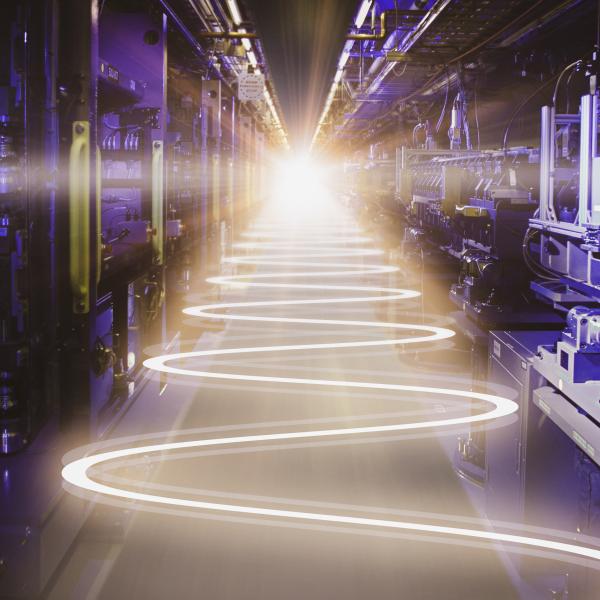
Accelerators form the backbone of SLAC’s national user facilities. They generate some of the highest quality particle beams in the world, helping thousands of scientists perform groundbreaking experiments each year.
Browse tagged content
Linac towards SLAC campus.
(Olivier Bonin/SLAC National Accelerator Laboratory)
Teams at SLAC installed new experimental hutches with cutting-edge instruments that will harness the upgraded facility’s new capabilities and expand the breadth of research...
The future of experimental particle physics is exciting – and energy intensive. SLAC physicists are thinking about how to make one proposal, the Cool...
Scientists developed a new method to unlock the secrets of RNA. The implications are wide-reaching, from better understanding diseases to designing new therapeutics.
Scientists developed a groundbreaking technology that allows them to see sound waves and microscopic defects inside crystals, promising insights that connect ultrafast atomic motion...
With up to a million X-ray flashes per second, 8,000 times more than its predecessor, it transforms the ability of scientists to explore atomic-scale...
Sebek’s extraordinary career at SSRL includes helping build the facility’s original electron injector back in the 1980s and working on almost all of its...
X-ray laser studies help researchers identify early steps in the freezing process to better understand how clouds make ice and their effect on climate.
Leora Dresselhaus-Marais, Claudio Emma, Bernhard Mistlberger and Johanna Nelson Weker will pursue cutting-edge research into decarbonizing steel production, theoretical physics, generating more intense particle...
Bringing ultrafast physics to structural biology has revealed the coordinated dance of molecules in unprecedented clarity, which could aid in the design of new...
Teams at SLAC installed new experimental hutches with cutting-edge instruments that will harness the upgraded facility’s new capabilities and expand the breadth of research done at the facility.
The future of experimental particle physics is exciting – and energy intensive. SLAC physicists are thinking about how to make one proposal, the Cool Copper Collider, more sustainable.
Scientists developed a new method to unlock the secrets of RNA. The implications are wide-reaching, from better understanding diseases to designing new therapeutics.
Scientists developed a groundbreaking technology that allows them to see sound waves and microscopic defects inside crystals, promising insights that connect ultrafast atomic motion to large-scale macroscopic behaviors.
With up to a million X-ray flashes per second, 8,000 times more than its predecessor, it transforms the ability of scientists to explore atomic-scale, ultrafast phenomena that are key to a broad range of applications, from quantum materials to clean...
Sebek’s extraordinary career at SSRL includes helping build the facility’s original electron injector back in the 1980s and working on almost all of its electrical systems since.
X-ray laser studies help researchers identify early steps in the freezing process to better understand how clouds make ice and their effect on climate.
Leora Dresselhaus-Marais, Claudio Emma, Bernhard Mistlberger and Johanna Nelson Weker will pursue cutting-edge research into decarbonizing steel production, theoretical physics, generating more intense particle beams, and improving X-ray microscopes.
Bringing ultrafast physics to structural biology has revealed the coordinated dance of molecules in unprecedented clarity, which could aid in the design of new light-responsive materials.