


SLAC topics

Accelerators RSS feed

Accelerators form the backbone of SLAC’s national user facilities. They generate some of the highest quality particle beams in the world, helping thousands of scientists perform groundbreaking experiments each year.

Browse tagged content

Linac towards SLAC campus
Feature

The facility is now one step away from releasing an unprecedented stream of ultra-bright X-rays.

This is a graphic representation of electron bunches travelling through SLAC's linear accelerator.
Feature

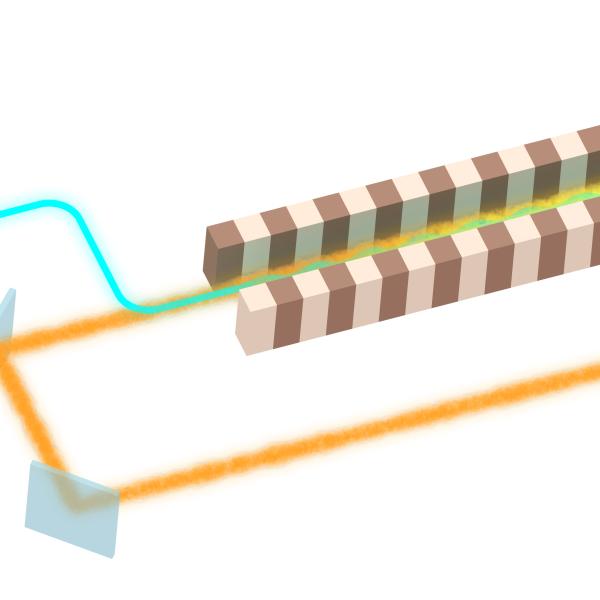
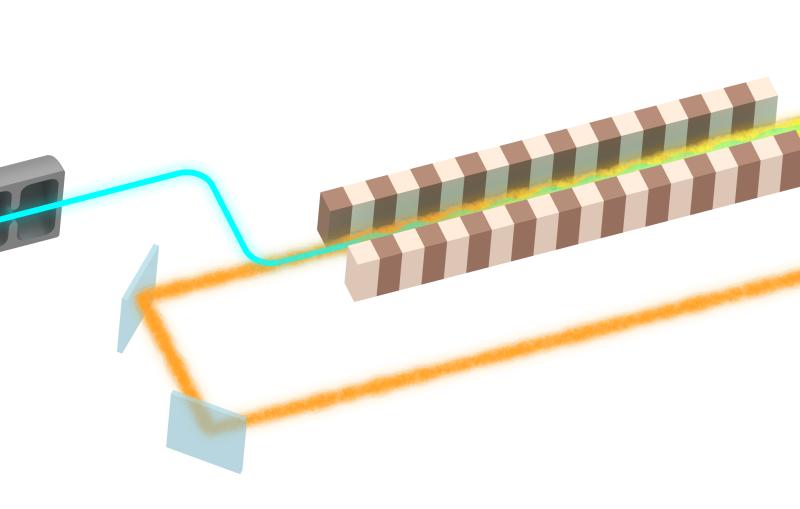
The long – but not too long – cavity would ping-pong X-ray pulses inside of a particle accelerator facility to help capture nature’s fastest...

This cartoon figure shows how the cavity-based X-ray free electron laser works in general. The electron beam (blue) travels through an undulator (brown), which causes the beam to release X-ray pulses. These pulses bounce around a set of four mirrors, helping them become coherent, before they continue down the accelerator to experimental halls.
News Release

After decades of effort, scientists have finally seen the process by which nature creates the oxygen we breathe using SLAC’s X-ray laser.

Photosystem II
Feature

The algorithm pairs machine-learning techniques with classical beam physics equations to avoid massive data crunching.

This is a representation of a particle beam traveling through an accelerator.
Photograph

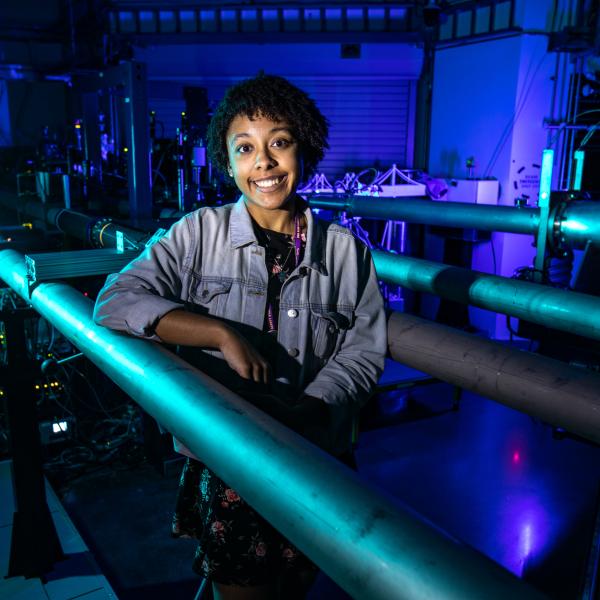
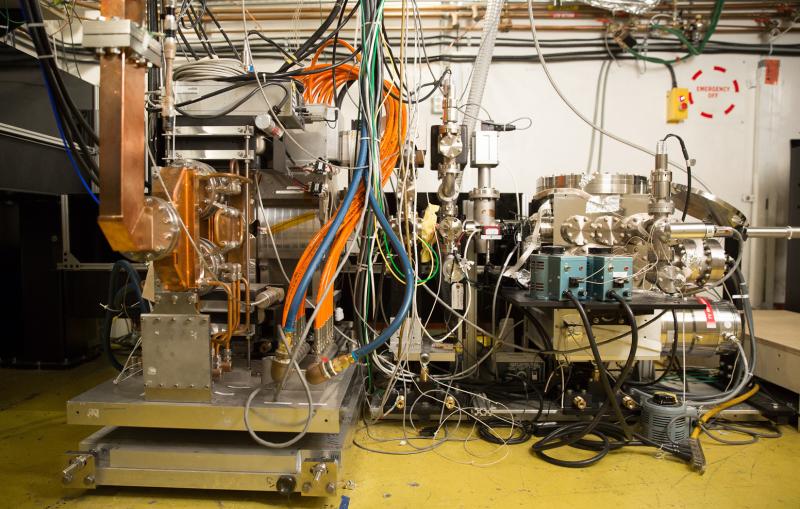
Aalayah Spencer inside the Linac Coherent Light Source at the Department of Energy’s SLAC National Accelerator Laboratory.
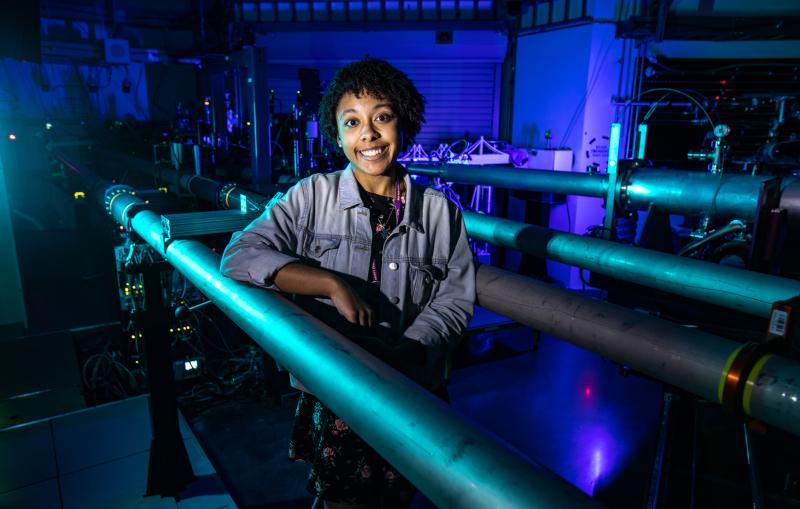
Aalayah Spencer inside the Linac Coherent Light Source at the Department of Energy’s SLAC National Accelerator Laboratory. Spencer is a science and engineering associate in Experiment Control Systems at LCLS.
Feature

By tinkering and troubleshooting, Aalayah Spencer helps turn researchers’ ideas into state-of-the-art science experiments.

Aalayah Spencer inside the Linac Coherent Light Source at the Department of Energy’s SLAC National Accelerator Laboratory. Spencer is a science and engineering associate in Experiment Control Systems at LCLS.
Feature

Experiments visualize how 2D perovskite structures change when excited.

MeV-UED
Feature

Two GEM Fellows reflect on their summer internships at SLAC and share their thoughts on representation and mentorship.

Nate Keyes and Zariq George
Illustration

Illustration of how a single crystal sample of silicon deforms during shock compression on nanosecond timescales.

MEC silicon
Feature

They saw how the material finds a path to contorting and flexing to avoid being irreversibly crushed.

MEC silicon
Photograph
Visitors to SLAC tour the accelerator control room during Community Day 2019.
Visitors to SLAC tour the accelerator control room during Community Day 2019