SLAC National Accelerator Laboratory
    • About

      Learn about our science, people, facilities and partners. Discover our history and vision for the future.

    • OUR STORY
      • Mission, vision, values
      • History
    • LAB OVERVIEW
      • SLAC at a glance
      • Lab organization
      • Our partnerships
    • OUR PEOPLE
      • Leadership
      • Meet our teams
      • Faculty
    • VISIT SLAC
      • Public tours
      • Contact us
    • Resources
      • Images, videos & more
      • Brochures & fact sheets
    • Connect With Us
      • Facebook
      • Flickr
      • Instagram
      • LinkedIn
      • Twitter
      • YouTube
    video

    Who we are

    We explore radically new ideas with an entrepreneurial mindset.

    Science and User Support Building to the left and Arrillaga Science Center building to the right from above the Main Quad at SLAC's campus.
    • Research

      Get an overview of research at SLAC: X-ray and ultrafast science, particle and astrophysics, cosmology, particle accelerators, biology, energy and technology.

    • X-ray and Ultrafast science icon X-ray & ultrafast science

      Revealing nature’s fastest processes with X-rays, lasers and electrons

    • Physics of the universe science icon Physics of the universe

      Studying the particles and forces that knit the cosmos together

    • Advanced Accelerators science icon Advanced accelerators

      Building smaller, faster, more powerful accelerators for all

    • Science of life science icon Science of life

      Understanding the machinery of life at its most basic level

    • New technologies science icon New technologies

      Inventing new tools for science and society

    • Energy sciences science icon Energy sciences

      Finding clean, sustainable solutions for the world’s energy challenges

    Spotlight

    SLAC science explained

    Cut through the jargon while exploring our research.

    SAGE campers have fun experimenting with a Van de Graff generator
    • Facilities & Centers

      Learn more about the places where science happens at SLAC: our major facilities, institutes and centers.

    • SCIENTIFIC FACILITIES
      • LCLS website

        Linac Coherent Light Source

      • SSRL website

        Stanford Synchrotron Radiation Lightsource

      • FACET-II website

        Facility for Advanced Accelerator Experimental Tests

      • CryoEM website

        Cryogenic Electron Microscopy

    • JOINT INSTITUTES & CENTERS
      • SIMES website

        Stanford Institute for Materials & Energy Science

      • KIPAC website

        Kavli Institute for Particle Astrophysics & Cosmology

      • PULSE website

        Stanford PULSE Institute

      • SUNCAT website

        Center for Interface Science & Catalysis

      • SLAC-Stanford Battery Center

    NSF-DOE Vera C. Rubin Observatory LSST

    SLAC & Stanford build the world’s largest digital camera for the Legacy Survey of Space and Time (LSST).

    A drone photo of Rubin Observatory while taking pictures during the First Look observing campaign
    • Work with Us

      Find a career, partner with us or apply to use our tools and facilities.

    • PARTNER WITH US
      • For industry partners
      • Research partnerships & tech transfer
      • Technology Innovation
    • CAREERS AT SLAC
      • Job openings
      • Internships
      • Life at SLAC
    • USE OUR FACILITIES

      Apply to become a user of our scientific research facilities and instruments.

    • COMING TO SLAC
    • BECOME A SUPPLIER

    Careers at SLAC

    Join our united workforce.

    SLAC staff in main quad
    • News & Events

      Get the latest news about the lab, our science and discoveries. Explore SLAC events and learn how to participate.

    • NEWS CENTER
      • News archive
      • Media resources
      • Images & videos
    • SLAC EVENTS
      • Public lectures
      • Scientific seminars
      • Community events
    • SYMMETRY MAGAZINE

      This joint publication of SLAC and Fermilab is your view into the world of particle physics.

    • EDUCATIONAL PROGRAMS
      • Educational tours
      • Resources for students & educators
    • Connect With Us
      • Facebook
      • Flickr
      • Instagram
      • LinkedIn
      • Twitter
      • YouTube
    Upcoming public lecture

    Reinventing the way we break down plastic waste

    Thursday, March 26, 2026
    7:00–8:00 p.m. PDT

    Public Lecture: Ozge Bozkurt
Filter search by
Staff portalStanford directoryComing to SLACResources for…
  1. Home
  2. …
Filter by research area
  • X-ray and ultrafast science (336)
  • Physics of the universe (280)
  • Energy sciences (96)
  • Science of life (86)
  • New technologies (58)
  • Advanced accelerators (41)
Filter by Type
  • News (1772)
  • Image (387)
  • Video (227)
  • Event (157)
  • Page (67)
  • Person (66)
  • resource (64)
  • News Collection (4)
Sort by
2744 results
Display Grid Display List
Feature

Scientists Get First Detailed Look at Nitrogen Doping in Single-layer Graphene

The strength, flexibility, transparency and high electrical conductivity of single-layer graphene make it a potentially unique and valuable material for the next generation of...

September 20, 2011  ·  4 min read
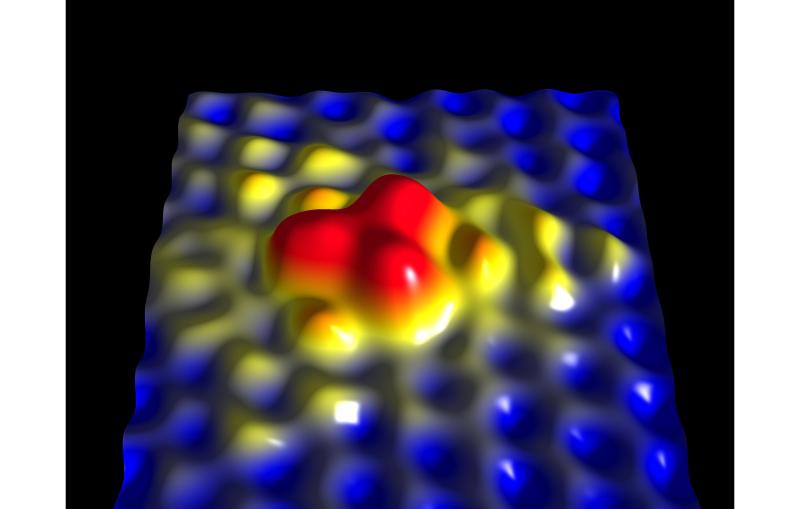
3-D Image of Nitrogen Atom in Graphene
Feature

Ultrafast Lasers at the Linac Coherent Light Source

The Linac Coherent Light Source at SLAC is the world’s first hard X-ray free-electron laser, or FEL, and one of the most complex light...

July 5, 2011  ·  4 min read
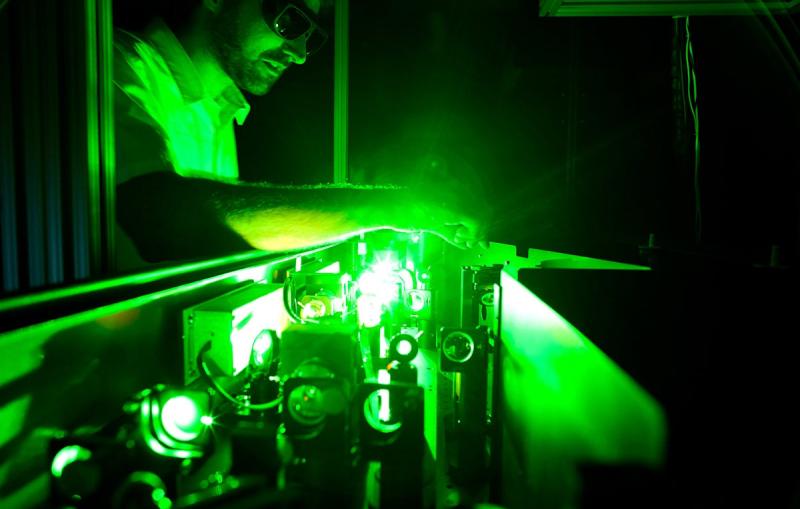
Ultrafast optical laser at the LCLS (Photo by Aubrie Pick.)
Feature

SLAC/Stanford Scientists Make First Direct Images of Topological Insulator's Edge Currents

Researchers at a SLAC/Stanford institute have made the first direct images of electrical currents flowing along the edges of a topological insulator – a...

June 17, 2013  ·  2 min read
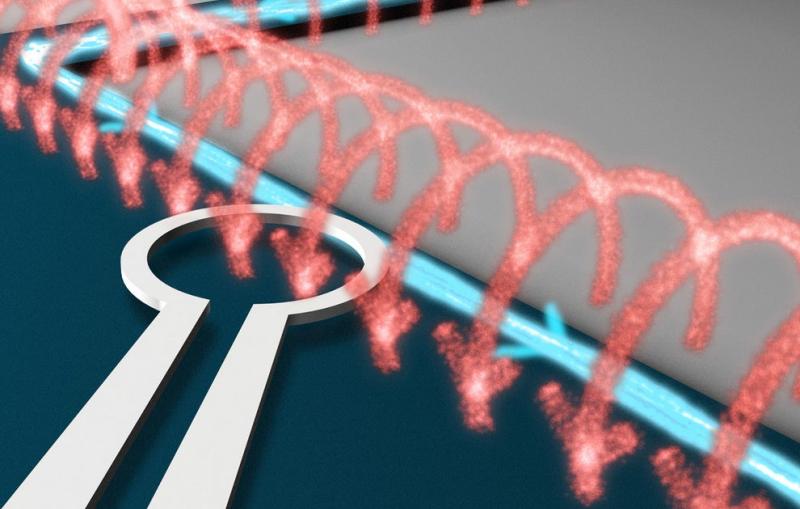
This graphic depicts the tiny loop of a scanning SQUID, or superconducting quantum interference device  (silver), which detects magnetic fields (red) created by an edge current (blue) in a topological insulator. (Greg Stewart)
Feature

Mysterious Asymmetry Puts SLAC Theorists on the Trail of Possible New Particle

As they say in the movie business, here's the pitch: tantalizing hints of an interaction that could demonstrate the existence of a new subatomic...

May 23, 2011  ·  5 min read
Image of a sink with water flowing down the drain.
Feature

X-ray Laser Explores How to Write Data with Light

Using laser light to read and write magnetic data by quickly flipping tiny magnetic domains could help keep pace with the demand for faster...

March 19, 2013  ·  3 min read
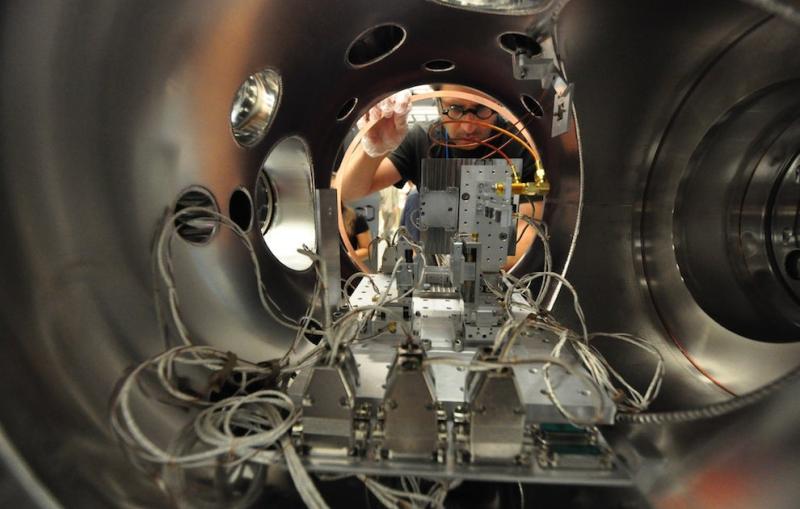
Photo - inside RCI sample chamber
Feature

BaBar Discovery a Top 10 Breakthrough in Physics in 2012

Each year, the editors of Physics World select what they consider the top 10 breakthroughs in the world of physics.

December 14, 2012  ·  1 min read
Image - Mirror images of "B" with clocks inside.
Feature

The Arias of Universes in a Box

Computer simulations have become an invaluable tool to study the formation of cosmic structures over an enormous range of scales, crucial aspects of the...

June 9, 2011  ·  2 min read
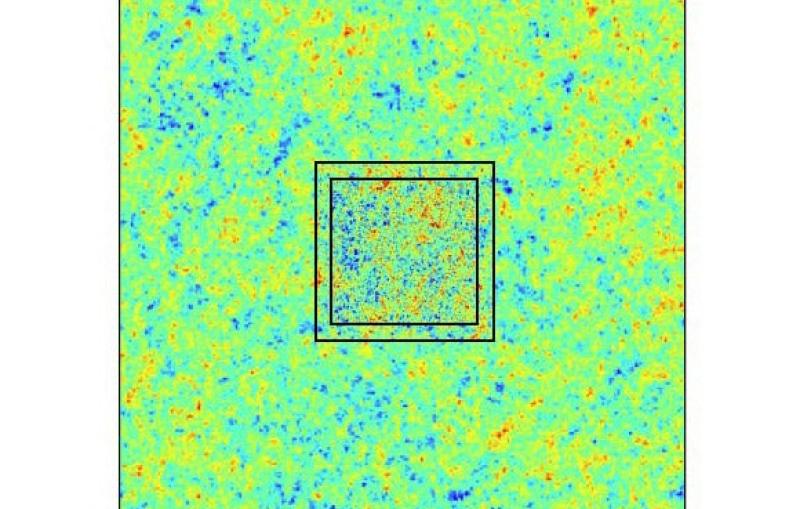
Multi-scale distribution of matter, or "density field," used as an initial condition for simulations exploring the evolution of both large- and smaller-scale structures in the Universe.
Feature

SLAC Theorist Helps Sharpen Tests of Fundamental Theory in High Energy Experiments

Three theoretical physicists have taken an important step toward eliminating theoretical ambiguities from the staggeringly complicated mathematics used to explore the interactions of quarks...

August 7, 2013  ·  2 min read
SLAC particle theorist Stan Brodsky (Matt Beardsley/SLAC)
News Release

Persis Drell to Step Down as SLAC Laboratory Director

Stanford University announced today that Persis S. Drell, director at SLAC National Accelerator Laboratory, has decided to return to her position as a faculty...

November 1, 2011  ·  3 min read
Persis Drell, SLAC Director
Feature

Roger Blandford Receives Royal Astronomical Society's Top Honor

Britain’s Royal Astronomical Society has named Stanford University Physics Professor Roger Blandford as the 2013 winner of the Society’s highest honor, the Gold Medal.

January 14, 2013  ·  1 min read
Photo
Feature

SLAC Software Developer Discusses Physics Simulation Tool to Make Cancer Therapy Safer

Tiny particles are making a big difference in the world of cancer therapy. And SLAC physicists—experts in particle transport—are using computer simulations to make...
October 20, 2011  ·  2 min read
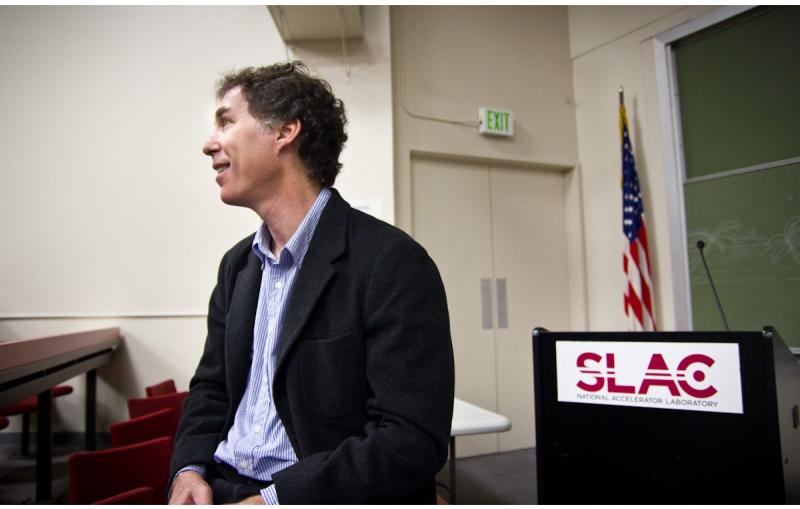
Photo - SLAC software developer Joseph Perl sSLAC software developer Joseph Perl sitting in front of lectern
Feature

Fifth X-ray Instrument at LCLS Debuts, With a Bead on Disorderly Structures

After five night shifts of shooting pairs of X-ray pulses through soups of fine sand and gold, Aymeric Robert was tired but exhilarated. The...

December 13, 2011  ·  5 min read
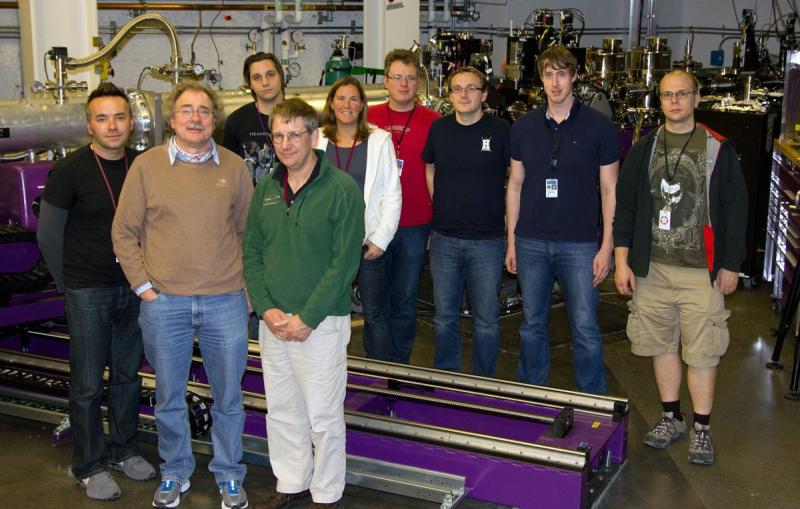
 The team that conducted the first experiment on the X-ray Correlation Spectroscopy instrument at SLAC's Linac Coherent Light Source
  • Go to previous page
  • Page 1
  • …
  • Page 5
  • Page 6
  • Page 7
  • Page 8
  • Currently on page 9
  • Page 10
  • Page 11
  • Page 12
  • Page 13
  • …
  • Page 229
  • Go to next page

SLAC National Accelerator Laboratory 
2575 Sand Hill Road  
Menlo Park, CA 94025-7015  
650.926.3300

  • Coming to SLAC
  • Connect with us
  • Contact us
  • Facebook
  • Flickr
  • Instagram
  • LinkedIn
  • Twitter
  • YouTube

Sign up for our email

Monthly newsletter for cutting-edge science, SLAC milestones and events.

Sign up

Bold People
Visionary Science
Real Impact

We explore how the universe works at the biggest, smallest and fastest scales and invent powerful tools used by scientists around the globe.

  • About
    • Our story
    • Our people
    • Lab overview
    • Visit SLAC
    • Resources
    • Connect with us
  • Research
    • X-ray & ultrafast science
    • Advanced accelerators
    • New technologies
    • Physics of the universe
    • Science of life
    • Energy sciences
    • SLAC science explained
  • Facilities & centers
    • Scientific facilities
    • Joint institutes & centers
  • Work with us
    • Partner with us
    • Become a supplier
    • Use our facilities
    • Careers at SLAC
  • News & events
    • News center
    • Symmetry Magazine
    • Media resources
    • Events
    • Educational programs
    • Connect with us
  • Staff portal
  • Privacy policy
  • Accessibility
  • Vulnerability disclosure
  • A–Z index
  • Website feedback
Home
  • SLAC home
  • Maps & directions
  • Emergency info
  • Careers

© 2026 SLAC National Accelerator Laboratory is operated by Stanford University for the U.S. Department of Energy Office of Science.

Stanford University U.S. Department of Energy
Top Top
Back to top Back to top