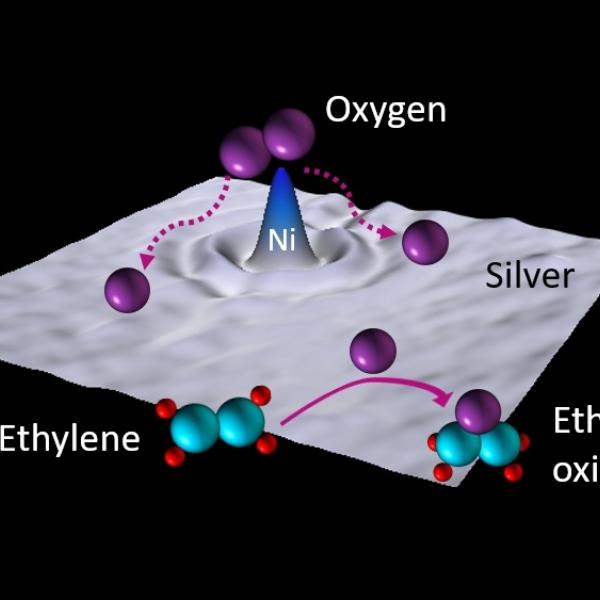
Chemical reactions often involve intermediate steps that are too fast and complex for us to see – even using our most advanced scientific instruments. Combining two X-ray spectroscopy techniques has now been shown to change that.
A low-cost, recyclable powder can kill thousands of waterborne bacteria per second when exposed to sunlight. Stanford and SLAC scientists say the ultrafast disinfectant could be a revolutionary advance for 2 billion people worldwide without access to safe drinking water.
SLAC researchers are experts in a broad range of scientific disciplines, including X-ray and ultrafast science, physics of the universe, advanced accelerators, energy sciences, science of life and new technologies.
They’ll work on experiments searching for dark matter and physics beyond the Standard Model of particle physics to push our understanding of what makes up the universe.
Batteries come in many shapes and sizes, but their materials can be hard to source. SLAC researchers are trying to build them with more abundant and ethical elements.
The first batch of data from the Dark Energy Spectroscopic Instrument is now available for researchers to mine. Taken during the experiment’s “survey validation” phase, the data include distant galaxies and quasars as well as stars in our own Milky...