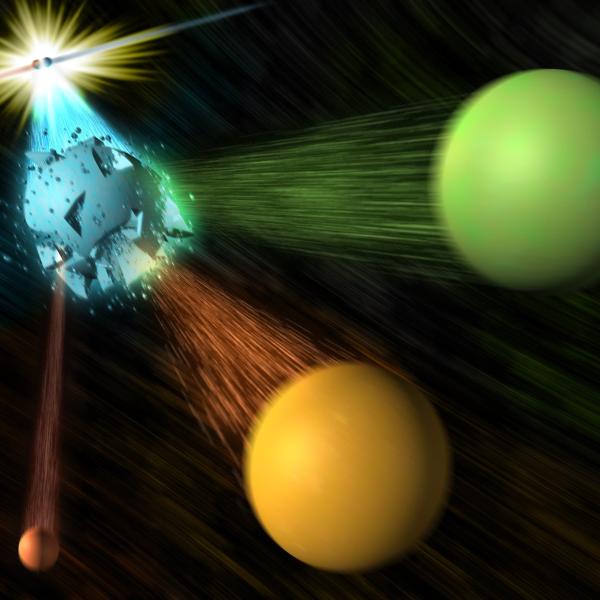
In this talk, Eduardo do Couto e Silva will explain that while the night sky appears calm, it is in fact populated by colossal explosions and cosmic conflagrations.
Presented by Sean Brennan. The Stardust mission returned from a 6-year voyage in January of 2006. During the mission it swept through the tail of comet Wild 2 (pronounced Vilt), collecting the microscopic particles streaming from it.
Presented by Sarah Church. The faint radio signal that fills our universe is the echo of the beginning of the universe. This signal, called the Cosmic Microwave Background radiation, was first detected by accident in 1964 but has since been...
Organic semiconductors hold immense promise for use in thin film and flexible displays – picture an iPad you can roll up – but they haven’t yet reached the speeds needed to drive high definition displays.
In experiments resembling an atomic-scale shooting gallery, researchers are pioneering a new method for chemical analysis by zapping the innermost electrons out of atoms with powerful X-ray laser pulses from SLAC’s Linac Coherent Light Source (LCLS).
In repeatedly and systematically surveying the sky with deep, large-field-of-view images in six optical color bands on a 3 billion pixel camera for years, the Large Synoptic Survey Telescope will home in on the nature of dark energy and increase...
Technology that helps ground-based telescopes cut through the haze of Earth's atmosphere to get a clearer view of the heavens may also be used to collect better data at cutting-edge X-ray lasers like the Linac Coherent Light Source (LCLS) at...
NASA's newest telescope headed for orbit yesterday, its rocket igniting in the night skies south of Kwajalein Atoll after being dropped from the underbelly of a Lockheed L-1011 plane.
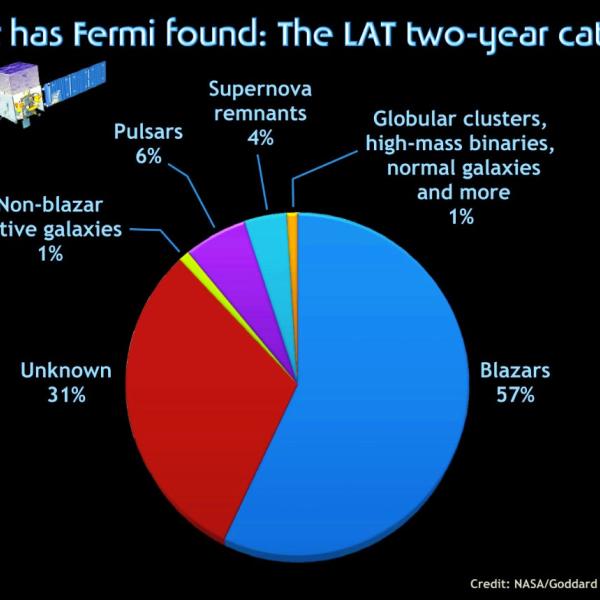
The Large Area Telescope (LAT), built by SLAC for the Fermi Gamma-ray Space Telescope, collects information on high-energy gamma rays from numerous sources in the sky.