KIPAC scientists have for the first time used artificial neural networks to analyze complex distortions in spacetime, called gravitational lenses, demonstrating that the method is 10 million times faster than traditional analyses.
The sun rises over the Science and User Support Building (SUSB) at the entrance to SLAC National Accelerator Laboratory. Stanford's iconic Hoover Tower is just visible in the distance.
Image from the Dark Energy Camera (DECam), which is mounted on the Victor M. Blanco 4-meter Telescope at the Cerro Tololo Inter-American Observatory (CTIO) in the Chilean Andes.
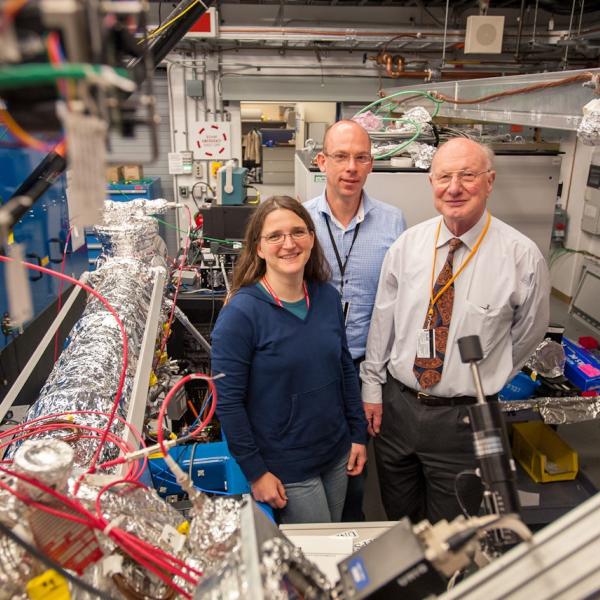
SLAC/Stanford Professor Zhi-Xun Shen (left) and SLAC staff scientist Patrick Kirchmann with the ARPES instrument used to measure electron energy and momentum in an iron selenide film.
An animation shows how an infrared laser beam (orange) triggers atomic vibrations in a thin layer of iron selenide, which are then recorded by ultrafast X-ray laser pulses (white) to create an ultrafast movie.
This animation shows molecular building blocks joining the tip of a growing nanowire. Each block consists of a diamondoid – the smallest possible bit of diamond – attached to sulfur and copper atoms (yellow and brown spheres). Like LEGO blocks...