SLAC topics

Science news RSS feed

The latest news about SLAC research, science programs, facilities and people. 

More on our News Center and Media Resources pages

Browse tagged content

Scientists create artificial catalysts inspired by living enzymes
Feature

About 550 visitors from all over the Bay Area came to explore a wide range of the institute’s cosmic research topics.

Photo - 3-D movies at the 2014 KIPAC open house
Feature

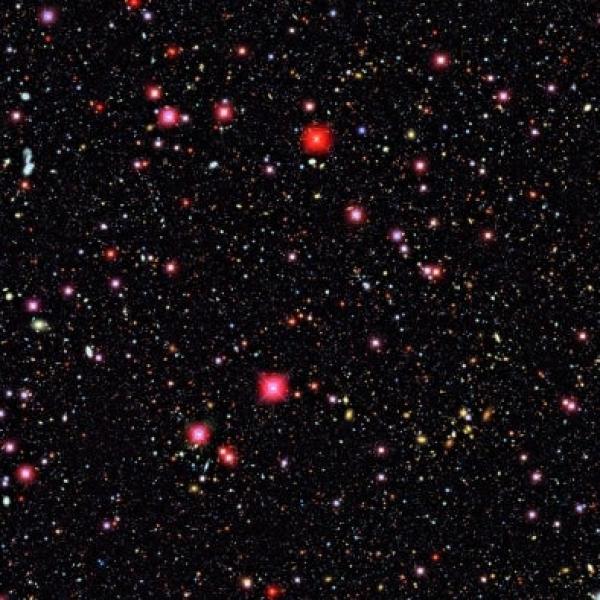
In a few years, scientists will come out with a new map of a third of the sky, one that will go deeper and...

Feature

SLAC recently hosted a forward-looking group of theoretical and experimental particle physicists. Their purpose: Follow the science to determine what a post-LHC collider could...

Photo - Members of the Physics at 100 TeV workshop
Feature

SLAC-led researchers have made the first direct measurements of a small, extremely rapid atomic rearrangement that dramatically changes the properties of many important materials.

The transformation of cadmium sulfide nanocrystals
Feature
VIA Symmetry Magazine

The 'Cosmos' connection

Science is no longer the wallflower who doesn’t get asked to the dance, writes physicist Glen Crawford in an essay about science outreach past...

Feature
VIA Symmetry Magazine

Research Abroad, CERN Style

Students from US universities work on LHC experiments through a new research abroad program.

Feature

Scientists at SLAC and Stanford show how high-temperature superconductivity emerges out of magnetism in an iron pnictide, a class of materials with great potential...

An illustration of electrons pairing up like dancers at a party
Feature

Rolls-Royce researchers came to SLAC earlier this month as part of a team testing titanium and its alloys, such as those used in engine...

Photo - Despina Milathianaki, a staff scientist at SLAC's LCLS, holds a series of titanium alloy samples prepared for an experiment. The experiment was designed to study the laser-shocked state of the materials. (Fabricio Sousa/SLAC)
Feature

Agostino Marinelli, a postdoctoral researcher in the Accelerator Directorate, has been named the 2014 recipient of the Frank Sacherer Prize from the European Physical...

SLAC accelerator physicist Agostino Marinelli in the LCLS Undulator Hall
Feature

SLAC's Siegfried Glenzer has been selected to receive an Ernest Orlando Lawrence Award, presented by the U.S. Secretary of Energy to honor scientists across...

Photo - Siegfried Glenzer
Feature

A new study, based on an experiment at SLAC's X-ray laser, pins down a major factor behind the appearance of superconductivity—the ability to conduct...

Image - In this illustration, stripes of charge run in perpendicular "ripples" between the copper-oxide layers of a material (top). When a mid-infrared laser pulse strikes the material, it "melts" these ripples and induces superconductivity.
Feature

A new theory and computer simulation by SLAC and Stanford researchers rule out high-energy magnetic interactions as a major factor in making copper oxide...

Photo - Researchers at SLAC