



SLAC topics

Science news RSS feed

The latest news about SLAC research, science programs, facilities and people. 

More on our News Center and Media Resources pages
Browse tagged content

Scientists create artificial catalysts inspired by living enzymes
Feature

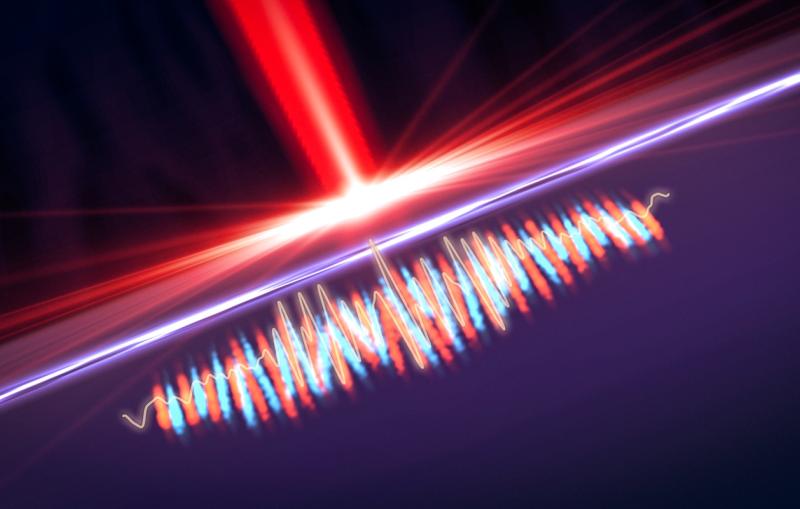
The technique could improve how scientists study materials and drive advancements in high-performance technologies, such as next-generation computer chips.

poincare beams
Feature

With a suite of reimagined instruments, researchers take up scientific inquiries that were out of reach just one year ago. 

Large metallic machine in a lab, featuring valves, circular bolts, and digital displays with surrounding wires and tubing.
News Brief

These observations are a crucial step toward truly understanding chemical processes.

Artist's impression: Diiodomethane irradiated with infrared light can undergo several different reactions. An intense X-ray pulse and a reaction microscope are used to characterize three major reaction pathways, illustrated in the figure.
News Brief

The team unexpectedly formed gold hydride in an experiment that could pave the way for studying materials under extreme conditions like those found inside...

Intense pulses from an X-ray free-electron laser heat compressed samples of hydrocarbons to extreme conditions, resulting in the reaction of gold and hydrogen to form gold hydride.
Multimedia

Researchers used the upgraded LCLS to better understand what makes Xanthone – a powerful photocatalyst used in cancer therapies –  so efficient.  

close up of instrumentation in the TMO hutch
Feature

Researchers taking the first-ever direct measurement of atom temperature in extremely hot materials inadvertently disproved a decades-old theory and upended our understanding of superheating. 

Graphic representation shows a pulse of yellow light hitting a lattice and diffracting into a spectrum of color
Feature

Ultrafast electrons at SLAC’s LCLS facility resolved the structural changes in a light-activated molecule to determine which simulations work best. 

Graphic representation of several molecules floating through space, circle of papers representing scientific results
Multimedia

Now 10,000 times brighter and thousands of times faster, LCLS sheds light on the formation of free radicals in nature. 

a closeup of the target chamber of the RIXS experimental hutch
Multimedia

On Monday, scientists and engineers reacted to the first images from the NSF–DOE Vera C. Rubin Observatory, marking a historic milestone.

Scientists reacting to presentation
Feature

Two decades ago, Stanford and SLAC took a gamble on an unproven telescope design. Now it's on the verge of paying off.

NSF–DOE Vera C. Rubin Observatory
News Release

The state-of-the-art ‘big-data facility’ unveils its first images and video, bringing the night sky to life like never before.

This image combines 678 separate images taken by NSF–DOE Vera C. Rubin Observatory in just over seven hours of observing time. Combining many images in this way clearly reveals otherwise faint or invisible details, such as the clouds of gas and dust that comprise the Trifid nebula (top) and the Lagoon nebula, which are several thousand light-years away from Earth
Feature

Shweta Saraf and her team work to ensure the LCLS beamline runs without interruption. 

A woman stands next to a large blue server rack filled with electronic control units, wiring, and monitoring equipment. She is smiling at the camera while using a stylus to interact with a touchscreen interface on one of the devices.