
Quantum networking is the framework that uses the strange properties of quantum mechanics to transmit quantum information, encoded in qubits, from one quantum device to another.
You can imagine entanglement as two dancers moving in perfect harmony, their steps mirroring each other instantly, no matter how far apart they are. Just as watching one dancer spin left reveals the other is spinning right, measuring one entangled qubit instantly shows the state of the other. Unlike dancers with a choreographed routine, though, entangled qubits have no set plan: their states are undecided until one is observed, instantly locking both into matching moves.
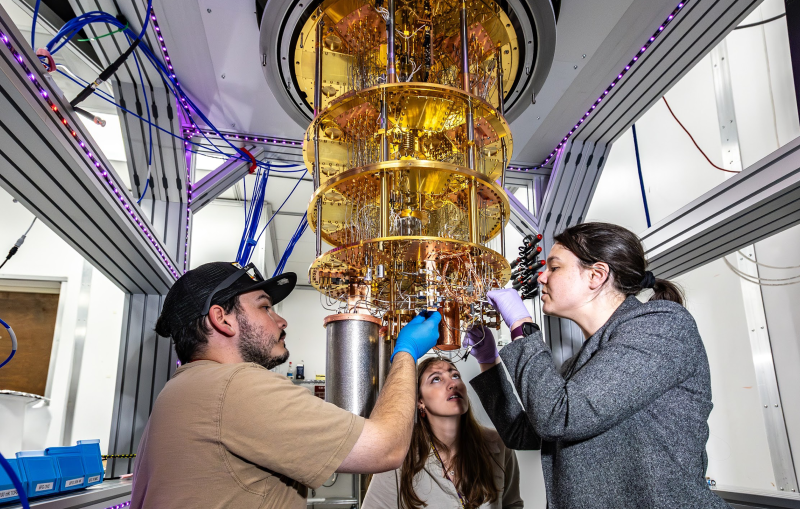
Because of the delicate nature of qubits, which travel by particles of light called photons, the network must shield them from disturbances such as temperature fluctuations or stray photons. Currently, qubits can only be sent over relatively short distances, approximately 60 miles. With the help of devices called quantum repeaters that can extend the entanglement for qubits, researchers at the Department of Energy’s SLAC National Accelerator Laboratory are working to increase that distance to eventually send information around the globe.
SLAC assistant professor of particle physics and astrophysics and of photon scienceWe are pursuing novel approaches to these challenges so that we can perform real-world experiments and start to build a quantum internet one node at a time.

“SLAC and its partner Stanford University are aiming to understand how we can transmit, route and detect photons without perturbing them and destroying entanglement,” says Emilio Nanni, SLAC assistant professor of particle physics and astrophysics and of photon science. “We are pursuing novel approaches to these challenges so that we can perform real-world experiments and start to build a quantum internet one node at a time.”
“By uniting leading experts in quantum hardware and quantum materials through initiatives like Stanford's Q-FARM and state-of-the-art fabrication facilities like SLAC's DMF, Nano-X and Stanford’s nano@Stanford shared cleanrooms, our community is equipped with the right combination of people and tools to tackle the core scientific and engineering challenges of deploying real-world quantum networks,” says Kevin Multani, Stanford PhD student.
For questions or comments, contact the SLAC Office of Communications at communications@slac.stanford.edu.
About SLAC
SLAC National Accelerator Laboratory explores how the universe works at the biggest, smallest and fastest scales and invents powerful tools used by researchers around the globe. As world leaders in ultrafast science and bold explorers of the physics of the universe, we forge new ground in understanding our origins and building a healthier and more sustainable future. Our discovery and innovation help develop new materials and chemical processes and open unprecedented views of the cosmos and life’s most delicate machinery. Building on more than 60 years of visionary research, we help shape the future by advancing areas such as quantum technology, scientific computing and the development of next-generation accelerators.
SLAC is operated by Stanford University for the U.S. Department of Energy’s Office of Science. The Office of Science is the single largest supporter of basic research in the physical sciences in the United States and is working to address some of the most pressing challenges of our time.
Quantum explained

Related stories
Containing multitudes: SLAC scientist collaborates to create scalable qubits


Containing multitudes: SLAC scientist collaborates to create scalable qubits


