SLAC topics

Materials science RSS feed

 SLAC develops materials to improve the performance of batteries, fuel cells and other energy technologies and set the stage for technologies of the future.

Related link: Energy sciences

Browse tagged content below
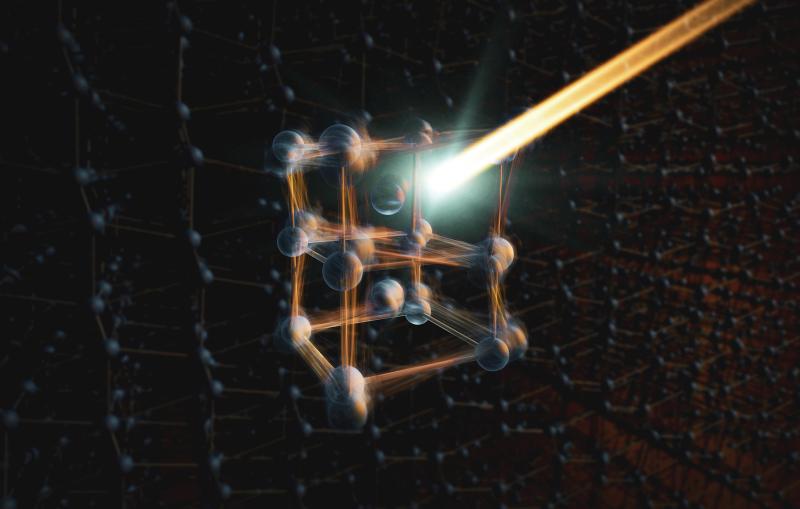
In materials hit with light, individual atoms and vibrations take disorderly paths.
News Brief

The team unexpectedly formed gold hydride in an experiment that could pave the way for studying materials under extreme conditions like those found inside...

Intense pulses from an X-ray free-electron laser heat compressed samples of hydrocarbons to extreme conditions, resulting in the reaction of gold and hydrogen to form gold hydride.
News Brief

Results obtained with SLAC’s X-ray laser show how tiny magnetic coils can align over a surprisingly broad timescale, inspiring new ideas for microelectronics. 

Vibrant 3D model with red and blue wave patterns on a layered surface, depicting magnetization points, set against blurry background.
Feature

Researchers taking the first-ever direct measurement of atom temperature in extremely hot materials inadvertently disproved a decades-old theory and upended our understanding of superheating. 

Graphic representation shows a pulse of yellow light hitting a lattice and diffracting into a spectrum of color
News Brief

SLAC researchers drew on advanced computation and X-ray methods to track down a water-splitting copper catalyst.

Illustration of X-ray beam interacting with the catalyst surface.
News Brief

The team watched how a strained strontium titanate membrane crossed into ferroelectric – and quantum – territory. 

A gold beam bounces off an atomic lattice made of red and blue spheres.
Feature

In this Q&A, Arianna Gleason discusses the technologies needed to make commercialized fusion energy a reality and how SLAC is advancing this energy frontier. 

Headshot of Arianna Gleason with graphic representation of a laser shot
Feature

Following a boom in catalysis users at SSRL, Beam Line 10-2 has been transformed and outfitted with new technologies. 

Beam Line 10-2 hutch
News Brief

The Hubbard Model was unable to predict electron dynamics in a simplified, one-dimensional cuprate system, hinting at an additional attractive force. 

Illustration of ultrastrong attraction between electrons in neighboring atoms within a 1D cuprate chain
News Brief

Using an advanced technique at SLAC’s Linac Coherent Light Source, researchers make surprising discoveries.

Image of a multicolored speckle pattern
News Brief

Supported by SLAC’s catalysis group, researchers have discovered a promising method to remove contaminants during the making of polymers.

Molecules strike a material below.
News Brief

SSRL scientists have figured out how platinum electrodes dissolve, potentially paving the way for renewable energy improvements.

White dots on a black background, with additional purple and blue dots and purple triangles connecting them.
News Brief

As a member of a collaborative team led by General Atomics, SLAC will help bridge basic research programs with the growing fusion industry. 

Graphic representation of lasers hitting a fusion fuel target in a fusion target chamber