

Learn about our science, people, facilities and partners. Discover our history and vision for the future.
Who we are
We explore radically new ideas with an entrepreneurial mindset.
Get an overview of research at SLAC: X-ray and ultrafast science, particle and astrophysics, cosmology, particle accelerators, biology, energy and technology.
Revealing nature’s fastest processes with X-rays, lasers and electrons
Studying the particles and forces that knit the cosmos together
Building smaller, faster, more powerful accelerators for all
Understanding the machinery of life at its most basic level
Inventing new tools for science and society
Finding clean, sustainable solutions for the world’s energy challenges
SLAC science explained
Cut through the jargon while exploring our research.
Learn more about the places where science happens at SLAC: our major facilities, institutes and centers.
Linac Coherent Light Source
Stanford Synchrotron Radiation Lightsource
Facility for Advanced Accelerator Experimental Tests
Cryogenic Electron Microscopy
Stanford Institute for Materials & Energy Science
Kavli Institute for Particle Astrophysics & Cosmology
Stanford PULSE Institute
Center for Interface Science & Catalysis
NSF-DOE Vera C. Rubin Observatory LSST
SLAC & Stanford build the world’s largest digital camera for the Legacy Survey of Space and Time (LSST).
Find a career, partner with us or apply to use our tools and facilities.
Apply to become a user of our scientific research facilities and instruments.
Careers at SLAC
Join our united workforce.
Get the latest news about the lab, our science and discoveries. Explore SLAC events and learn how to participate.
This joint publication of SLAC and Fermilab is your view into the world of particle physics.
Reinventing the way we break down plastic waste
Thursday, March 26, 20267:00–8:00 p.m. PDT
A better understanding of these systems will aid in developing next-generation energy technologies.
SLAC Director Chi-Chang Kao spoke to the Stanford University Faculty Senate at its Feb. 21 meeting.
The LSST camera integration and testing team inserted a raft of nine imaging sensors into the body of the ComCam. This miniature version of...
Presented by Christopher Tassone. Throughout human history, improvements in the structure of metals have been essential to the sharpness of swords and the strength...
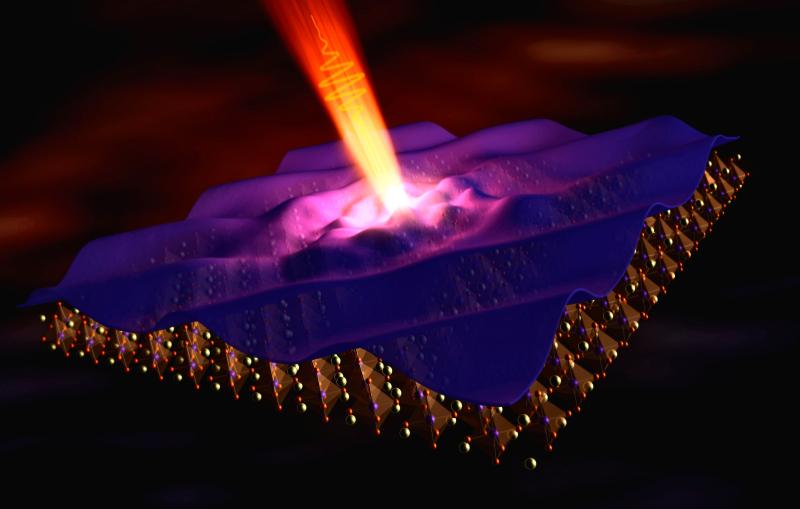
X-ray laser snapshots give scientists a new tool for probing trillionths-of-a-second atomic motions in 2-D materials
Researchers used a unique approach to learn more about what happens to silicon under intense pressure.
Scientists around the world are testing ways to further boost the power of particle accelerators while drastically shrinking their size.
Combination of research methods reveals causes of capacity fading, giving scientists better insight to design advanced batteries for electric vehicles
Researchers will use SLAC’s X-ray light source to probe 150-million-year-old dinosaur fossils at the atomic level.
SLAC researchers say their new method could make it easier to study interactions of ultrabright X-rays with matter
He helped lay the groundwork for SLAC’s LCLS X-ray laser and for the institute, which was founded to explore the science LCLS would enable.
Some theorists have taken to designing their own experiments to broaden the search for dark matter.