Join us for the inaugural SLAC on Tap event at The Patio in Palo Alto. SLAC scientist Alan Fry will chat about lasers not attached to sharks, ultrafast science and the quantum mechanics of your sunglasses. Have a drink, learn...
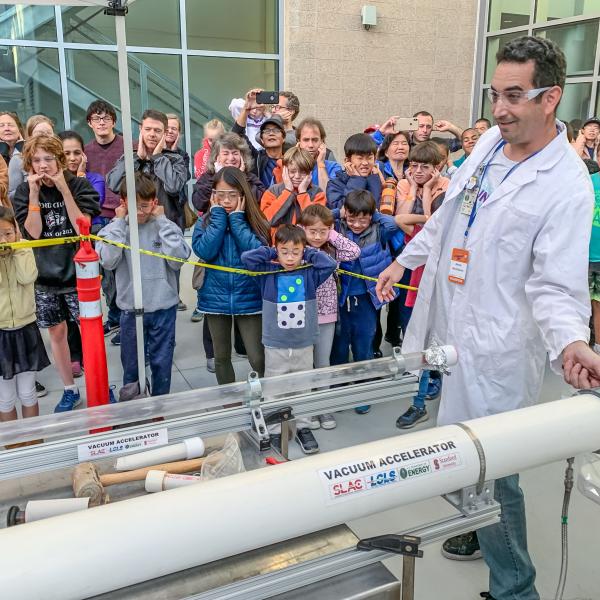
Thank you to all who joined us this year!2024 event photos are available here. STEM Community Day is a fun-filled event that includes an action-packed program for all ages. Interactive demos Engaging displays Short science talks Mini...
In a first-ever collaboration, three U.S. Department of Energy national laboratory light source facilities—the Advanced Light Source, the Linac Coherent Light Source, and the Stanford Synchrotron Radiation Lightsource—will come together for a joint users’ meeting, hosted at the SLAC National...
What do the sound of Rice Krispies and the motion of atoms and magnets have in common? Join us at the Dutch Goose for SLAC on Tap on April 14 at 5:30 pm to hear for yourself. SLAC scientist Joshua...
From our kitchens to our clothes to the delivery of medicines, plastics play an indispensable role in our daily lives. But, the end-life of these plastics is not always taken into account. Few types of plastics can be readily recycled...
SLAC is hosting a workshop Driving critical chemical transformations with photons, electrons, and catalysts. The workshop will identify key approaches and opportunities to breathe new life into the structure-function paradigm foundational to the understanding of chemistry.
Join us at the Kavli Building or online. Registration is required if you plan to attend in person. Catalysts are the unsung heroes of our modern age. Working tirelessly behind the scenes, they find many applications that touch our lives...
The world’s biggest digital camera was built at SLAC, and shipped to the NSF-DOE Vera C. Rubin Observatory in northern Chile last year. This observatory has a goal no less ambitious than to map the entire the southern sky and...
Modern particle accelerator control rooms are like busy air traffic control centers, where skilled operators juggle hundreds of interconnected and time-sensitive tasks to generate and shape high-energy particle beams. Control room tasks are increasingly performed with the support of AI...
Electrons are tiny, charged particles with huge jobs: They hold all matter together, they drive the chemical reactions that power life, and they transport information and energy across the globe. Despite their importance, we still don’t fully understand how they...
Please join us for a workshop being hosted as part of SLAC National Accelerator Laboratory’s X-ray and Ultrafast Strategic Initiative. The workshop is focused on advancing the durability of energy technologies through mastery of fundamental processes leading to material degradation...