A day in the life of an X-ray ‘magic’ maker
Silvia Russi’s love of science led her to travel the world to pursue X-rays at the most advanced particle accelerator facilities. Now a beamline scientist at SLAC, Russi dons many hats to keep beamlines running smoothly and educate budding researchers.
By Carol Tseng
Key takeaways:
- Russi juggles many roles as a beamline scientist at SLAC’s Stanford Synchrotron Radiation Lightsource (SSRL).
- From supporting researchers to pioneering new techniques, Russi shares her journey and experiences in creating the “magic” behind SSRL’s X-rays.
She devotes her time to educating the next generation of researchers.
As a researcher remotely operates his structural molecular biology experiment from Canada, Silvia Russi checks a monitor in her office at the Department of Energy’s SLAC National Accelerator Laboratory to make sure everything is running smoothly. Nearby, the SPEAR3 storage ring for the Stanford Synchrotron Radiation Lightsource (SSRL) dutifully stores electrons traveling at nearly the speed of light. As the electrons hurtle around the storage ring, they generate the bright X-rays needed for his experiment.
“This is his first time with us, so we make ourselves available if he has any problem,” said Russi, keeping a watchful eye on the monitor.
Researchers from around the world come to SSRL to conduct cutting-edge experiments whose aims range from discovering new drugs that improve human health to advancing transformative energy technologies. Russi, a beamline scientist for the Structural Molecular Biology Division at SSRL, ensures the four beamlines designed for biology experiments are ready for researchers.
Synchrotron explainer
‘Wake up your curiosity’
Russi’s path to science started in Uruguay, where she grew up with parents who encouraged her and her siblings to explore their surroundings. “They would say, ‘wake up your curiosity and find out how things work and why they are that way,’” Russi reminisced. “I remember using a microscope to look at things, even dirty water, to see what was in there.”
She decided to study chemistry and earned her bachelor’s and master’s degrees at the University of the Republic in Uruguay. While there, she connected with the crystallography group. “I was absolutely fascinated with studying three-dimensional structures of matter and how you produce organic and inorganic compounds,” she said.
During her studies, she became more interested in biology, so she decided to pursue a PhD in structural biology at the Autonomous University of Barcelona. There, she had the opportunity to run experiments at the European Synchrotron Research Facility (ESRF) in Grenoble, France.
“Once I put my feet in, I was totally fascinated by this big X-ray machine,” said Russi. “There were so many applications and interesting things to do there. That’s when I decided I wanted to be a beamline scientist.” She continued with a postdoctoral position at the European Molecular Biology Laboratory (EMBL), also in Grenoble. This group was dedicated to designing instrumentation for the protein crystallography beamlines. As a scientist among engineers, she helped test the instrumentation to determine what worked and how to improve the design. Along the way, she started supporting researchers at some of the EMBL beamlines, then moved to the structural molecular biology group at ESRF.
When her postdoc concluded, a position for a beamline scientist opened at SSRL, and she joined in 2013.
Pioneering spirit
Today, most of her time is spent in the experimental station areas, preparing the beamline for incoming researchers. Each day sees a different researcher, who has 20 hours to conduct their experiment. Roughly 95% opt for the remote access capability, where researchers ship their samples to SSRL and then operate their experiments – from loading the sample into the delivery system to screening samples and collecting data – from their location anywhere in the world.
Pausing to take another look at the monitor on her desk, Russi checks on the first-time researcher from Canada. “We trained him over Zoom yesterday morning on how to use the beamline controls software,” she said. “Today, he is running the experiment.”
Some do come on site, especially if the researcher has specific experimental needs beyond standard conditions. SSRL is open to trying new methods, and Russi will typically work with the researcher to make the experiment possible. “In many cases, it’s truly a collaboration,” she said.
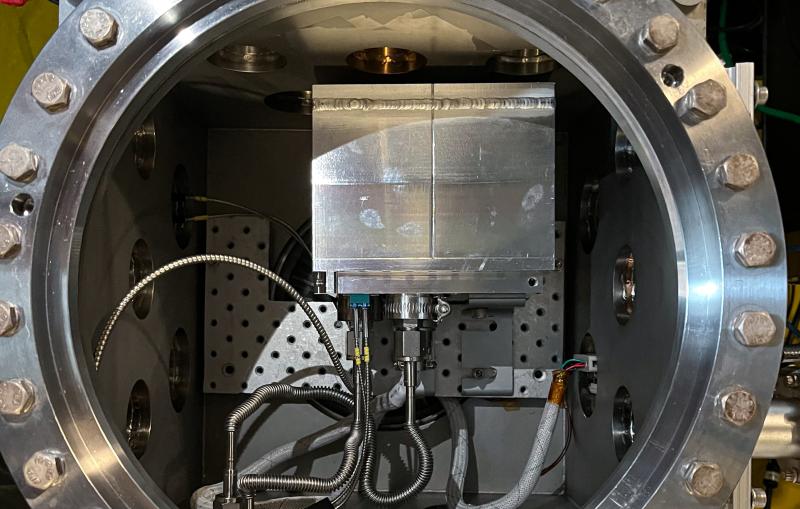
To continue advancing state-of-the-art capabilities, Russi helps develop new experimental methods and instrumentation, such as an automated sample loading robotic system that enables researchers to load samples remotely. More recently, she helped develop the ability to conduct crystallography experiments at room temperature, an alternative to the usual cryogenic testing temperatures. Room temperature testing offers insights into protein behavior closer to body temperature.
“Even though SSRL has been around a long time, we keep that pioneering spirit,” she said.
Making the magic
As a problem solver, Russi finds the challenge of pushing the envelope motivating. “I feel like I was born to do this,” she said. “The synchrotron is a very big X-ray machine formed by thousands of components. The way it works – it’s like magic – and it is amazing to be part of the magic that makes research possible.”
Russi also likes to teach and recognizes the importance of reaching out to early-career researchers and promoting macromolecular crystallography. She plays an important role in organizing and teaching workshops, such as the annual RapiData.
SLAC ScientistIf you really are interested in something, have a passion for it and are good at it, make it happen. If the first place you go doesn’t work out, you will find another place that does. Remember that you are good enough and doors will open.
Outside of work, she unwinds by spending time with her husband, reading and watching movies. Whenever she can, she rides her bike, taking in the scenery. Science, though, is often close by. Science fiction is her favorite genre and Michael Crichton her favorite author.
Reflecting on her journey to supporting research at world-renowned facilities at SLAC and Stanford University, she feels proud of her accomplishments.
“If you really are interested in something, have a passion for it and are good at it, make it happen,” she said. “If the first place you go doesn’t work out, you will find another place that does. Remember that you are good enough and doors will open.”
SSRL is a DOE Office of Science user facility.
For media inquiries, please contact media@slac.stanford.edu. For other questions or comments, contact SLAC Strategic Communications & External Affairs at communications@slac.stanford.edu.
About SLAC
SLAC National Accelerator Laboratory explores how the universe works at the biggest, smallest and fastest scales and invents powerful tools used by researchers around the globe. As world leaders in ultrafast science and bold explorers of the physics of the universe, we forge new ground in understanding our origins and building a healthier and more sustainable future. Our discovery and innovation help develop new materials and chemical processes and open unprecedented views of the cosmos and life’s most delicate machinery. Building on more than 60 years of visionary research, we help shape the future by advancing areas such as quantum technology, scientific computing and the development of next-generation accelerators.
SLAC is operated by Stanford University for the U.S. Department of Energy’s Office of Science. The Office of Science is the single largest supporter of basic research in the physical sciences in the United States and is working to address some of the most pressing challenges of our time.