Creating the perfect X-ray pulse
After five years, SLAC scientists are ready to prototype a new X-ray laser concept.
By Emily Ayshford
Key takeaways:
- SLAC researchers are developing an X-ray laser oscillator (XLO) – an offshoot of the Linac Coherent Light Source (LCLS) that is designed to emit perfectly coherent X-ray pulses.
- The tool will help researchers explore the structure and interaction of matter at the atomic and molecular levels and provide extremely accurate images of tiny, complex biological systems.
Now that designs have been nearly finalized, the team will begin building a prototype for tests at both LCLS and SACLA in Japan.
When a team at the Department of Energy’s SLAC National Accelerator Laboratory proposed an idea to advance X-ray laser technology in 2020, they faced a daunting challenge.
Ahead of them lay years of research, theory, simulation, design and redesign – all in service of pursuing a novel concept that would boost the capabilities of existing X-ray lasers to explore the structure and interaction of matter at the atomic and molecular level and provide extremely accurate images of tiny, complex biological systems.
In fact, the past five years have been a labor of love for the team that proposed creating an X-ray laser oscillator (XLO) – an offshoot of the Linac Coherent Light Source (LCLS) that is designed to emit perfectly coherent X-ray pulses that do not vary in length and intensity like current LCLS X-rays do.
Through engineering challenges and collaborations across institutions, the team is now ready to create a prototype and show the scientific world just how mighty this tool can be.
"LCLS has been highly successful, but we’re always thinking, 'What can we do next?'" said Alex Halavanau, lead scientist at SLAC and member of the project. "We started with an idea to refine the X-rays coming out of LCLS, looking at the process from a completely different angle. It has been a formidable challenge, since when we proposed this idea, we had to start with a clean slate. Along the way, we have learned a lot and solved problems that have helped other SLAC projects as well. Now, we are looking forward to building it and seeing what scientists can reveal with it."
Inspired by optical lasers, but with engineering challenges
When SLAC turned on LCLS, the world’s first hard X-ray free-electron laser (XFEL), in 2009, scientists finally had access to X-ray laser pulses that could probe tiny atoms and molecules in action at extremely fast timescales.
LCLS had been more than a decade in the making. It was first proposed in the 1990s by Claudio Pellegrini, distinguished professor emeritus of physics at the University of California, Los Angeles, and adjunct professor of photon science at SLAC. But when his dream was realized, he wasn’t content to stop there. "He’s always very forward-looking," Halavanau said.
That’s because LCLS and other XFELs emit pulses that fluctuate in central wavelength, intensity and spectral width from pulse to pulse. Having access to perfect X-ray pulses that all have the same properties would produce even better atomic- and molecular-scale images.
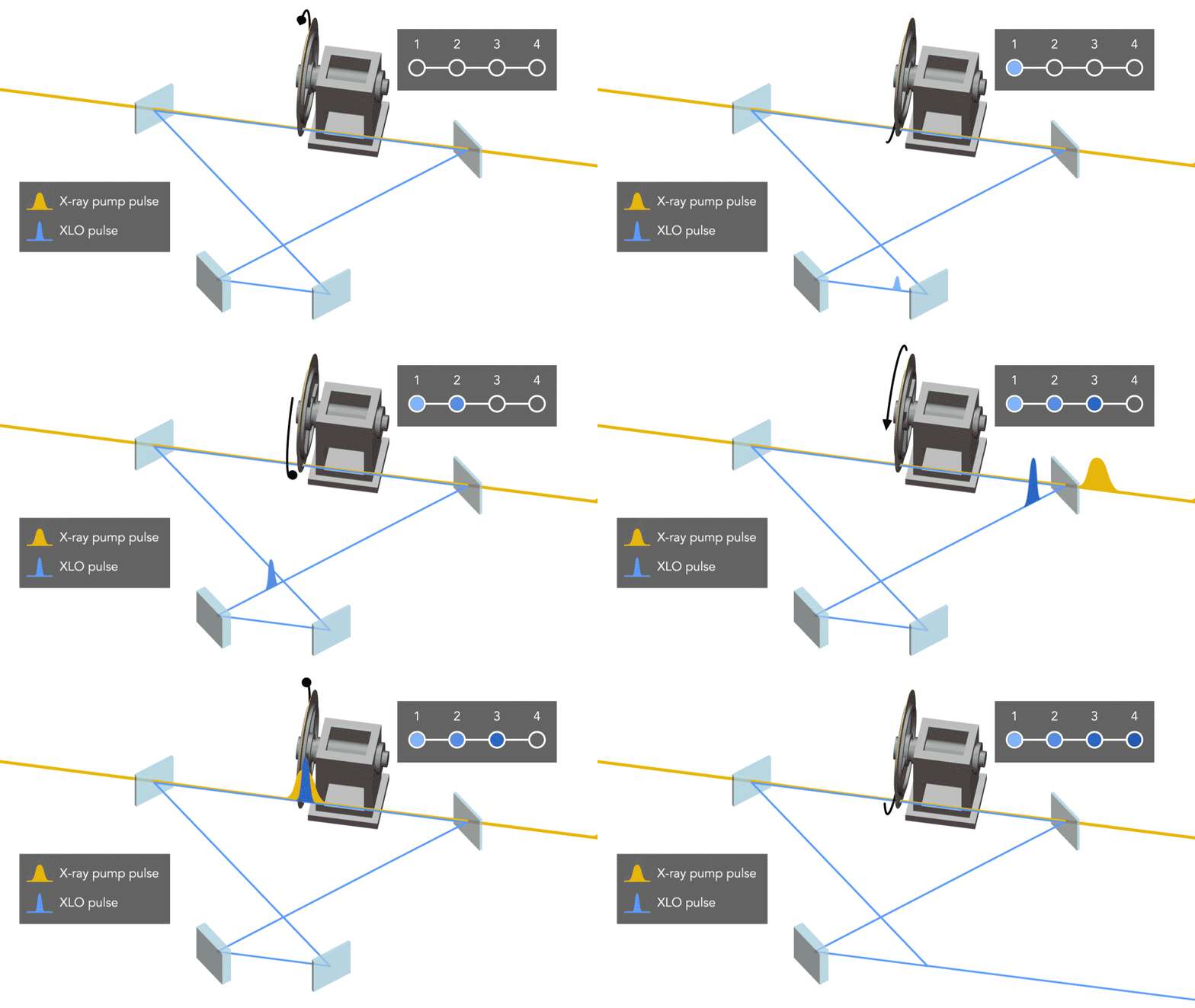
Optical lasers achieve perfect pulses with oscillators, which send photons bouncing off mirrors and through a gain medium, a material used to amplify the light. Each loop through this design concentrates the beam until it reaches a steady state, and a single-color laser beam is then emitted.
Pellegrini, Halavanau and their collaborator Uwe Bergmann, Martin L. Perl Endowed Professor in Ultrafast X-Ray Science at the University of Wisconsin, Madison, and visiting faculty at SLAC, wanted to create a similar system for X-rays.
The XLO project became part of SLAC’s research and development portfolio. But to realize their vision, the team faced a unique set of challenges.
For the gain medium, the team originally proposed jets of liquid copper. But because the LCLS’s X-rays are so powerful that they vaporize any copper gain medium they hit, the team soon found that the liquid copper would need to move through the system so fast that no pump had the ability to do it. "The X-ray beam is only 100 nanometers wide, but it creates a big hole in the copper," Bergmann said. "It’s a violent event."
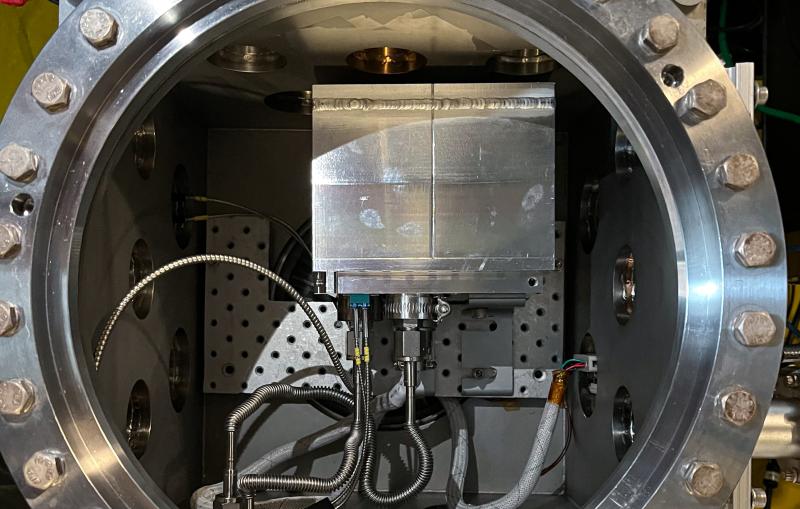
The team got around this problem by developing a disc that holds a copper foil and rotates it between each pulse – no small feat, considering X-ray pulses arrive every 30 nanoseconds.
To reflect the beam around the cavity to strengthen it, the team used crystals instead of mirrors. They needed to figure out how to position the crystals within the cavity for peak reflectivity. "And when the beam reflects and hits the gain medium again, you need to focus it to get high power," Pellegrini said. "We need to focus it to a very small size, on the order of 200 nanometers. With a visible laser, you can just use lenses to focus. But X-rays are much harder to focus."
The team has collaborated with Ichiro Inoue, associate professor at the University of Tokyo and unit leader of SACLA, an XFEL at the RIKEN research center in Japan, on the focusing optics for the beam.
"In Japan, there is a strong X-ray optics community," Inoue said. "The SACLA team, including staff scientist Taito Osaka and Osaka University Associate Professor Jumpei Yamada, has adopted various types of focusing optics to achieve tightly focused X-ray beams smaller than 10 nanometers. When Alex and I discussed XLO, we realized that one of our X-ray optics already perfectly matched the requirements for the project."
SLAC ScientistThis is a project for ultraprecise measurements, using pulses you cannot make through any other method. Scientists have infinite curiosity and creativity, so we look forward to seeing how they will take advantage of that.
A new tool for scientists to probe the atomic scale
Now that designs have been nearly finalized, the team will begin building a prototype for tests at both LCLS and SACLA.
The team hopes that within a few years, researchers can begin using the XLO – ultimately at a dedicated XLO beamline at LCLS after its high-energy upgrade – to study atomic-scale, complex systems and how they change on ultrafast timescales that could drive the development of novel applications, including quantum optics.
"This is a project for ultraprecise measurements, using pulses you cannot make through any other method," Halavanau said. "Scientists have infinite curiosity and creativity, so we look forward to seeing how they will take advantage of that."
Critical contributions to the 3D theory and simulations of stimulated emission guiding XLO design were made by Andrei Benediktovitch, staff scientist at the Center for Free-Electron Laser Science (CFEL) and the DESY research center, Germany, and Nina Rohringer, professor at Hamburg University and group leader at CFEL and DESY. Major parts of this project have been funded by the DOE Office of Science. LCLS is an Office of Science user facility.
For questions or comments, contact SLAC Strategic Communications & External Affairs at communications@slac.stanford.edu.
About SLAC
SLAC National Accelerator Laboratory explores how the universe works at the biggest, smallest and fastest scales and invents powerful tools used by researchers around the globe. As world leaders in ultrafast science and bold explorers of the physics of the universe, we forge new ground in understanding our origins and building a healthier and more sustainable future. Our discovery and innovation help develop new materials and chemical processes and open unprecedented views of the cosmos and life’s most delicate machinery. Building on more than 60 years of visionary research, we help shape the future by advancing areas such as quantum technology, scientific computing and the development of next-generation accelerators.
SLAC is operated by Stanford University for the U.S. Department of Energy’s Office of Science. The Office of Science is the single largest supporter of basic research in the physical sciences in the United States and is working to address some of the most pressing challenges of our time.
Related stories