Claudio Pellegrini Elected to National Academy of Sciences
His Research Helped Lay the Groundwork for the World’s First Hard X-Ray Free-Electron Laser, SLAC’s LCLS
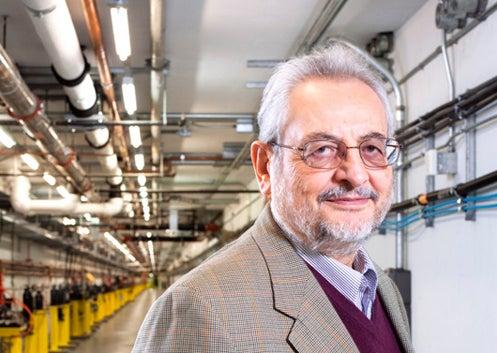
Claudio Pellegrini, a distinguished professor emeritus of physics at UCLA and adjunct professor of photon science at the Department of Energy’s SLAC National Accelerator Laboratory, has been elected to the National Academy of Sciences in recognition of his “distinguished and continuing achievements in original research.”
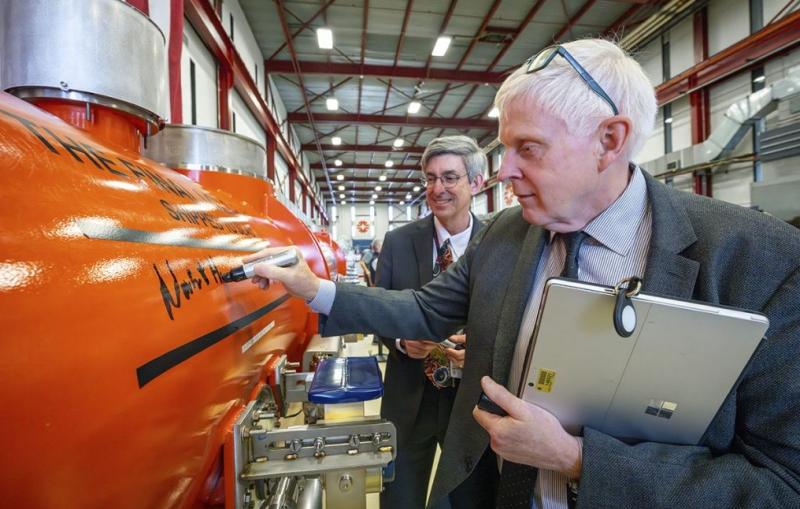
Pellegrini’s work helped lay the scientific groundwork for development of the world’s first hard X-ray free-electron laser, SLAC’s Linac Coherent Light Source (LCLS), a DOE Office of Science User Facility that launched in 2009. He played a critical role in developing “self-amplified spontaneous emission” or SASE, the process that generates ultrabright X-ray laser pulses at LCLS. His work built on earlier free-electron laser research by John Madey at Stanford University.
Pellegrini describes his pioneering work on LCLS in this video.
In 2015, President Barack Obama named Pellegrini a recipient of the Enrico Fermi Award, a presidential award and one of the government’s oldest and most prestigious awards for scientific achievement. Pellegrini received that award “for pioneering research advancing understanding of relativistic electron beams and free-electron lasers, and for transformative discoveries profoundly impacting the successful development of the first hard X-ray free-electron laser, heralding a new era for science.”
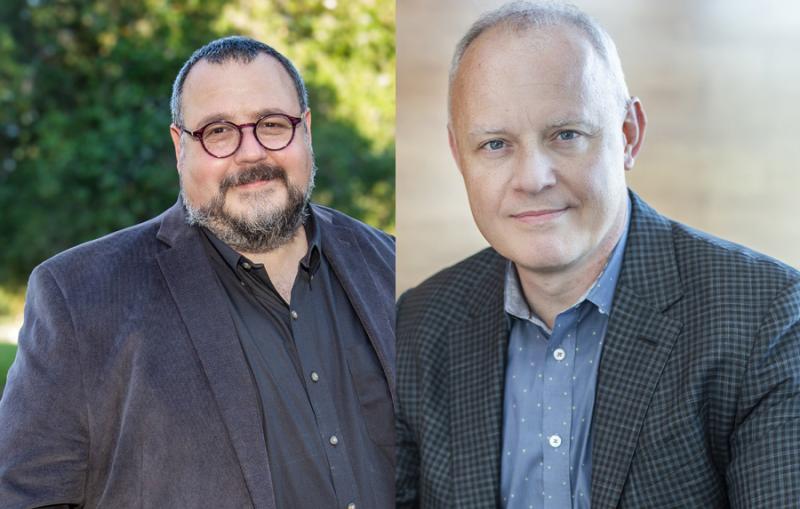
The National Academy of Sciences announced the election of 84 new members and 21 foreign associates on May 2, including three new members from the Stanford School of Medicine: Dominique Bergmann, professor of biology; John Pringle, professor of genetics; and Anne Villeneuve, professor of developmental biology and of genetics.
Membership in the academy is one of the highest honors that a U.S. scientist can receive. Its members have included Albert Einstein, Robert Oppenheimer, Thomas Edison, Orville Wright and Alexander Graham Bell.
The National Academy of Sciences was established in 1863 by a congressional act of incorporation signed by Abraham Lincoln that calls on the academy to act as an official adviser to the federal government, upon request, in any matter of science or technology. The academy is a private organization of scientists and engineers dedicated to the furtherance of science and its use for the general welfare.
Contact
For questions or comments, contact the SLAC Office of Communications at communications@slac.stanford.edu.
SLAC is a multi-program laboratory exploring frontier questions in photon science, astrophysics, particle physics and accelerator research. Located in Menlo Park, Calif., SLAC is operated by Stanford University for the U.S. Department of Energy's Office of Science.
SLAC National Accelerator Laboratory is supported by the Office of Science of the U.S. Department of Energy. The Office of Science is the single largest supporter of basic research in the physical sciences in the United States, and is working to address some of the most pressing challenges of our time. For more information, please visit science.energy.gov.
Related stories