Researchers Study How Metal Contamination Makes Gasoline Production Inefficient
Scientists at SLAC and Utrecht University have identified how catalysts degrade when used to refine crude oil.
Scientists at the Department of Energy’s SLAC National Accelerator Laboratory and Utrecht University have identified key mechanisms of the aging process of catalyst particles that are used to refine crude oil into gasoline. This advance could lead to more efficient gasoline production.
Their recent experiments studied so-called fluid catalytic cracking (FCC) particles that are used to break long-chain hydrocarbons in crude oil into smaller, more valuable hydrocarbons like gasoline.
“A major problem is that these catalysts quickly age and lose their activity, so tons of fresh catalysts have to be added to a reactor system every day,” said lead researcher Florian Meirer, assistant professor of inorganic chemistry and catalysis at Utrecht University in the Netherlands. “We are trying to understand how this aging happens, and we’re working with companies that produce these FCC catalysts to make the process more efficient.”
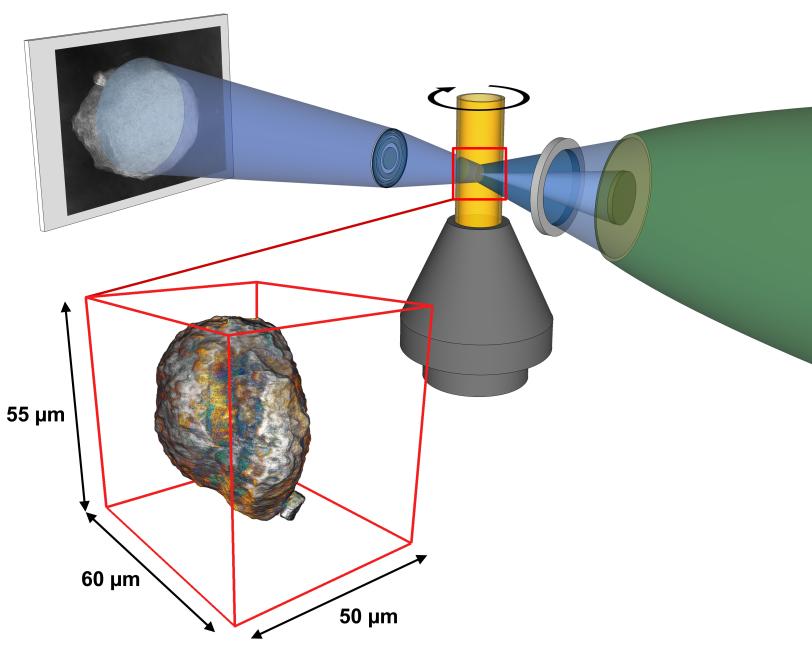
In experiments using X-ray beams at SLAC’s Stanford Synchrotron Radiation Lightsource (SSRL), a DOE Office of Science User Facility, the researchers studied FCC catalysts of various ages to better understand the effects of aging. They were able to image whole catalyst particles with high resolution so they could also see the catalysts’ internal structure – like taking a panoramic landscape photograph where you can zoom in to see the ants.
“We have been able to localize the metal poisons that are a leading cause of catalyst aging and also determine how they influence the materials,” said Bert Weckhuysen, professor of inorganic chemistry and catalysis at Utrecht University. “It’s been studied in the past, but not at this resolution and not on the single particle level. That is the beauty of what we have done.”
Researchers at SLAC Study How to Improve Gasoline Production
Casting Light on Metals
The problem of catalyst aging is widespread and costly. Worldwide, about 400 reactor systems refine crude oil into gasoline, and each system requires 10 to 40 tons of fresh FCC catalysts daily.
Crude oil is contaminated with metals, mostly iron, nickel and vanadium. These metals accumulate in catalysts during refining and eventually deactivate them. This is particularly an issue for low-quality crude oil, the largest available oil supply.
“Cheaper oil is often more polluted with metal poisons,” said Weckhuysen. “If we want to use cheap oil as feedstock, then we have to improve FCC catalysts to make them more resistant against metal poisons.”
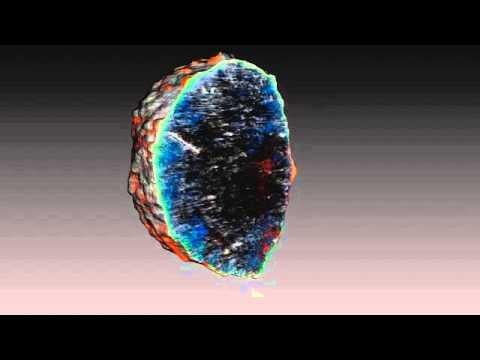
In the SSRL study, the research team took a series of two-dimensional images of catalyst particles at various angles and used software they developed to combine them into three-dimensional images of whole particles. These images show the 3-D distribution of iron and nickel in catalysts of various ages.
“This ‘mosaic imaging’ technique is a major reason why we do our experiments at the SSRL,” Meirer said.
Designing Better 'Catalyst Highways'
The researchers determined that the metals quickly accumulate on the outer surface of a catalyst, blocking the crude oil molecules from traveling through catalyst pores to reach deeper into its still-active core. They also showed that some catalyst particles stick together in clusters, which disturbs the fluidity of the catalysts and lowers gasoline production yields.
The Utrecht researchers are already working with companies to redesign these FCC catalysts.
“All of our conclusions are about the macropores, which are like highways for crude oil traveling through the catalysts. It’s about blockage along Highway 101 or 280, not small streets in San Francisco,” explained Weckhuysen. “Can we design better catalyst pores or highways?”
The research team also included Sam Kalirai at Utrecht and Darius Morris, Yijin Liu and Joy C. Andrews at SSRL. This research was supported by the NWO Gravitation program, Netherlands Center for Multiscale Catalytic Energy Conversion, Netherlands Research School Combination-Catalysis and a European Research Council Advanced Grant.
Citations: F. Meirer et al., Chemical Communications, 14 April 2015 (doi:10.1039/c5cc0040b)
F. Meirer et al., Science Advances, 3 April 2015 (doi:10.1126/sciadv.1400199)
F. Meirer et al., Journal of the American Chemical Society, 2 January 2015 (doi:10.1021/ja511503d)
For questions or comments, contact the SLAC Office of Communications at communications@slac.stanford.edu.
SLAC is a multi-program laboratory exploring frontier questions in photon science, astrophysics, particle physics and accelerator research. Located in Menlo Park, Calif., SLAC is operated by Stanford University for the U.S. Department of Energy's Office of Science.
SLAC National Accelerator Laboratory is supported by the Office of Science of the U.S. Department of Energy. The Office of Science is the single largest supporter of basic research in the physical sciences in the United States, and is working to address some of the most pressing challenges of our time. For more information, please visit science.energy.gov.

Related stories


Scientists capture first molecular-level images of water reorganization during a reaction crucial for life