US Scientists Celebrate Nobel Prize for Higgs Discovery
The Nobel Prize in physics has been awarded to theorists Peter Higgs and Francois Englert to recognize their work developing the theory of what is now known as the Higgs field. U.S. scientists played a significant role in advancing their theory and confirming it with the discovery of the Higgs boson.
The Royal Swedish Academy of Sciences today awarded the Nobel Prize in physics to theorists Peter Higgs and Francois Englert to recognize their work developing the theory of what is now known as the Higgs field, which gives elementary particles mass. U.S. scientists played a significant role in advancing the theory and in discovering the particle that proves the existence of the Higgs field, the Higgs boson.
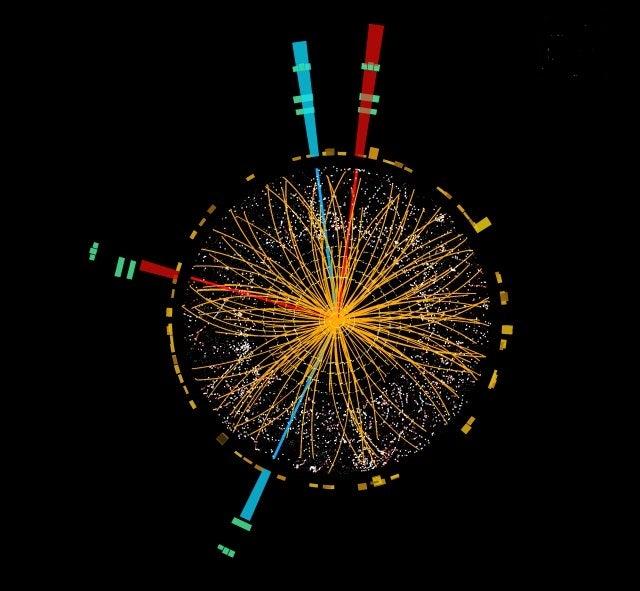
In the 1960s, Higgs and Englert, along with other theorists, including Robert Brout, Tom Kibble and Americans Carl Hagen and Gerald Guralnik, published papers introducing key concepts in the theory of the Higgs field. In 2012, scientists on the international ATLAS and CMS experiments, performed at the Large Hadron Collider at CERN laboratory in Europe, confirmed this theory when they announced the discovery of the Higgs boson.
Nearly 2000 physicists from U.S. institutions—including 89 U.S. universities and seven U.S. Department of Energy laboratories—participate in the ATLAS and CMS experiments, making up about 23 percent of the ATLAS collaboration and 33 percent of CMS at the time of the Higgs discovery. Brookhaven National Laboratory serves as the U.S. hub for the ATLAS experiment, and Fermi National Accelerator Laboratory serves as the U.S. hub for the CMS experiment. U.S. scientists provided a significant portion of the intellectual leadership on Higgs analysis teams for both experiments.
"Confirmation of the existence of the Higgs is also a clear example of the capabilities of the world-wide physics community," said David MacFarlane, Director of SLAC's Particle Physics and Astrophysics directorate. MacFarlane has watched the search unfold for decades. "This Nobel Prize also recognizes the global effort involved in the construction and commissioning of the LHC experiments; we are now seeing the fruits of that process. Personally I would also like to thank everyone at SLAC who has been involved in this momentous discovery."
"Confirming the existence of the Higgs is only the beginning," said Michael Peskin, a member of SLAC's Particle Theory Group. "The Higgs boson is a new type of elementary particle," he said. "Its discovery opens the door to a new realm in particle physics. The Higgs answers the 'how' question about the origin of mass in the other fundamental particles of the Standard Model, but it does not answer 'why?', and we need to keep looking for that answer."
For more information about the 2013 Nobel Prize in physics, see:
Related stories
Seagull Nebula through the eyes of NSF–DOE Vera C. Rubin Observatory Commissioning Camera

Seagull Nebula through the eyes of NSF–DOE Vera C. Rubin Observatory Commissioning Camera
Containing multitudes: SLAC scientist collaborates to create scalable qubits