
SLAC topics

Particle physics RSS feed

Working at the forefront of particle physics, SLAC scientists use powerful particle accelerators to create and study nature’s fundamental building blocks and forces, build sensitive detectors to search for new particles and develop theories that explain and guide experiments. SLAC's particle physicists want to understand our universe – from its smallest constituents to its largest structures.

Related links:
Physics of the universe
Elementary particle physics
Browse tagged content below

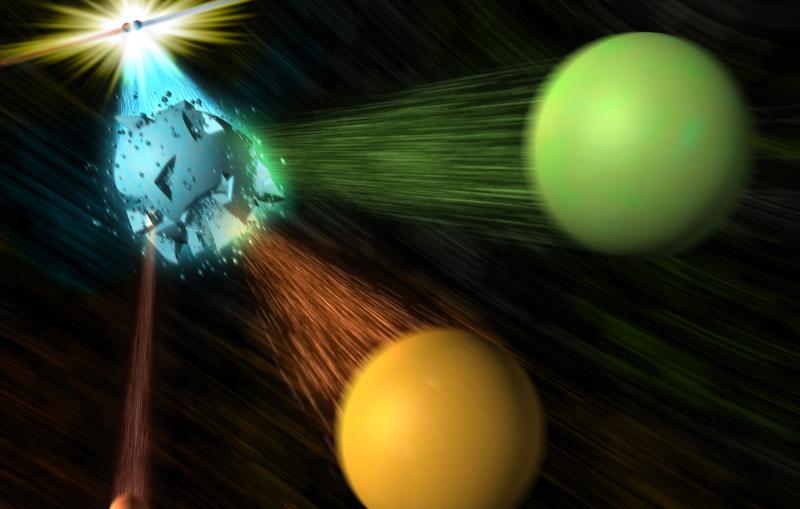
Particles collide in this illustration
News Release

In the largest dataset ever collected by a dark matter detector, LUX-ZEPLIN's latest results provide the strongest constraints on low-mass WIMPs and detect boron-8...

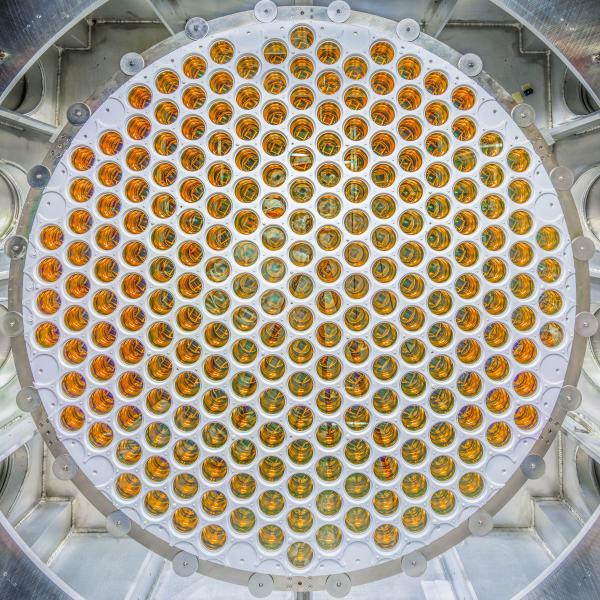
Overhead view looking down into a white structure with dozens of orange circular components arranged radially.
Feature

Her work will advance a next-generation experiment in the hope of detecting this mysterious ingredient of the universe.

Portrait of Ann Wang
News Release

The state-of-the-art ‘big-data facility’ unveils its first images and video, bringing the night sky to life like never before.

This image combines 678 separate images taken by NSF–DOE Vera C. Rubin Observatory in just over seven hours of observing time. Combining many images in this way clearly reveals otherwise faint or invisible details, such as the clouds of gas and dust that comprise the Trifid nebula (top) and the Lagoon nebula, which are several thousand light-years away from Earth
Feature

NSF–DOE Vera C. Rubin Observatory will add an unprecedented amount of cosmological data to the study of the structure and expansion of the Universe.

An illustration of a woman holding a book is surrounded by photographic negatives showing pictures of the universe.
Feature

A look inside the data processing infrastructure built by the NSF–DOE Vera C. Rubin Observatory to handle the Universe’s greatest data challenge.

Computer code, circles and data overlaid on an image of a red-orange nebula.
Feature

Now that NSF–DOE Vera C. Rubin Observatory’s LSST Camera has been installed, what’s next?

A large black cylindrical camera is positioned in a telescope dome.
Feature

The long and continuing quest to understand dark energy has entered exciting new territory.

An illustration of a telescope with verdant trees on one side and a person raking leaves on the other.
News Release

Using the largest digital camera in the world, Rubin Observatory will soon be ready to capture more data than any other observatory in history.

A person in a hard hat looks at a giant black lens cap surrounded by a mirror
Feature

Researchers positioned lasers to compress billions of electrons together, creating a beam five times more powerful than before.

Claudio Emma and Brendan O’Shea examine experimental apparatus.
News Brief

Rubin Observatory’s rapid scanning of the night sky will capture the largest sample of Type Ia supernovae yet, unlocking new insights into dark energy.

An illustration of a telescope scanning the night sky.
Feature

The microelectronics that power daily life and speed discoveries in science and technology are the focus of a bold new vision to make them...

photo of detector
Past Event
Register to watch in person in the  Kavli Auditorium,  or watch the lecture live on our YouTube page.  In particle physics, we search for...
Public lecture illustration