Using X-ray free-electron lasers like SLAC’s LCLS, researchers study how enzymes catalyze reactions, which could help them develop drugs and other medical treatments.
Using the powerful LCLS X-ray laser, researchers at SLAC have directly imaged for the first time how molecules rearrange during a chemical reaction controlled...
Experiments running at these higher pulse rates will allow scientists to capture ultrafast processes with greater precision, collect data more efficiently and explore phenomena...
The technique could improve how scientists study materials and drive advancements in high-performance technologies, such as next-generation computer chips.
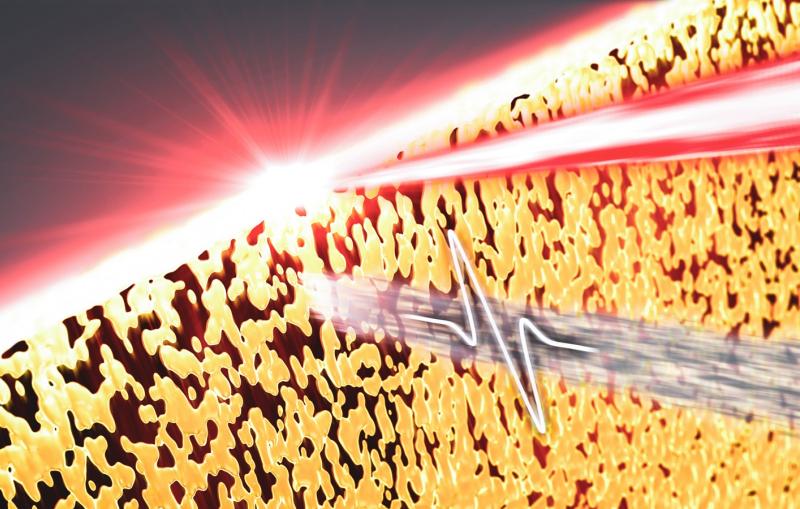
Researchers taking the first-ever direct measurement of atom temperature in extremely hot materials inadvertently disproved a decades-old theory and upended our understanding of superheating.
One-quintillionth of a second lasing breakthrough could lead to next-generation X-ray technologies, improving imaging in medical, material, and quantum science.
In this Q&A, Arianna Gleason discusses the technologies needed to make commercialized fusion energy a reality and how SLAC is advancing this energy frontier.
Using X-ray free-electron lasers like SLAC’s LCLS, researchers study how enzymes catalyze reactions, which could help them develop drugs and other medical treatments.
Using the powerful LCLS X-ray laser, researchers at SLAC have directly imaged for the first time how molecules rearrange during a chemical reaction controlled by light.
With a new method that could be extended to study Earth’s core and nuclear fusion, they identify and explain jumps in the electrical conductivity of aluminum under extreme conditions.
Experiments running at these higher pulse rates will allow scientists to capture ultrafast processes with greater precision, collect data more efficiently and explore phenomena that were previously out of reach.
The technique could improve how scientists study materials and drive advancements in high-performance technologies, such as next-generation computer chips.
Researchers taking the first-ever direct measurement of atom temperature in extremely hot materials inadvertently disproved a decades-old theory and upended our understanding of superheating.
One-quintillionth of a second lasing breakthrough could lead to next-generation X-ray technologies, improving imaging in medical, material, and quantum science.
In this Q&A, Arianna Gleason discusses the technologies needed to make commercialized fusion energy a reality and how SLAC is advancing this energy frontier.