Researchers capture strange behavior of laser-excited gold
The research could lead to a better understanding of how metals behave under extreme conditions, which will aid in the development of more resilient materials.
New research, conducted at the Department of Energy’s SLAC National Accelerator Laboratory, illuminates the strange behavior of gold when zapped with high-energy laser pulses.
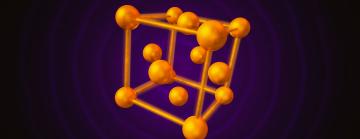
When certain materials, such as silicon, are subjected to intense laser excitation, they quickly fall apart. But gold does the opposite: it gets tougher and more resilient. This is because the way the gold atoms vibrate together – their phonon behavior – changes.
"Our findings challenge previous understandings by showing that, under certain conditions, metals like gold can become stronger rather than melting when subjected to intense laser pulses,” said Adrien Descamps, a researcher at Queen's University Belfast who led the research while he was a graduate student at Stanford and SLAC. “This contrasts with semiconductors, which become unstable and melt."
For decades, simulations hinted at the possibility of this phenomenon, known as phonon hardening. Now, using SLAC’s Linac Coherent Light Source (LCLS), the researchers have finally brought this phonon hardening to light. The team published their results on Friday in Science Advances.
"It's been a fascinating journey to see our theoretical predictions confirmed experimentally,” said collaborator Emma McBride, a researcher at Queen's University Belfast who was previously a Panofsky fellow at SLAC’s High Energy Density Science (HEDS) division. “The precision with which we can now measure these phenomena at LCLS is astonishing, and it opens up new possibilities for future research in material science."
In their experiment, the team targeted thin gold films with optical laser pulses at the Matter in Extreme Conditions experimental hutch, then used super-fast X-ray pulses from LCLS to take atomic-level snapshots of how the material responded. This high-resolution glimpse into the atomic world of gold allowed researchers to observe subtle changes and capture the moment when its phonon energies increased, providing concrete evidence of phonon hardening.
"We used X-ray diffraction at LCLS to measure the structural response of gold to laser excitation,” McBride said. “This revealed insights into the atomic arrangements and stability under extreme conditions.”
The researchers found that when gold absorbs extremely high-energy optical laser pulses, the forces holding its atoms together become stronger. This change makes the atoms vibrate faster, which can change how the gold responds to heat and might even affect the temperature at which it melts.
“This work resolves a long-standing question about the ultrafast excitation of metals and shows that intense lasers can completely alternate the response of the lattice,” said Siegfried Glenzer, director of the High Energy Density Division at SLAC.
Researchers believe similar phenomena could exist in other metals such as aluminum, copper, and platinum. Further exploration could lead to a better understanding of how metals behave under extreme conditions, which will aid in the development of more resilient materials.
"Looking ahead, we're excited about the potential to apply these findings to more practical applications, such as in laser machining and material manufacturing, where understanding these processes at the atomic level could lead to improved techniques and materials,” Descamps said. “We're also planning more experiments and hoping to explore these phenomena across a wider range of materials. It's an exciting time for our field, and we're looking forward to seeing where these discoveries take us."
LCLS is a DOE Office of Science user facility. This research was supported in part by the Office of Science (BES and FES).
Citation: A. Descamps et al., Science Advances, 9 February 2024 (10.1126/sciadv.adh5272)
Contact
For questions or comments, contact the SLAC Office of Communications at communications@slac.stanford.edu.
About SLAC
SLAC National Accelerator Laboratory explores how the universe works at the biggest, smallest and fastest scales and invents powerful tools used by researchers around the globe. As world leaders in ultrafast science and bold explorers of the physics of the universe, we forge new ground in understanding our origins and building a healthier and more sustainable future. Our discovery and innovation help develop new materials and chemical processes and open unprecedented views of the cosmos and life’s most delicate machinery. Building on more than 60 years of visionary research, we help shape the future by advancing areas such as quantum technology, scientific computing and the development of next-generation accelerators.
SLAC is operated by Stanford University for the U.S. Department of Energy’s Office of Science. The Office of Science is the single largest supporter of basic research in the physical sciences in the United States and is working to address some of the most pressing challenges of our time.
Related stories
Containing multitudes: SLAC scientist collaborates to create scalable qubits
Containing multitudes: SLAC scientist collaborates to create scalable qubits


NSF–DOE Vera C. Rubin Observatory Founding Director Tony Tyson included in 2026 TIME100