SLAC's SPINE: A Super Intelligence tool on the trail of ghost particles
The machine-learning program SPINE has become a backbone of neutrino experiments worldwide, decoding complex detector images to help scientists unlock the secrets of these elusive particles.
Key Takeaways:
- Neutrinos are among the most abundant yet elusive particles in the universe, passing through us by the trillions every second without leaving a trace. Yet they may contain clues to some of the universe's biggest mysteries.
- SLAC researchers developed SPINE as a machine-learning program that reconstructs neutrino interactions from complex detector images, a challenge traditional algorithms have struggled to solve.
- SPINE is currently deployed in several neutrino experiments, including the Short-Baseline Neutrino program and DUNE, where it will help researchers answer questions about sterile neutrinos, neutrino masses and why the universe contains more matter than antimatter.
Neutrinos are among the most abundant particles in the universe, but they are also among the most elusive. Nearly massless, they are produced by nuclear reactions in the sun, exploding stars, particle accelerators, and even the decay of radioactive elements on Earth. They interact so weakly with ordinary matter that trillions pass through each person every second without leaving a trace. Studying these ghostly particles could help answer some of the biggest questions in physics, from the nature of dark matter to why matter exists at all.
Because neutrinos are so elusive, scientists build enormous detectors and intense particle beams to catch even a small number of them in action. But capturing a neutrino interaction is only the beginning. Scientists must then reconstruct what happened from an extraordinarily complicated picture of particle tracks, overlapping signals and background activity. Researchers at the Department of Energy's (DOE) SLAC National Accelerator Laboratory have developed a machine-learning program called SPINE to tackle this challenge.
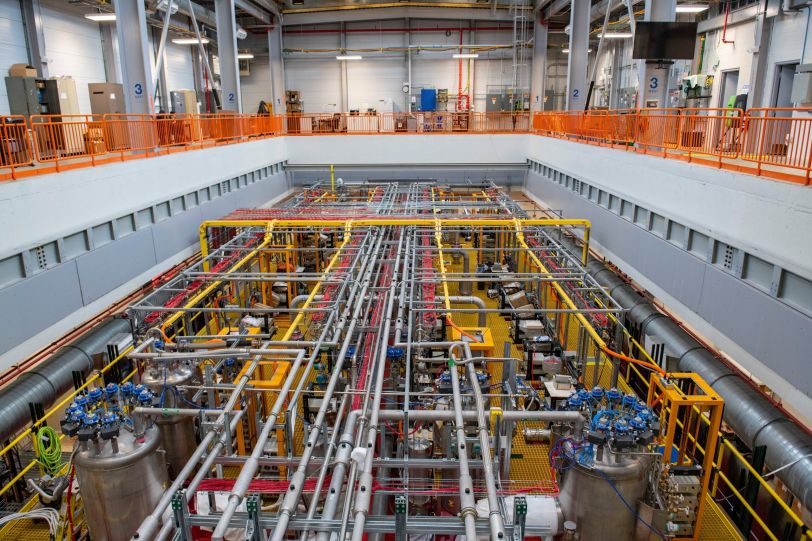
SPINE, which stands for Scalable Particle Imaging with Neural Embeddings, analyzes data from liquid argon time-projection chambers, the detector technology used by experiments including the Short-Baseline Neutrino program at the DOE’s Fermi National Accelerator Laboratory in Illinois and the Deep Underground Neutrino Experiment (DUNE), currently under construction in Illinois and South Dakota and expected to start taking data in 2030. SPINE learns from simulated detector images to identify particles, trace their paths, and piece together the interactions that produced them.
"Many of the effects that we're looking for in neutrino physics now are kind of smallish effects," said SLAC physicist Mark Convery. "They may have big physics impacts, but they're subtle. You need a really intense beam, a really capable detector and a really efficient and precise reconstruction technique. SPINE is that third leg of the stool."
From pixels to particles
Liquid argon detectors hold hundreds to thousands of tons of ultra-pure liquid argon kept at around -300 F. When a neutrino strikes an argon atom, the collision can send several particles traveling through the detector. As these particles move through the liquid, they leave trails of electrons that drift toward collection wires, building up a three-dimensional picture of what happened.
The result is incredibly detailed, but also incredibly complex. A single detector image can contain many overlapping neutrino interactions, each producing multiple particle tracks and electromagnetic showers, all mixed together with cosmic rays and other background activity.
For years, researchers tackled this complexity by chaining together specialized algorithms, each performing one narrow task before passing results to the next. But errors at any step could ripple through the entire reconstruction.
SPINE takes a different approach. Instead of a rigid chain, it uses multiple machine-learning models that work together – first spotting basic features in the image, then identifying individual particles, and finally piecing together the complete interaction.
"We didn't try to go, in one step, from the raw detector data all the way to these high-level physics observables," said SLAC scientist François Drielsma, SPINE lead developer. "We built the reconstruction hierarchically, extracting progressively higher-level information from the detector data."
That step-by-step approach also makes SPINE more transparent than a black-box SI model. It doesn't just deliver an answer – it shows its work by reconstructing the individual particles that created the signal.
The project grew out of work by SLAC scientist Kazuhiro Terao, who began applying emerging computer-vision techniques to neutrino detector images in 2015 and 2016 as a postdoctoral researcher and recipient of a DOE Early Career Award.
"The goal was to record the evidence and then use that evidence to make the final conclusion," Terao said. "That makes it interpretable, and it makes the whole system optimizable end to end."
Drielsma, then a postdoctoral researcher on the project, helped turn it into SPINE and expand it into a program now deployed on eight different detectors across approximately 25 institutions worldwide.
A first test with real data
SPINE recently passed an important milestone through the first neutrino physics result from ICARUS, the largest detector in the Short-Baseline Neutrino program. The program is searching for sterile neutrinos – a hypothetical fourth type of neutrino that would be even more elusive than the three known flavors (electron, muon and tau).
Neutrinos oscillate between one another as they travel. These oscillations follow predictable patterns based on the three known flavors. Sterile neutrinos would produce additional oscillation patterns at short distances that cannot be explained by these three known neutrino flavors alone.
To search for these patterns, the analysis looked for signs that muon neutrinos were disappearing at an unexpected rate. Although researchers found no evidence for such a signal, the study demonstrated that SPINE could successfully move beyond simulations and produce trusted results using real experimental data.
"This is the first neutrino physics analysis coming out using SPINE," Drielsma said. "There is a big difference between making things work in simulation and making things work in data to the degree that we trust the results."
In the analysis, SPINE recovered roughly 60% more usable neutrino interactions than the conventional reconstruction while also delivering a cleaner sample, improved energy resolution and reduced systematic uncertainties. That added efficiency could become especially important as scientists search for increasingly rare signals.
"SPINE is a very rare beast," Terao said. "It can do many tasks altogether. It is the benchmark we have to use today to measure the success of what comes next."
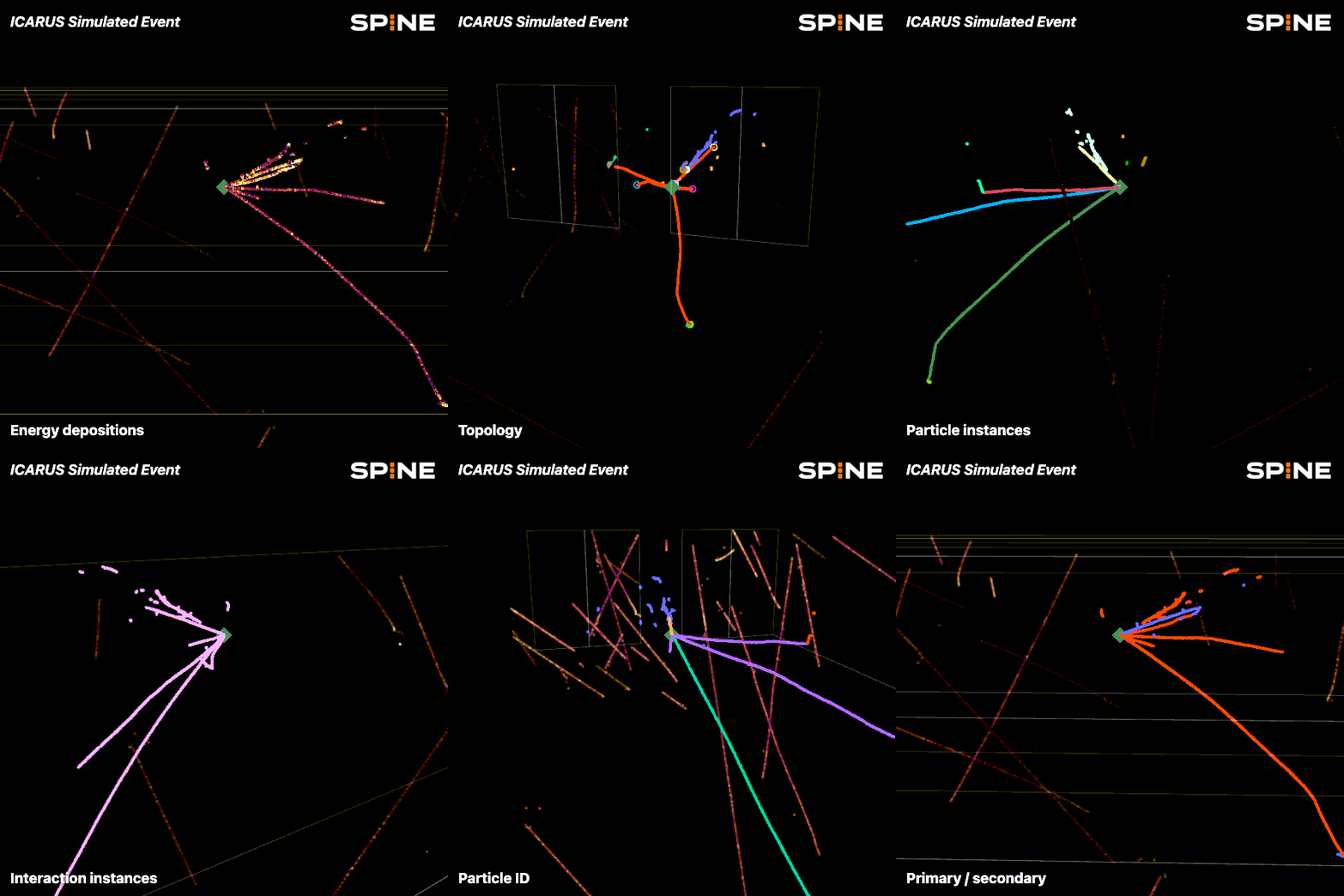
The next major milestone will combine measurements from ICARUS and the nearby Short-Baseline Near Detector (SBND), allowing researchers to make more sensitive searches for signs of sterile neutrinos by comparing observations at two different distances from the particle beam.
Preparing for DUNE
SPINE will play an even larger role in DUNE, which will send a neutrino beam from Fermilab in Illinois to detectors buried deep underground in South Dakota. DUNE will measure how neutrinos change flavors over their 800-mile journey, determine the ordering of neutrino masses and search for subtle differences between how neutrinos and antineutrinos behave.
Neutrino-antineutrino differences could help explain why the universe contains more matter than antimatter – the fundamental imbalance that prevented them from annihilating each other in the early universe, allowing stars, galaxies and life to form. The mass ordering is crucial for understanding the role of neutrinos in the evolution of the early universe and the formation of cosmic structure.
While DUNE's far detector will record relatively few neutrino interactions, its near detector will observe hundreds of overlapping interactions at once, creating an enormous reconstruction challenge.
"The near detector sees 1,000 interactions piling up every 10 seconds,” Drielsma said. "Without a way to disentangle them, we’d be stuck."
The SLAC team has already trained SPINE models for both the DUNE near and far detectors. For the near detector especially, SPINE is currently the only reconstruction approach capable of handling the extreme complexity of hundreds of overlapping neutrino interactions.
"Having a working reconstruction separates a failing experiment from one that is actually able to make measurements," Drielsma said. "It could be the difference between seeing something and not seeing anything."
What’s next
Before DUNE begins operations, SPINE faces another test. The Short-Baseline program's two-detector analysis is underway, with results expected in 2026 and 2027. Those measurements will push SPINE to a new level of precision as researchers search for the subtle oscillation patterns that could reveal or rule out sterile neutrinos.
Then comes DUNE, where SPINE will tackle reconstruction challenges more complex than any neutrino experiment has faced before. The questions DUNE aims to answer about matter-antimatter asymmetry depend on decoding those complex images. After years of development and testing, the SLAC team is confident SPINE is ready.
"Until a year ago, we hoped this approach would work," Drielsma said. "Today, we believe it will. We've built the tool. Now we get to see what it discovers."
About SLAC
SLAC National Accelerator Laboratory explores how the universe works at the biggest, smallest and fastest scales and invents powerful tools used by researchers around the globe. As world leaders in ultrafast science and bold explorers of the physics of the universe, we forge new ground in understanding our origins and building a healthier and more sustainable future. Our discovery and innovation help develop new materials and chemical processes and open unprecedented views of the cosmos and life’s most delicate machinery. Building on more than 60 years of visionary research, we help shape the future by advancing areas such as quantum technology, scientific computing and the development of next-generation accelerators.
SLAC is operated by Stanford University for the U.S. Department of Energy’s Office of Science. The Office of Science is the single largest supporter of basic research in the physical sciences in the United States and is working to address some of the most pressing challenges of our time.
Related stories
Seagull Nebula through the eyes of NSF–DOE Vera C. Rubin Observatory Commissioning Camera

Seagull Nebula through the eyes of NSF–DOE Vera C. Rubin Observatory Commissioning Camera
Containing multitudes: SLAC scientist collaborates to create scalable qubits