SLAC researchers find proof of altermagnetism, a new magnetic phase
The team directly observed a unique property in an altermagnetic candidate material, delivering key evidence of a new phase of magnetism first postulated in 2022.
Key takeaways:
- The scientific case for a third type of magnetism – termed “altermagnetism” – has been building over recent years.
- Now, a SLAC-led team has experimentally proven that a material exhibits characteristics that are theoretically impossible to explain without altermagnetism.
- Altermagnetic materials could be used to design advanced electronics, with applications including quantum technologies, memory devices and data centers.
For decades, physicists recognized only two types of magnetism that occur in materials without external influence: ferromagnetism and antiferromagnetism. Today, in findings published in Science, a team led by the U.S. Department of Energy's SLAC National Accelerator Laboratory has delivered conclusive experimental proof of a third magnetic phase called altermagnetism.
“In the past few years, scientists have observed phenomena that don't fit neatly into the ferromagnetism-antiferromagnetism dichotomy,” explained lead author Daniel Jost, associate scientist at SLAC and Stanford Institute for Materials and Energy Sciences. “Researchers have been compiling evidence of a third type of magnetism that bridges the qualities of these two classes. We believe our results provide robust experimental confirmation that this third phase – altermagnetism – is real.”
Building on previous studies, this research confirmed that manganese telluride (MnTe) is an altermagnet – a new class of magnet that exhibits properties of both ferromagnetism and antiferromagnetism. Their results showed direct experimental evidence of chirality – an asymmetric magnetic structure, akin to a spiral staircase or a screw – in the spins of an altermagnetic candidate material.
Identifying these unique materials could allow researchers to manipulate their properties in ways that make them ideal candidates for advanced electronics, with applications including quantum technologies, memory devices and data centers.
A primer on magnetism
To most of us, magnetism is a tangible force: It’s what holds a child's artwork to a refrigerator door and points a compass needle north. But to a physicist, magnetism is more complex. It’s a quantum property of a material, and not all magnetic materials have a directly observable magnetic effect.
In physics, a material is considered magnetic if its electrons’ spins – their internal angular momentum, which can be either “up” or “down” – are polarized, or ordered in a specific pattern.
In ferromagnets, all electronic spins point the same direction (up-up-up or down-down-down), creating an observable magnetic field. Humans have known about and made use of this class of magnets since ancient times. In 1933, scientists discovered another type of material with polarized spins. Antiferromagnets have alternating electronic spins (up-down-up-down) that cancel each other out, producing no net magnetic effect.
A new type of magnetism?
For nearly 90 years, this two-category system dominated our understanding of magnetism.
But in recent years, researchers have noticed that some materials don’t fit neatly into either category. Certain materials seemed to exhibit features of both antiferromagnetism, such as alternating spin configuration with no net magnetization, and ferromagnetism, such as the ability to use spin currents. These behaviors were once thought to be mutually exclusive.
In 2022, researchers proposed the term “altermagnets” to label this wily class of materials.
Associate Scientist at SLAC and Stanford Institute for Materials and Energy SciencesWe believe our results provide robust experimental confirmation that this third phase – altermagnetism – is real.
To explain this behavior, researchers postulated that altermagnets exhibit an alternating spin polarization (up-down-up-down), much like conventional antiferromagnets, but with a crucial twist: the crystal lattice structure surrounding the “up” spins is rotated relative to the lattice surrounding the “down” spins. This geometric twist is a break in symmetry that could give rise to their unusual behavior.
Chirality: the final piece of the puzzle
“By 2024, there were some factors that spoke strongly in favor of altermagnetism being real,” Jost said, “but there was still a missing piece to the puzzle.”
That missing piece was experimental evidence of chirality in an altermagnetic candidate material. Chirality, often referred to as “handedness,” means a material cannot be superimposed on a mirror image of itself, just like a left hand cannot fit into a right-handed glove.
Chirality offers a clever way to distinguish subtle, quantum-level differences between antiferromagnets and suspected altermagnets: While an altermagnetic material would have alternating spins (up-down-up-down) like an antiferromagnet, the geometric twists in its lattice would give the material’s electronic and magnetic structure a distinct handedness that conventional antiferromagnets lack.
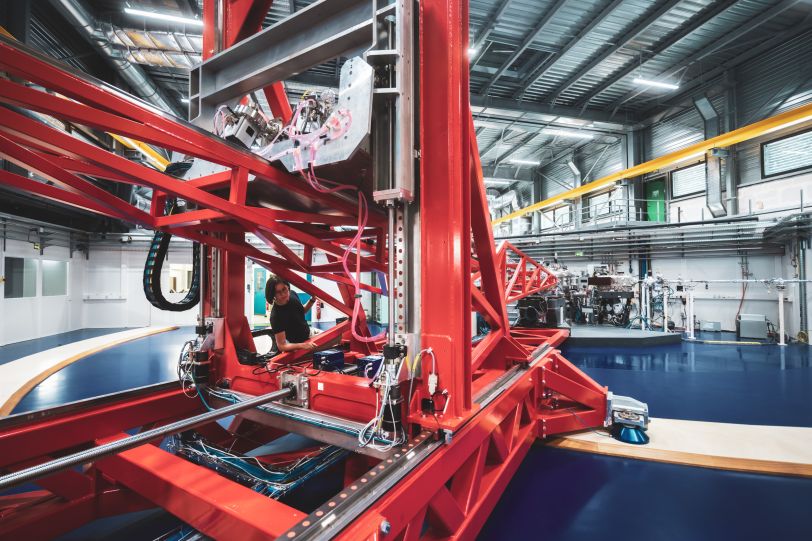
Jost’s team chose to investigate chirality in MnTe – a material considered antiferromagnetic for decades until a few years ago when it was suspected to be altermagnetic. The team brought it to the European Synchrotron Radiation Facility (ESRF) in France, to a beamline known for its ability to generate highly controlled polarized X-ray beams.
“Chiral materials scatter left-handed polarized X-ray beams differently than they do right-handed beams,” explained Jost. “Non-chiral materials would scatter each beam of light the same way.”
By scattering circularly polarized X-rays from the material and comparing how it responded to left- versus right-handed light, they teased out a clear chiral signal that shouldn’t exist in a conventional antiferromagnet.
“This chiral signature gave us the solid experimental ground to say altermagnetism stands in a class of its own,” Jost said. The initial experiment was completed in 2024; the team repeated their experiment in early 2025, confirming their earlier results.
“This technique helped us confirm that manganese telluride was really exhibiting altermagnetic properties,” said Rachel Nickel, postdoctoral scientist with ESRF, a co-author who helped design and conduct the experiment on the ID32 beamline. “Altermagnetism was only proposed a few years ago, and the rapid progress in confirming these models is incredible.”
Altermagnetism in the real world
This discovery has big implications for the field of spintronics, where researchers are leveraging the polarized spin of magnetic materials to design next-generation electronics.
Where traditional computing technologies use only an electron’s charge to store and move information, spintronics takes advantage of both an electron’s charge and its spin, giving researchers an additional control knob. Spintronic devices have the potential to be faster, be more robust and significantly decrease power consumption in computing and data centers.
Researchers have had some success with spintronic devices, but that success has been limited by the nature of ferro- and antiferromagnetism.
“Ferromagnets are too easily influenced by magnetic fields,” Jost explained. “If you have a permanent magnet in your pocket and walk by a spintronic device built with ferromagnets, you could start flipping the bits, scrambling the information stored there. Antiferromagnets fix that problem, but they are practically invisible – so you can’t easily read the data stored in them or use them to drive efficient spin currents.”
“Altermagnets combine the best of both,” Jost said. “They have zero net magnetization, so they're stable, but they still have the capability to generate spin-polarized currents needed to easily extract information. That gives you an additional degree of freedom to work with.”
Future research will explore how altermagnetic states can be influenced and controlled using light and electricity to enhance their usefulness in spintronic solutions for quantum technologies, memory devices and data centers.
This research is supported in part by the DOE Office of Science.
Citation: D. Jost et al., Science, 29 October 2026, 10.1126/science.adv3196.
For media inquiries, please contact media@slac.stanford.edu. For other questions or comments, contact SLAC Strategic Communications & External Affairs at communications@slac.stanford.edu.
About SLAC
SLAC National Accelerator Laboratory explores how the universe works at the biggest, smallest and fastest scales and invents powerful tools used by researchers around the globe. As world leaders in ultrafast science and bold explorers of the physics of the universe, we forge new ground in understanding our origins and building a healthier and more sustainable future. Our discovery and innovation help develop new materials and chemical processes and open unprecedented views of the cosmos and life’s most delicate machinery. Building on more than 60 years of visionary research, we help shape the future by advancing areas such as quantum technology, scientific computing and the development of next-generation accelerators.
SLAC is operated by Stanford University for the U.S. Department of Energy’s Office of Science. The Office of Science is the single largest supporter of basic research in the physical sciences in the United States and is working to address some of the most pressing challenges of our time.
Related stories

Seagull Nebula through the eyes of NSF–DOE Vera C. Rubin Observatory Commissioning Camera

Seagull Nebula through the eyes of NSF–DOE Vera C. Rubin Observatory Commissioning Camera