SLAC topics

Ultrafast science RSS feed

SLAC is the world’s leading center for developing “ultrafast” X-ray, laser and electron beams that allow us to see atoms and molecules moving in just millionths of a billionth of a second. We can even create stop-action movies of these tiny events.

Related Links:
DOE explains...Ultrafast science
Browse tagged content

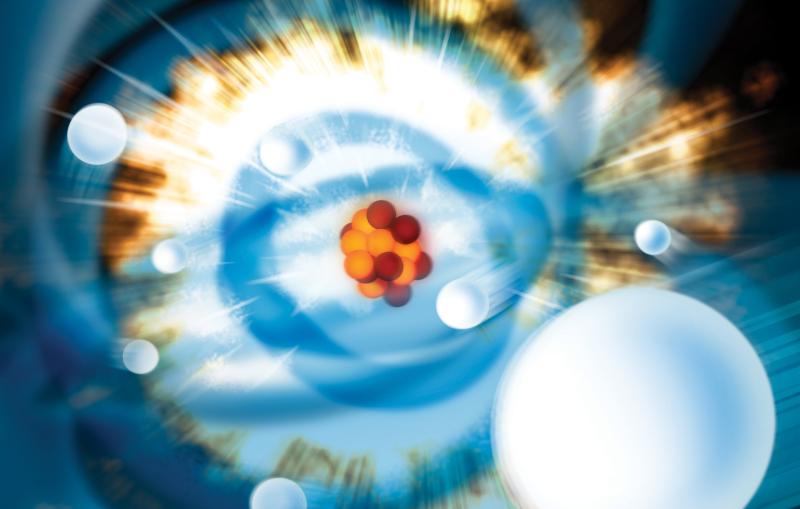
This illustration shows how the first experiment at SLAC's Linac Coherent Light Source X-ray laser stripped away electrons from neon atoms. (SLAC National Accelerator Laboratory)
Multimedia

After a major upgrade, SLAC's X-ray free-electron laser is 10,000 times brighter and thousands of times faster. Now, researchers are using LCLS to observe...

Detail of the TMO hutch at SLAC's X-ray laser
News Brief

X-rays unveil new molecular structure details that will help researchers design novel drug therapies to address antibiotic resistant bacteria.

Image of spherical bacteria
Multimedia

His visit highlighted the breadth of our world-class research and the people and collaborations that make it possible. A key theme of the day...

U.S. Deputy Secretary of Energy Danly watches a simulation of dark matter.
Multimedia

Researchers used LCLS to capture the ultrafast motion of electrons inside molecules – at scales never before possible. 

Complex scientific machinery with metal components
Feature

They used SLAC’s ultrafast X-ray laser to follow the impact of a single electron moving within a molecule during an entire chemical reaction.

An illustration of X-rays scattering off the valence electrons surrounding ammonia molecules and getting captured on a detector.
Feature

The technique could improve how scientists study materials and drive advancements in high-performance technologies, such as next-generation computer chips.

poincare beams
Feature

With a suite of reimagined instruments, researchers take up scientific inquiries that were out of reach just one year ago. 

Large metallic machine in a lab, featuring valves, circular bolts, and digital displays with surrounding wires and tubing.
Multimedia

Researchers used the upgraded LCLS to better understand what makes Xanthone – a powerful photocatalyst used in cancer therapies –  so efficient.  

close up of instrumentation in the TMO hutch
Feature

Ultrafast electrons at SLAC’s LCLS facility resolved the structural changes in a light-activated molecule to determine which simulations work best. 

Graphic representation of several molecules floating through space, circle of papers representing scientific results
Multimedia

Now 10,000 times brighter and thousands of times faster, LCLS sheds light on the formation of free radicals in nature. 

a closeup of the target chamber of the RIXS experimental hutch
Feature

Shweta Saraf and her team work to ensure the LCLS beamline runs without interruption. 

A woman stands next to a large blue server rack filled with electronic control units, wiring, and monitoring equipment. She is smiling at the camera while using a stylus to interact with a touchscreen interface on one of the devices.
Feature

One-quintillionth of a second lasing breakthrough could lead to next-generation X-ray technologies, improving imaging in medical, material, and quantum science.

A purple blob with black streaks and a yellow center.