





SLAC topics

Chemistry and catalysis RSS feed

Catalysts are the unsung heroes of chemistry, accelerating reactions used to make fertilizers, fuels and consumer products. Our work aims to make catalysts more efficient and reduce the use of fossil fuels.

Related link: Energy sciences
Browse tagged content below

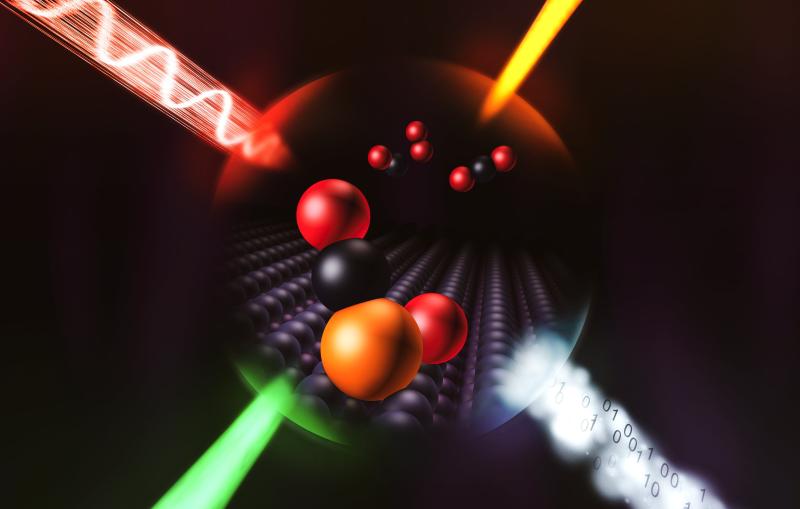
Depiction of four techniques used to study a single-atom catalyst.
Video
Public lecture presented by Siqi Li
stillframe image from public lecture: clocking electrons
Video
News Release

With up to a million X-ray flashes per second, 8,000 times more than its predecessor, it transforms the ability of scientists to explore atomic-scale...

LCLS-II first light
Feature

SLAC scientists showed that a carbon-metal compound with a perfectly placed nickel atom plays a key role in converting carbon dioxide into components for...

A multicolored diagram of a molecule.
Feature

Researchers demonstrate a way to remove the potent greenhouse gas from the exhaust of engines that burn natural gas.  

Illustration of bubbles of methane on surface of catalyst
Feature

The results should further our understanding of similar reactions with vital roles in chemistry, such as the production of vitamin D in our bodies.

UED transition state
News Release

After decades of effort, scientists have finally seen the process by which nature creates the oxygen we breathe using SLAC’s X-ray laser.

Photosystem II
news collection

Two of the most urgent challenges of our time – clean energy and sustainability – require investigation at the atomic level.

Aerial image of workers installing solar panels on a home.
Feature

Two GEM Fellows reflect on their summer internships at SLAC and share their thoughts on representation and mentorship.

Nate Keyes and Zariq George
Feature

Encapsulating precious-metal catalysts in a web-like alumina framework could reduce the amount needed in catalytic converters – and our dependency on these scarce metals.

A web of red material encapsulates blue polyhedrons.
Illustration

Studies of atomic-level processes that drain battery life and efficiency help improve battery performance. 

Studies of atomic-level processes that drain battery life and efficiency help improve battery performance.
Illustration
When light drives electron transfer in a molecular complex, the surrounding solvent molecules also rapidly move.
Illustration

Identifying each tiny chemical step in photosynthesis could aid the development of renewable energy technology.

Identifying each tiny chemical step in photosynthesis could aid the development of renewable energy technology.