A ‘COMPASS’ for turning federally-funded inventions into economic opportunities
A new program led by SLAC and Sandia national laboratories connects investors and entrepreneurs with Department of Energy scientists to launch startups in key technology areas.
By Ula Chrobak
Key takeaways:
- Department of Energy laboratories are committed to moving new technologies into the market to benefit the economy.
- COMPASS, a new program funded by DOE’s Office of Technology Commercialization (OTC) and led by SLAC and Sandia is collaborating with investors, entrepreneurs and a coalition of national labs to bridge the gap from invention to commercialization of national lab-developed technologies.
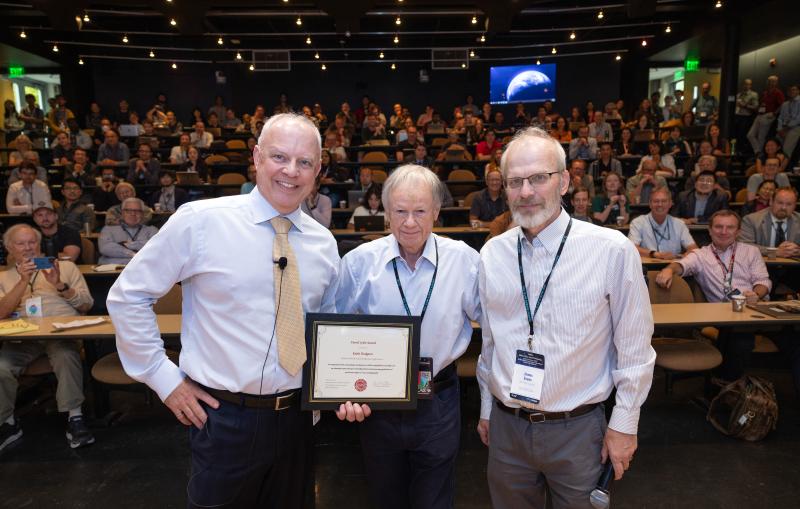
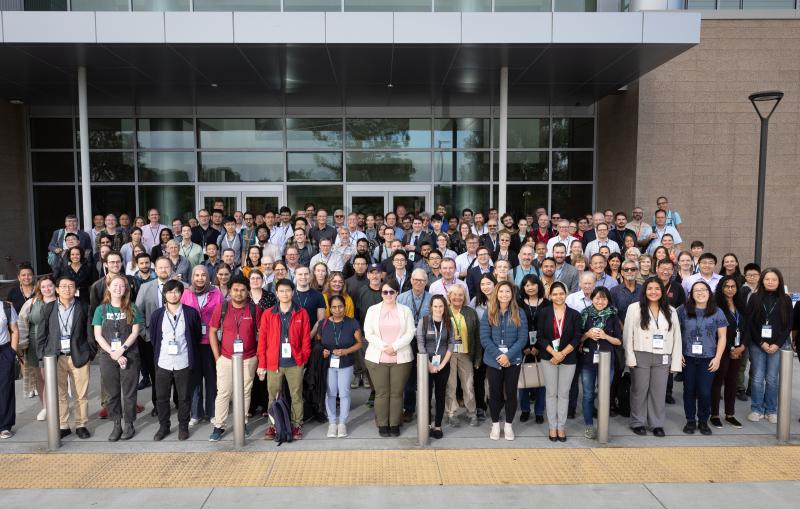
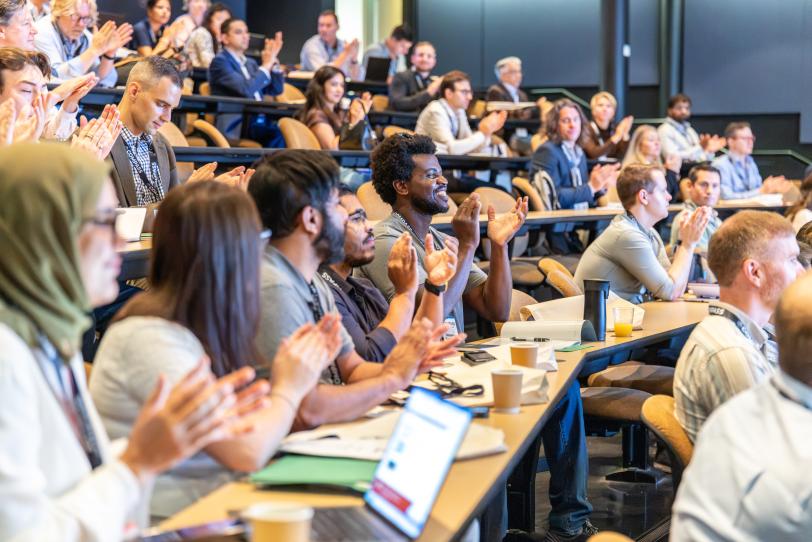
A COMPASS event in July brought together researchers, investors and founders at SLAC in the heart of Silicon Valley to identify promising technologies to pursue.
While a new technology developed in the Department of Energy’s national laboratories might be impressive from a technical standpoint, that alone doesn’t lead to wider adoption and benefits to the American economy. The transition of great discoveries that make lives better – the next smartphone, MRI, or the World Wide Web – requires the right investors at the right moment, a founder to build a business around the product, and a market ready for that product. Lining those pieces up is hard.
That’s where a new program called COMPASS, funded by DOE’s Office of Technology Commercialization and led by SLAC and Sandia national laboratories in partnership with several other national labs, comes in. The team at COMPASS — short for Commercialization Pathways for Accelerating Scientific Solutions — collaborates with investors to dial into the areas they are interested in, then uses that information to identify promising opportunities from national laboratories to launch startups. The approach aims to match national lab inventions to needs in AI and autonomous systems, advanced sensing, advanced manufacturing, energy technologies, and more.
For early-stage technologies with the potential to benefit the economy, new companies are one way to make significant impact in terms of returns on research investment.
“COMPASS brings a proven commercialization paradigm, one that has successfully launched countless startups in the private sector, into the environment of the national labs,” said Despina Milathianaki, director of technology transfer and strategic partnerships at SLAC. “We have an exciting opportunity to build and scale a launchpad for startups from the impressive innovation portfolio of the national labs.”
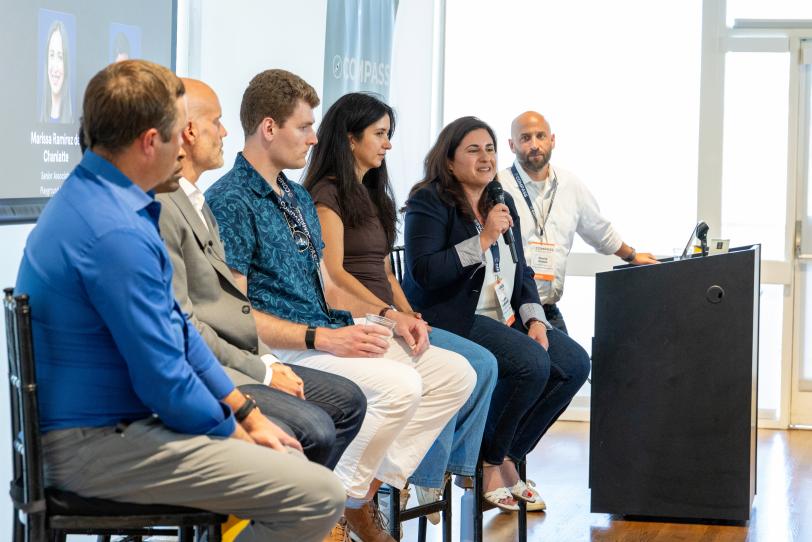
COMPASS aims to boost the success rate of finding science solutions for today’s challenges in three ways. First, COMPASS focuses on the needs of industries and consumers, taking a market-first approach that matches needs with national lab technologies.
Second, to head the startups, COMPASS recruits seasoned founders with success in how to hire talented employees, scale prototypes into products, and grow the customer base.
Finally, the program engages a network of venture firms that shapes early-stage companies to attract investment when the startups are ready to take flight.
COMPASS is co-led by SLAC’s Alex Rousina-Webb and Mary Monson, Sandia’s senior manager of technology and economic development, with input from DOE leadership and labs. In addition to SLAC and Sandia, COMPASS members include the Lawrence Berkeley, Los Alamos, Brookhaven, and Savannah River national laboratories, as well as the National Laboratory of the Rockies and the Kansas City National Security Campus. The program is partnering with two entities experienced in working to bring advanced technologies to the marketplace, SRI International and Roadrunner Venture Studios.
This July COMPASS brought investors, entrepreneurs and researchers together at SLAC to further collaborations – and set the stage for launching successful startups.
We spoke with Rousina-Webb at SLAC National Accelerator Laboratory and David Kistin, based at Sandia National Laboratories, to learn more about how COMPASS will fuel greater adoption of technology innovations.
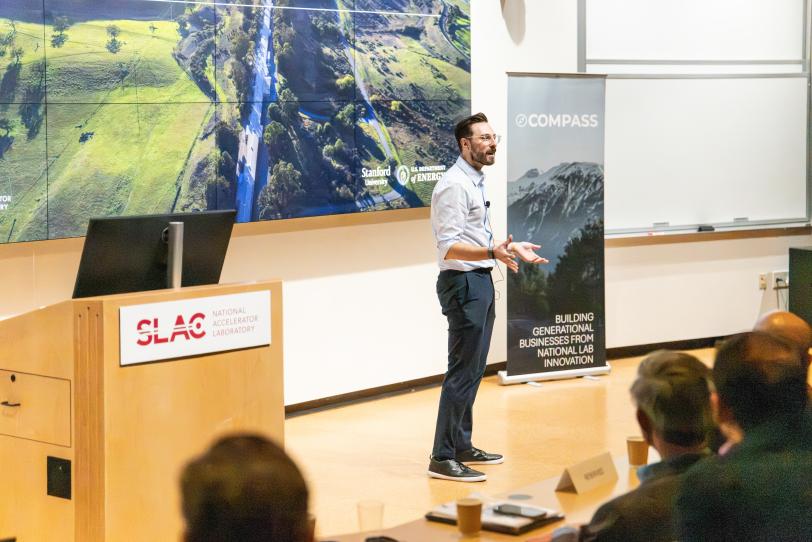
Why did DOE national laboratories come together to start COMPASS?
Rousina-Webb: Too many breakthrough technologies developed in the national labs fail to reach the market because the bridge from invention to capital has not been built. We think a more curated approach can help the most impactful technologies leave the labs and reach the markets that need them.
What makes COMPASS different from other tech transfer programs?
Rousina-Webb: The path from a strong invention to a venture-backed company often depends on having the right investors and operators in the conversation early.
We select for technologies that can scale in a way that’s attractive to venture capital, build compelling teams around them, and conduct a level of due diligence not typically seen for these kinds of opportunities.
How does COMPASS connect technologies to investors and company founders?
Kistin: We spend a lot of time talking to individual investors about what technology areas they care about. We bring all that information into the national labs’ tech transfer offices, who do an internal scan to find inventions and intellectual property that might fit the bill.
We worked with these offices to select about 30 technologies, which go up onto a platform for the investors to weigh in on. Next, we hosted our in-person event, Waypoints, in July to bring together the investors, inventors, and experienced operators who could help co-lead these ventures.
What is the key to getting all these people – labs, inventors, investors and entrepreneurs — working together?
Rousina-Webb: If you want to work with the investment community, you have to speak their language. The technology transfer offices of the labs act like scouts for investment opportunities, by asking investors their opinion about what is in their lab’s portfolio. For the researchers who invented these technologies, there are a variety of options in terms of how they want to be involved, from being loosely involved to being an advisor or a co-founder.
What types of technologies does COMPASS focus on?
Rousina-Webb: Labs across the COMPASS coalition talk to investors about what are the most urgent market opportunities, then triangulate that with what the labs are developing. The key areas that we boiled it down to are AI and autonomy, advanced sensing, advanced manufacturing and power generation.
What are some examples of technologies that COMPASS is working to launch startups around?
Rousina-Webb: One is a technology out of Sandia where they've developed a new way to manufacture extremely strong carbon fibers at almost half the cost of current manufacturing techniques.
One more that I can highlight is a technology out of SLAC. The team here is developing a new way to do semiconductor manufacturing. Whereas current lithography machines, used to print nano-scale features into microchips, can cost up to half a billion dollars, our researchers believe they can build a version of the machine for a small fraction of that cost.
Other technologies being developed at SLAC include optical interconnects that replace the heat-leaking copper wiring in today's quantum computers, a water-based zinc battery chemistry built for safety and long cycle life, and a wireless system that delivers near-GPS timing and positioning through walls, steel and concrete.
What are COMPASS’s long-term goals?
Rousina-Webb: We hope to spin out six successful companies based on DOE lab technologies over the next three years. We want to be highly selective about the technologies we take on and the resources we put behind them.
In the long term, we envision this going from the pilot we have today, expanding across to all the DOE labs, and then increasing in size from there. We'd really like to put a stake in the ground, show the model works and then use that as traction to go from there.
What does COMPASS hope will come out of the event in July?
Kistin: Based on the input from the July event, the 30 will be narrowed to six promising technologies, and we will work with partners to develop a commercialization roadmap for each.
We want to see people do big things as a result of this. When we see more startups based on national lab inventions launch and take off, we’ll know we’ve reached our goal.
How can investors and founders get involved with COMPASS?
Kistin: We welcome you to visit our website at www.buildwithcompass.org.
This work is supported by funding from the U.S. Department of Energy's Office of Technology Commercialization through the Technology Commercialization Fund (TCF). The goal of the TCF is to bridge the gap between research and commercial application.
For media inquiries, please contact media@slac.stanford.edu. For other questions or comments, contact SLAC Strategic Communications & External Affairs at communications@slac.stanford.edu.
About SLAC
SLAC National Accelerator Laboratory explores how the universe works at the biggest, smallest and fastest scales and invents powerful tools used by researchers around the globe. As world leaders in ultrafast science and bold explorers of the physics of the universe, we forge new ground in understanding our origins and building a healthier and more sustainable future. Our discovery and innovation help develop new materials and chemical processes and open unprecedented views of the cosmos and life’s most delicate machinery. Building on more than 60 years of visionary research, we help shape the future by advancing areas such as quantum technology, scientific computing and the development of next-generation accelerators.
SLAC is operated by Stanford University for the U.S. Department of Energy’s Office of Science. The Office of Science is the single largest supporter of basic research in the physical sciences in the United States and is working to address some of the most pressing challenges of our time.
Related stories