SLAC Topics

Rubin Observatory/LSSTCam RSS feed

The NSF-DOE Vera C. Rubin Observatory and the SLAC-built LSST Camera image the visible southern sky over and over for a decade, creating a vast archive of data that will advance our knowledge of dark energy and dark matter.

Related Link: 
LSST Camera: World’s largest camera for astrophysics

Browse tagged content

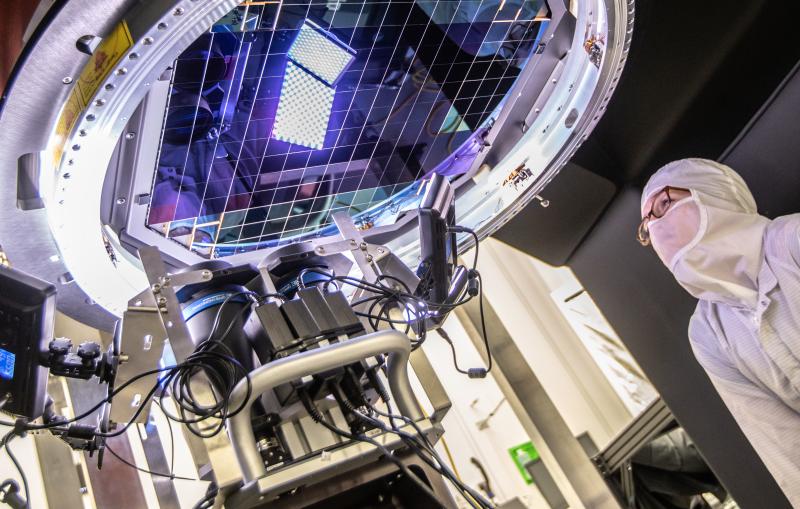
Vera C. Rubin Observatory LSST Camera Focal Plane Build 158
Video
Public Lecture presented by Travis Lange
Stillframe public lecture presented by Travis Lange
Video
Past Event
The world’s biggest digital camera was built at SLAC, and shipped to the NSF-DOE Vera C. Rubin Observatory in northern Chile last year. This...
Public Lecture: Travis Lange
News Brief

New 3D, interactive visualization of planets and minor planets in our solar system lets you explore Rubin discoveries in real time.

The main viewing screen of Orbitviewer, a groundbreaking new web app developed by NSF–DOE Vera C. Rubin Observatory that brings the dynamic movement of objects in our solar system to life.
Multimedia

On Monday, scientists and engineers reacted to the first images from the NSF–DOE Vera C. Rubin Observatory, marking a historic milestone.

Scientists reacting to presentation
Feature

Two decades ago, Stanford and SLAC took a gamble on an unproven telescope design. Now it's on the verge of paying off.

NSF–DOE Vera C. Rubin Observatory
News Release

The state-of-the-art ‘big-data facility’ unveils its first images and video, bringing the night sky to life like never before.

This image combines 678 separate images taken by NSF–DOE Vera C. Rubin Observatory in just over seven hours of observing time. Combining many images in this way clearly reveals otherwise faint or invisible details, such as the clouds of gas and dust that comprise the Trifid nebula (top) and the Lagoon nebula, which are several thousand light-years away from Earth
Video

In about 10 hours of observations, NSF-DOE Vera C. Rubin Observatory discovered 2,104 never-before-seen asteroids in our solar system, including seven near-Earth asteroids (which...

A Swarm of New Asteroids video still frame
Video
Video

Made from over 1,100 images captured by NSF-DOE Vera C. Rubin Observatory, the video begins with a close-up of two galaxies then zooms out...

A small section of NSF–DOE Vera C. Rubin Observatory’s view of the Virgo Cluster, offering a vivid glimpse of the variety in the cosmos
Video
Photograph

This image captures a small section of NSF–DOE Vera C. Rubin Observatory’s view of the Virgo Cluster, offering a vivid glimpse of the variety...

A small section of NSF–DOE Vera C. Rubin Observatory’s view of the Virgo Cluster, offering a vivid glimpse of the variety in the cosmos
Photograph

This image of the Trifid nebula (top right) and the Lagoon nebula, combines 678 separate images taken by NSF-DOE Vera C. Rubin Observatory in...

This image combines 678 separate images taken by NSF–DOE Vera C. Rubin Observatory in just over seven hours of observing time. Combining many images in this way clearly reveals otherwise faint or invisible details, such as the clouds of gas and dust that comprise the Trifid nebula (top) and the Lagoon nebula, which are several thousand light-years away from Earth
Video

A view of Cerro Pachón at sunset in 2024 shows the Rubin Observatory with Gemini South and SOAR in the distance, ahead of Rubin’s...

Front Page Rubin Cerro Pachón
Video
Video

A drone circles the Rubin Observatory at sunset in 2024, just before it begins a 10-year survey of the southern sky.

Front Page Rubin Summit
Video