
Learn about our science, people, facilities and partners. Discover our history and vision for the future.
Who we are
We explore radically new ideas with an entrepreneurial mindset.
Get an overview of research at SLAC: X-ray and ultrafast science, particle and astrophysics, cosmology, particle accelerators, biology, energy and technology.
Revealing nature’s fastest processes with X-rays, lasers and electrons
Studying the particles and forces that knit the cosmos together
Building smaller, faster, more powerful accelerators for all
Understanding the machinery of life at its most basic level
Inventing new tools for science and society
Finding clean, sustainable solutions for the world’s energy challenges
SLAC science explained
Cut through the jargon while exploring our research.
Learn more about the places where science happens at SLAC: our major facilities, institutes and centers.
Linac Coherent Light Source
Stanford Synchrotron Radiation Lightsource
Facility for Advanced Accelerator Experimental Tests
Cryogenic Electron Microscopy
Stanford Institute for Materials & Energy Science
Kavli Institute for Particle Astrophysics & Cosmology
Stanford PULSE Institute
Center for Interface Science & Catalysis
NSF-DOE Vera C. Rubin Observatory LSST
SLAC & Stanford build the world’s largest digital camera for the Legacy Survey of Space and Time (LSST).
Find a career, partner with us or apply to use our tools and facilities.
Apply to become a user of our scientific research facilities and instruments.
Careers at SLAC
Join our united workforce.
Get the latest news about the lab, our science and discoveries. Explore SLAC events and learn how to participate.
This joint publication of SLAC and Fermilab is your view into the world of particle physics.
Reinventing the way we break down plastic waste
Thursday, March 26, 20267:00–8:00 p.m. PDT
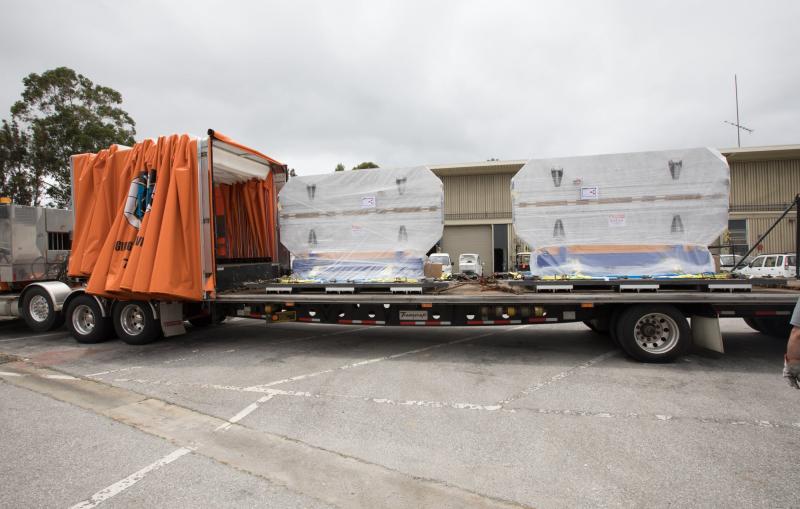
Construction has officially launched for the LZ next-generation dark matter experiment.
Advance your romance with science.
H. Pierre Noyes, the first director of SLAC's Theory Group, died in Stanford on Sept. 30, 2016, at age 92. Noyes, a theoretical physicist...
X-rays show details of an insect virus’s crystalline cocoon with sub-nanometer resolution.
SLAC’s team of dark matter hunters recently gained a new member.
Why can a neutrino pass through solid objects?
Researchers, including from SIMES, say extracting uranium from seawater could help nuclear power play a larger role in a carbon-free energy future.
After losing its first match of the day to the defending champions, The Harker School’s team won 10 consecutive rounds to claim victory in...
Detectors long used to look at the cosmos are now part of X-ray experiments here on Earth.
A research collaboration designed a new assembly-line system that rapidly replaces exposed samples and allows the team to study reactions in real-time.
A new paper describes a way to fabricate glasses that can correct X-ray focusing problems at synchrotrons and X-ray lasers.
Paving the way for flexible electronics, engineers have developed a plastic electrode that stretches like rubber but carries electricity like wires.