Learn about our science, people, facilities and partners. Discover our history and vision for the future.
Who we are
We explore radically new ideas with an entrepreneurial mindset.
Get an overview of research at SLAC: X-ray and ultrafast science, particle and astrophysics, cosmology, particle accelerators, biology, energy and technology.
Revealing nature’s fastest processes with X-rays, lasers and electrons
Studying the particles and forces that knit the cosmos together
Building smaller, faster, more powerful accelerators for all
Understanding the machinery of life at its most basic level
Inventing new tools for science and society
Finding clean, sustainable solutions for the world’s energy challenges
SLAC science explained
Cut through the jargon while exploring our research.
Learn more about the places where science happens at SLAC: our major facilities, institutes and centers.
Linac Coherent Light Source
Stanford Synchrotron Radiation Lightsource
Facility for Advanced Accelerator Experimental Tests
Cryogenic Electron Microscopy
Stanford Institute for Materials & Energy Science
Kavli Institute for Particle Astrophysics & Cosmology
Stanford PULSE Institute
Center for Interface Science & Catalysis
NSF-DOE Vera C. Rubin Observatory LSST
SLAC & Stanford build the world’s largest digital camera for the Legacy Survey of Space and Time (LSST).
Find a career, partner with us or apply to use our tools and facilities.
Apply to become a user of our scientific research facilities and instruments.
Careers at SLAC
Join our united workforce.
Get the latest news about the lab, our science and discoveries. Explore SLAC events and learn how to participate.
This joint publication of SLAC and Fermilab is your view into the world of particle physics.
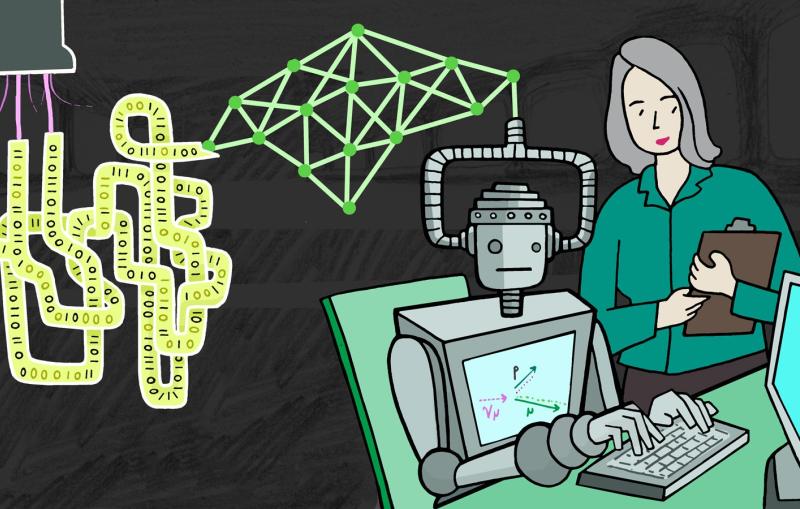
How scientists are building the AI-powered laboratory
Thursday, June 4, 2026
A new way to arrange the hard-working atoms in this part of an exhaust system could lower the cost of curbing pollution from automotive...
The next revolutionary X-ray laser in a class of its own, LCLS-II, is under construction at SLAC, with support from four other DOE national...
The studies could lead to a new understanding of how high-temperature superconductors operate.
The coating significantly extends the battery's life and reduces the problems that cause batteries to burst into flames.
Made with ‘Jenga chemistry,’ the discovery could help crack the mystery of how high-temperature superconductors work.
From middle schoolers to graduate students, more than 300 were introduced this year to real-world science, technology, engineering and math.
SUNCAT researchers discover a way to improve a key step in these conversions, and explore what it would take to turn the climate-changing gas...
Using SLAC’s X-ray synchrotron SSRL, Wang improves fundamental knowledge about how cells communicate, which could enable the development of more effective drugs.
SLAC/Stanford scientists and their colleagues find a new way to efficiently convert CO2 into the building block for sustainable liquid fuels.
Two projects will look for ways to link individual quantum devices into networks for quantum computing and ultrasensitive detectors.
Molecular movie-making is both an art and a science; the results let us watch how nature works on the smallest scales.
Early career award recognizes Mitrano’s work in ultrafast X-ray scattering.