SLAC National Accelerator Laboratory
    • About

      Learn about our science, people, facilities and partners. Discover our history and vision for the future.

    • OUR STORY
      • Mission, vision, values
      • History
    • LAB OVERVIEW
      • SLAC at a glance
      • Lab organization
      • Our partnerships
    • OUR PEOPLE
      • Leadership
      • Meet our teams
      • Faculty
    • VISIT SLAC
      • Public tours
      • Contact us
    • Resources
      • Images, videos & more
      • Brochures & fact sheets
    • Connect With Us
      • Facebook
      • Flickr
      • Instagram
      • LinkedIn
      • Twitter
      • YouTube
    video

    Who we are

    We explore radically new ideas with an entrepreneurial mindset.

    Science and User Support Building to the left and Arrillaga Science Center building to the right from above the Main Quad at SLAC's campus.
    • Research

      Get an overview of research at SLAC: X-ray and ultrafast science, particle and astrophysics, cosmology, particle accelerators, biology, energy and technology.

    • X-ray and Ultrafast science icon X-ray & ultrafast science

      Revealing nature’s fastest processes with X-rays, lasers and electrons

    • Physics of the universe science icon Physics of the universe

      Studying the particles and forces that knit the cosmos together

    • Advanced Accelerators science icon Advanced accelerators

      Building smaller, faster, more powerful accelerators for all

    • Science of life science icon Science of life

      Understanding the machinery of life at its most basic level

    • New technologies science icon New technologies

      Inventing new tools for science and society

    • Energy sciences science icon Energy sciences

      Breaking new ground in securing abundant, affordable and reliable energy.

    Spotlight

    SLAC science explained

    Cut through the jargon while exploring our research.

    SAGE campers have fun experimenting with a Van de Graff generator
    • Facilities & Centers

      Learn more about the places where science happens at SLAC: our major facilities, institutes and centers.

    • SCIENTIFIC FACILITIES
      • LCLS website

        Linac Coherent Light Source

      • SSRL website

        Stanford Synchrotron Radiation Lightsource

      • FACET-II website

        Facility for Advanced Accelerator Experimental Tests

      • CryoEM website

        Cryogenic Electron Microscopy

    • JOINT INSTITUTES & CENTERS
      • SIMES website

        Stanford Institute for Materials & Energy Science

      • KIPAC website

        Kavli Institute for Particle Astrophysics & Cosmology

      • PULSE website

        Stanford PULSE Institute

      • SUNCAT website

        Center for Interface Science & Catalysis

      • SLAC-Stanford Battery Center

    NSF-DOE Vera C. Rubin Observatory LSST

    SLAC & Stanford build the world’s largest digital camera for the Legacy Survey of Space and Time (LSST).

    A drone photo of Rubin Observatory while taking pictures during the First Look observing campaign
    • Work with Us

      Find a career, partner with us or apply to use our tools and facilities.

    • PARTNER WITH US
      • For industry partners
      • Research partnerships & tech transfer
      • Technology Innovation
    • CAREERS AT SLAC
      • Job openings
      • Internships
      • Life at SLAC
    • USE OUR FACILITIES

      Apply to become a user of our scientific research facilities and instruments.

    • COMING TO SLAC
    • BECOME A SUPPLIER

    Careers at SLAC

    Join our united workforce.

    SLAC staff in main quad
    • News & Events

      Get the latest news about the lab, our science and discoveries. Explore SLAC events and learn how to participate.

    • NEWS CENTER
      • News archive
      • Media resources
      • Images & videos
    • SLAC EVENTS
      • Public lectures
      • Scientific seminars
      • Community events
    • SYMMETRY MAGAZINE

      This joint publication of SLAC and Fermilab is your view into the world of particle physics.

    • EDUCATIONAL PROGRAMS
      • Educational tours
      • Resources for students & educators
    • Connect With Us
      • Facebook
      • Flickr
      • Instagram
      • LinkedIn
      • Twitter
      • YouTube
    Upcoming Public Lecture

    Blazing the path to a fusion future

    Thursday, October 8, 7:00 p.m.

    Public Lecture: Arianna Gleason
Filter search by
Staff portalStanford directoryComing to SLACResources for…
  1. Home
  2. …
Filter by research area
  • X-ray and ultrafast science (353)
  • Physics of the universe (285)
  • Energy sciences (102)
  • Science of life (88)
  • (-) New technologies (61)
  • Advanced accelerators (40)
Filter by Type
  • News (24)
  • Video (13)
  • Image (11)
  • Event (6)
  • resource (3)
  • Page (2)
  • Person (2)
Sort by
61 results
Display Grid Display List
Clear all
Feature

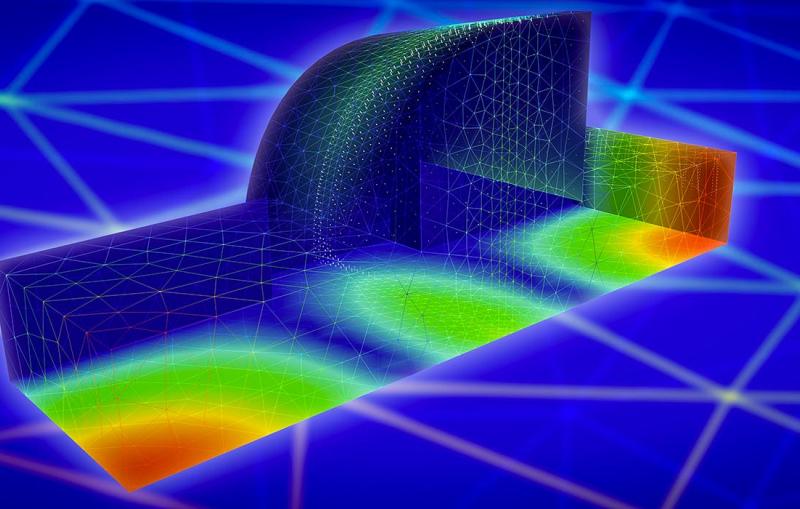
Vintage SLAC accelerator software spreads its wings

SLAC works with two small businesses to make its ACE3P software easier to use in supercomputer simulations for optimizing the shapes of accelerator structures.

August 29, 2022  ·  8 min read
A large, complex shape is seen against a blue background crisscrossed with white lines. The shape is dark blue and resembles a brick partially topped with a thick shark’s fin. Three areas of bright red, orange and green, are on the shape’s bottom edge.
Feature
VIA Stanford

Scientists seek to invent a safe, reliable, and cheap battery for electricity grids

The Aqueous Battery Consortium of Stanford, SLAC, and 13 others seeks to overcome the limitations of a battery using water as its electrolyte.

September 3, 2024
Feature

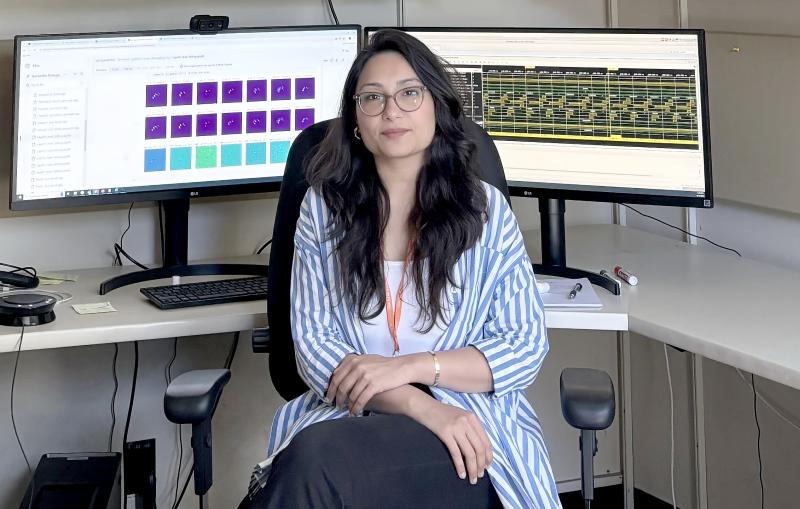
A day in the life of a machine learning expert

Digital design engineer Abhilasha Dave’s passion for connecting machine learning and hardware is helping SLAC solve big data challenges.

September 16, 2024  ·  5 min read
Photo of Abhilasha Dave in her office
SLAC Experts

Daniel Ratner

Machine Learning Department Head

Areas of research: New technologies; machine learning; deep learning; artificial intelligence; accelerator physics; physics and machine learning

Physicist Daniel Ratner.

Quantum explained: The fascinating world unlocking new scientific breakthroughs

Check out our quantum explainers to learn more about the funky quantum realm and how SLAC researchers are advancing this field.

illustration of two hands flipping coins
Video

Humans Navigating Complexity with AI Helpers

Public lecture presented by Dr. Wan-Lin Hu

February 26, 2026  ·  01:16:24  runtime
Video
Past Event
Public Lectures

Reinventing the way we break down plastic waste

From our kitchens to our clothes to the delivery of medicines, plastics play an indispensable role in our daily lives. But, the end-life of...
Date Thursday, March 26, 2026
7:00 p.m.  –  8:00 p.m.  PT
Location SLAC National Accelerator Laboratory, Kavli Auditorium
Public Lecture: Ozge Bozkurt
Past Event
Public Lectures

Humans Navigating Complexity with AI Helpers

Modern particle accelerator control rooms are like busy air traffic control centers, where skilled operators juggle hundreds of interconnected and time-sensitive tasks to generate...
Date Thursday, January 22, 2026
7:00 p.m.  –  8:00 p.m.  PT
Location SLAC National Accelerator Laboratory, Kavli Auditorium
Poster art for January 2026 public lecture
Research

New technologies

Modern technology creates new opportunities for society: Just think about how artificial intelligence has changed our cars and cell phone apps.

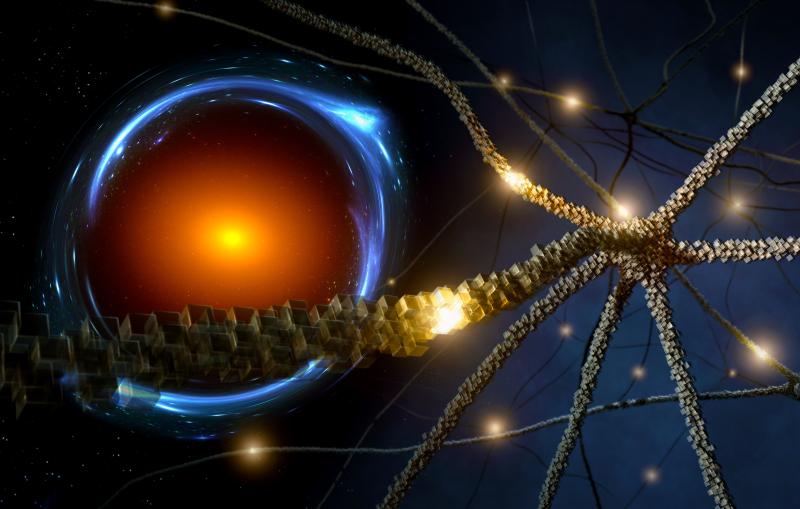
Neural Nets and Gravitational Lenses
Past Event
Public Lectures

How scientists are building the AI-powered laboratory

Register here to join us in-person, or watch online.  How do we find the next super material? How do we discover the next breakthrough...
Date Thursday, June 4, 2026
7:00 p.m.  –  8:00 p.m.  PT
Location SLAC National Accelerator Laboratory, Kavli Auditorium
Public Lecture Poster
News Brief
Argonne National Laboratory

Containing multitudes: SLAC scientist collaborates to create scalable qubits
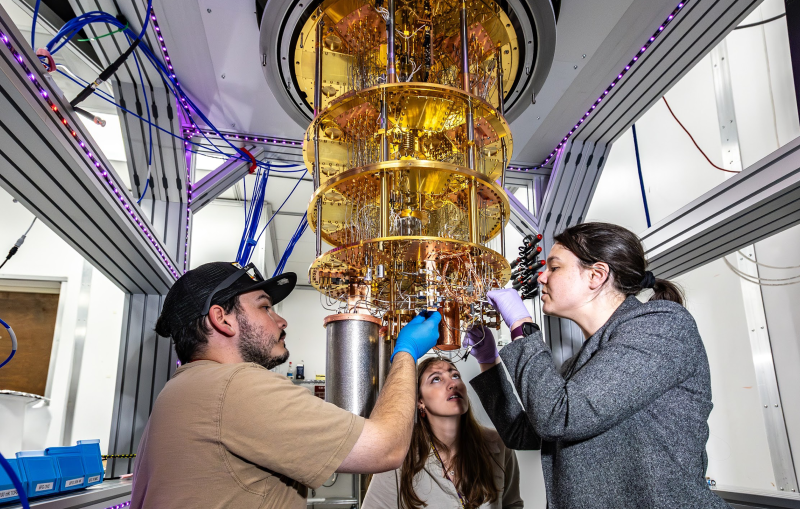
Driven by curiosity about nature, SLAC researcher Shannon Harvey develops quantum dots, a mass-producible type of qubit, as part of the Q-NEXT collaboration.

July 12, 2026
Researchers working with a dilution refrigerator, a piece of equipment that is made of gold-colored metal and resembles a chandelier.
Feature

A ‘COMPASS’ for turning federally-funded inventions into economic opportunities

A new program led by SLAC and Sandia national laboratories connects investors and entrepreneurs with Department of Energy scientists to launch startups in key...

July 28, 2026  ·  6 min read
Hand holding a compass made with blue light
  • Go to previous page
  • Page 1
  • Page 2
  • Page 3
  • Page 4
  • Currently on page 5
  • Page 6
  • Go to next page

SLAC National Accelerator Laboratory 
2575 Sand Hill Road  
Menlo Park, CA 94025-7015  
650.926.3300

  • Coming to SLAC
  • Connect with us
  • Contact us
  • Facebook
  • Flickr
  • Instagram
  • LinkedIn
  • Twitter
  • YouTube

Sign up for our email

Monthly newsletter for cutting-edge science, SLAC milestones and events.

Sign up

Bold People
Visionary Science
Real Impact

We explore how the universe works at the biggest, smallest and fastest scales and invent powerful tools used by scientists around the globe.

  • About
    • Our story
    • Our people
    • Lab overview
    • Visit SLAC
    • Resources
    • Connect with us
  • Research
    • X-ray & ultrafast science
    • Advanced accelerators
    • New technologies
    • Physics of the universe
    • Science of life
    • SLAC science explained
  • Facilities & centers
    • Scientific facilities
    • Joint institutes & centers
  • Work with us
    • Partner with us
    • Become a supplier
    • Use our facilities
    • Careers at SLAC
  • News & events
    • News center
    • Symmetry Magazine
    • Media resources
    • Events
    • Educational programs
    • Connect with us
  • Staff portal
  • Privacy policy
  • Accessibility
  • Vulnerability disclosure
  • A–Z index
  • Website feedback
Home
  • SLAC home
  • Maps & directions
  • Emergency info
  • Careers

© 2026 SLAC National Accelerator Laboratory is operated by Stanford University for the U.S. Department of Energy Office of Science.

Stanford University U.S. Department of Energy
Top Top
Back to top Back to top