Learn about our science, people, facilities and partners. Discover our history and vision for the future.
Who we are
We explore radically new ideas with an entrepreneurial mindset.
Get an overview of research at SLAC: X-ray and ultrafast science, particle and astrophysics, cosmology, particle accelerators, biology, energy and technology.
Revealing nature’s fastest processes with X-rays, lasers and electrons
Studying the particles and forces that knit the cosmos together
Building smaller, faster, more powerful accelerators for all
Understanding the machinery of life at its most basic level
Inventing new tools for science and society
Finding clean, sustainable solutions for the world’s energy challenges
SLAC science explained
Cut through the jargon while exploring our research.
Learn more about the places where science happens at SLAC: our major facilities, institutes and centers.
Linac Coherent Light Source
Stanford Synchrotron Radiation Lightsource
Facility for Advanced Accelerator Experimental Tests
Cryogenic Electron Microscopy
Stanford Institute for Materials & Energy Science
Kavli Institute for Particle Astrophysics & Cosmology
Stanford PULSE Institute
Center for Interface Science & Catalysis
NSF-DOE Vera C. Rubin Observatory LSST
SLAC & Stanford build the world’s largest digital camera for the Legacy Survey of Space and Time (LSST).
Find a career, partner with us or apply to use our tools and facilities.
Apply to become a user of our scientific research facilities and instruments.
Careers at SLAC
Join our united workforce.
Get the latest news about the lab, our science and discoveries. Explore SLAC events and learn how to participate.
This joint publication of SLAC and Fermilab is your view into the world of particle physics.
STEM Community Day 2026
Saturday, September 12
Scientists have determined in atomic detail how a potential drug molecule fits into and blocks a channel in cell membranes that Ebola and related “filoviruses” need to infect victims’ cells.
A new experiment at the South Pole picks up where BICEP2 left off.
A bump in the LHC data has physicists electrified…but what does it mean?
CERN physicist Edda Gschwendtner explains why we need big machines to study tiny particles.
Their results suggest a more efficient way to store energy from solar and wind power by converting it into renewable fuels.
Scientists have used X-rays to observe exactly how silver electrical contacts form during manufacturing of solar modules.
The center of our galaxy is a busy place. But it might be one of the best sites to hunt for dark matter.
Working together, researchers at SLAC and Stanford expand our knowledge of materials, molecules and the universe.
Upgrade will sharpen our view of nature’s atomic processes at work, aiding the development of a number of transformative technologies.
Method’s unprecedented combination of atomic resolution and extraordinary speed opens up new opportunities for ultrafast science.
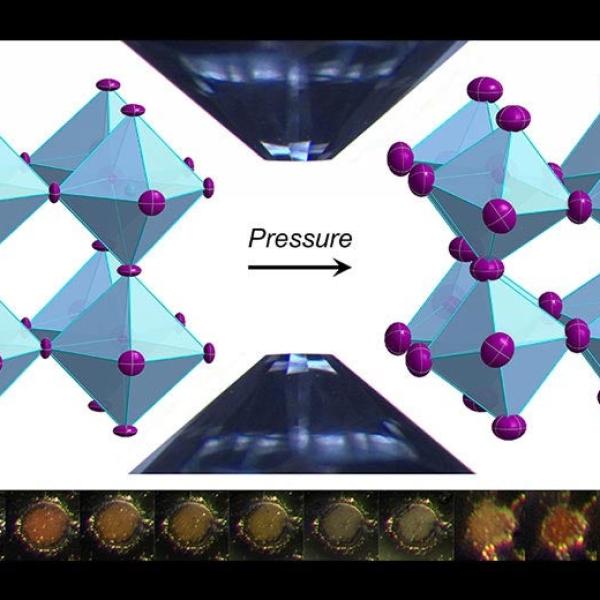
Adding pressure could improve the performance of solar cells made of perovskites, a promising photovoltaic material.
New insights into how bacteria interact with host cells could help fight off harmful microbes.