A view of Cerro Pachón at sunset in 2024 shows the Rubin Observatory with Gemini South and SOAR in the distance, ahead of Rubin’s 10-year survey of the southern sky.
This image of the Trifid nebula (top right) and the Lagoon nebula, combines 678 separate images taken by NSF-DOE Vera C. Rubin Observatory in just over seven hours of observing time.
In about 10 hours of observations, NSF-DOE Vera C. Rubin Observatory discovered 2,104 never-before-seen asteroids in our solar system, including seven near-Earth asteroids (which pose no danger).
Made from over 1,100 images captured by NSF-DOE Vera C. Rubin Observatory, the video begins with a close-up of two galaxies then zooms out to reveal about 10 million galaxies.
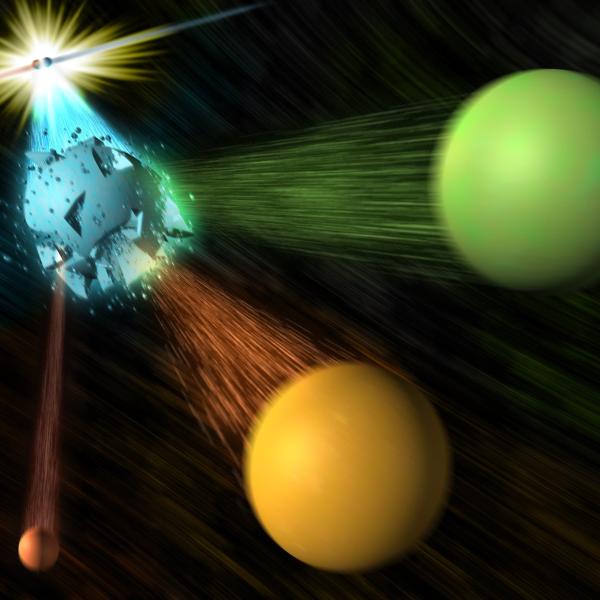
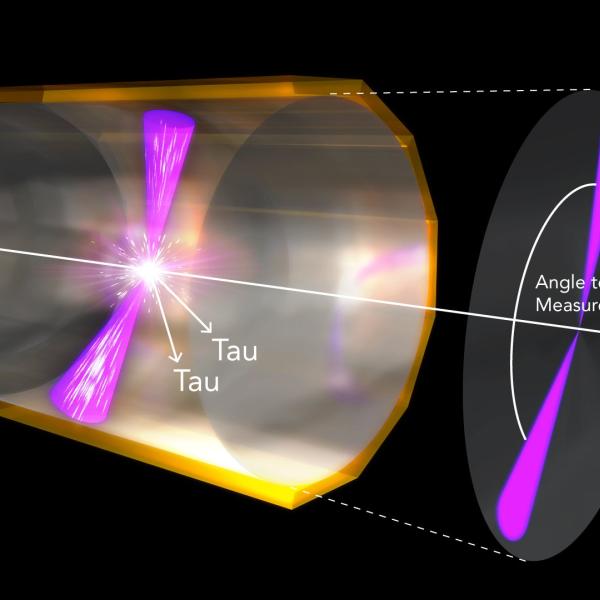
In this conceptual art, an electron and positron collide, resulting in a B meson (not shown) and an antimatter B-bar meson, which then decays into a D meson and a tau lepton as well as a smaller antineutrino.
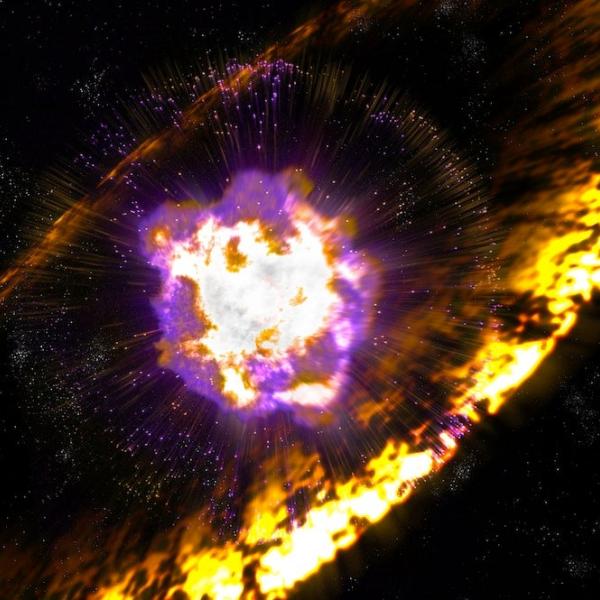
When stars explode, the supernovas send off shock waves like the one shown in this artist's rendition, which accelerate protons to cosmic-ray energies through a process known as Fermi acceleration.