In 1974, the independent discovery of the J/psi particle at SLAC and Brookhaven National Laboratory rocked the physics world, and entire textbooks had to be rewritten. Earlier this month, SLAC hosted a symposium to celebrate the milestone.
About 30 years ago an ‘ideas guy’ and a team builder joined forces to search for the invisible bulk of existence. In this Q&A, SLAC’s Thomas Shutt and Daniel Akerib discuss the challenges of their field and how future generations...
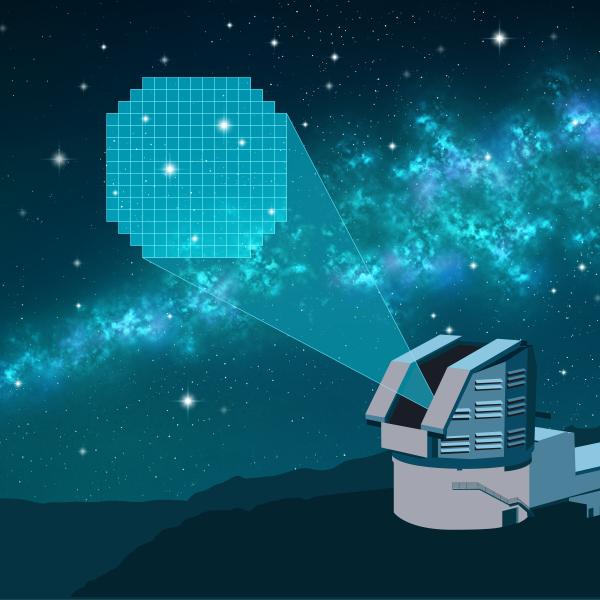
Rubin Observatory’s rapid scanning of the night sky will capture the largest sample of Type Ia supernovae yet, unlocking new insights into dark energy.
Presented by Justin Myles. As the universe expanded from the Big Bang, regions where the density of matter was higher than average grew into galaxies and clusters of galaxies.
Bernhard Mistlberger will receive the APS's 2023 Henry Primakoff Award for Early-Career Particle Physics for his work on precision Standard Model calculations.