SIMES Professor Honored for Superconductivity Research
Steven Kivelson, a member of SLAC’s Stanford Institute for Materials and Energy Sciences, has been named a winner of the 2012 John Bardeen Prize, in recognition of his theoretical research that has provided significant insights into the nature of “unconventional” superconductors.
By Mike Ross
Steven Kivelson, a member of SLAC’s Stanford Institute for Materials and Energy Sciences, has been named a winner of the 2012 John Bardeen Prize, in recognition of his theoretical research that has provided significant insights into the nature of “unconventional” superconductors.
The prize is named for the distinguished physicist John Bardeen (1923-91), who shared two Nobel Prizes in Physics: with Walter H. Brattain and William Shockley, in 1956, for their invention of the transistor at Bell Labs; and with Leon N. Cooper and Robert Schrieffer, in 1972, for their jointly developed theory of superconductivity – usually called the BCS theory.
Conventional superconductors are typically simple metals or alloys that lose all electrical resistance at temperatures below a very low critical temperature. In contrast, “unconventional” superconductors have complex atomic structures, may contain many different elements and can become superconducting at relatively high temperatures.
One goal of scientists trying to understand these exotic materials is to learn how to design a room-temperature superconductor, which could dramatically improve the energy efficiency of many industrial and electronic processes.
Kivelson’s award-winning research has two parts. The first relates to the two transformations that occur when a material becomes superconducting: electron pairing and the subsequent “condensation” into a superconducting state. For conventional superconductors, electron pairing is the most delicate aspect; once it is achieved, condensation – and superconductivity – occurs spontaneously.
For unconventional superconductors, however, Kivelson suggested that so-called “phase fluctuations” – local variations in the character of the incipient condensate – prevent condensation even though the electrons have already formed pairs. Experiments are under way to learn the nature of these fluctuations and how to predict, control and exploit them.
Second, Kivelson determined that unconventional superconductors’ complicated atomic arrangements made them prone to unusual electronically inhomogeneous states that don’t occur in ordinary metals or conventional superconductors. One example, now being studied widely, is a “striped” state having alternating bands of metallic and antiferromagnetic behaviors.
Created in 1991, the Bardeen prize is sponsored by the University of Illinois, Urbana-Champaign’s Department of Physics, where Bardeen was a professor from 1951 to 1975, and the Friends of Bardeen group. It is given every three years at the triennial International Conference on the Materials and Mechanisms of Superconductivity (M2S). Previous winners are listed here.
Kivelson shares the 2012 John Bardeen Prize with theoretical physicists Chandra M. Varma (University of California, Riverside) and James A. Sauls (Northwestern University), who were honored for their research on the electron-pairing symmetry, mechanism and multiple superconducting phases in “heavy fermion superconductors” – superconductors containing elements such as cerium or uranium that have partially filled f-orbitals. They will receive their awards on Aug. 1 in Washington, D.C.
Contact
For questions or comments, contact the SLAC Office of Communications at communications@slac.stanford.edu.
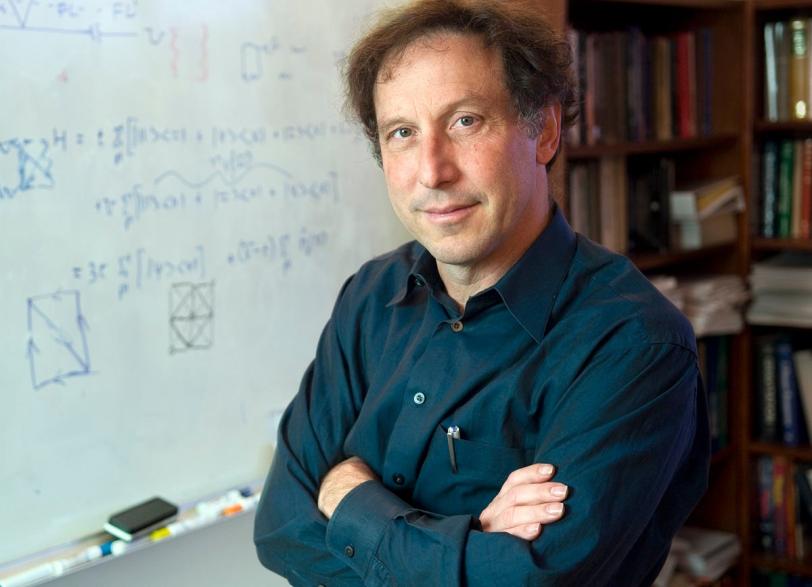
(Photo by L.A. Cicero)
About SLAC
SLAC National Accelerator Laboratory explores how the universe works at the biggest, smallest and fastest scales and invents powerful tools used by researchers around the globe. As world leaders in ultrafast science and bold explorers of the physics of the universe, we forge new ground in understanding our origins and building a healthier and more sustainable future. Our discovery and innovation help develop new materials and chemical processes and open unprecedented views of the cosmos and life’s most delicate machinery. Building on more than 60 years of visionary research, we help shape the future by advancing areas such as quantum technology, scientific computing and the development of next-generation accelerators.
SLAC is operated by Stanford University for the U.S. Department of Energy’s Office of Science. The Office of Science is the single largest supporter of basic research in the physical sciences in the United States and is working to address some of the most pressing challenges of our time.
Related stories