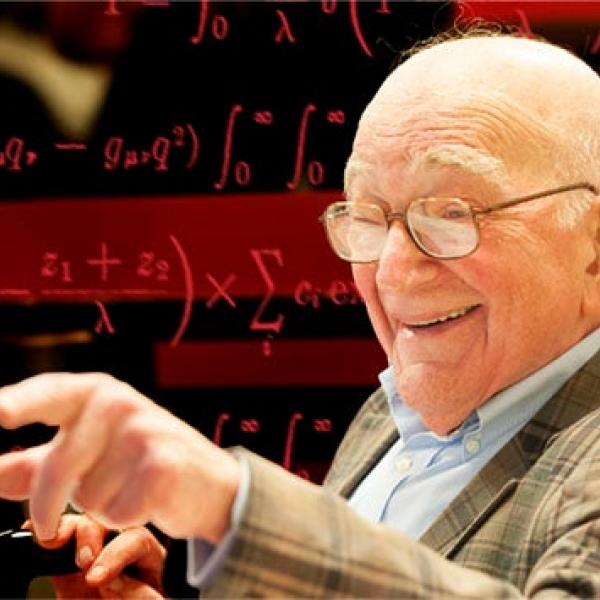
welcome back for the final session of this symposium so before I introduce the
next speaker I guess this is an appropriate time for me to just to say a few things that need to be said first of
all I'd like to thank very much the rest of the program committee so this the
program for this was set up by a committee of four people and I'd like to
especially recognize Tom Apple Quist Michael Chenoweth's and Joel Premack who are all actually
former slack theory well slack theory alumni who helped to create this program
so let's please give them a round of applause so the last session we'll go
outside of technical high energy physics and explore some of the other realms
that Sid was involved in I like the slide that Bob Jaffe showed that showed
how science somehow comes first and by going out of science you can achieve
good understanding and I think that also is some analogy for the way that Sid
dealt with all of his responsibilities in the world in administration in advising the government advising the
military etc it's not always so easy to play those roles famously Sid had on his
desk a little sign that said there is only so much stupidity that one man can
prevent but that actually is a segue
into a piece of poetry that when I read it I said this is immediately associated
with SID this is William Butler Yeats epitaph for Jonathan Swift and I think
the analogy is very strong the poem ends imitate him if you dare world besotted
traveler he served human liberty so thank you I now introduce the next
speaker this is Raymond John lows he's a professor at UC Berkeley of geophysics he's one of the experts on
matter at extremely high pressure created with diamond anvil cells and how that affects the structure of the earth
he's also a longtime jason and his work with sid on the military advising and
nuclear weapons policy for a long time and he's going to discuss that aspect of
SIDS profile thank you very much in fact the title that was assigned me
physics of nuclear weapons you'll see is not exactly appropriate so i will modify that in a few moments as you now sid was
an advisor to presidents of the united states and elsewhere he was close friend
with a number of important and influential people and you'll hear about the relationship with soccer off in the next talk but this all goes back to p
f-- Panofsky we've talked about sid as a mentor but in fact sid has it had his
own mentors i think someone described briefly the relationship with vicki vice cop but clearly p f-- was both colleague
and mentor at the same time p f-- had the experience of the manhattan project
and as a result was plugged into the advisory system well before sid wasn't
actually helped sid enter into government advising I think Sid also based on what he told me and others had
a huge amount of regard for p f-- intellectually but also I'll say morally ethically for example were all aware
that p f-- left my own campus University of California because of the loyalty oath issues in nineteen fifty and that
was quite important to sit to be thinking about the ethical context of our work so in fact what I'm going to
talk about today is physics based policy
for nuclear weapons in some sense I don't think Sid was all that interested in the physics of nuclear weapons per se
except to the degree that the scientific approach could help inform policy and
broader societal issues and I'm going to touch on three topics that are listed here hopefully I can do this quickly
enough to get us through the talk so let's start right away with the first one which is sock pile
stewardship I'll explain what that means in a moment and the nuclear explosion ban and as Michael already mentioned Sid
was involved with the Jason group academic independent advisors to the government in any and all areas but
especially in national defense and security areas and Sid was quite involved really as a founding father he
taught it talked about a phone call he got from my colleague Charlie towns well
well before I was at Berkeley in 1960 Sid didn't know Charlie at the time but knew him by reputation an enormous
regard for Charlie and he therefore took the call and answered to the request
that he participate in a first experiment at establishing a new
generation of independent technical experts post Manhattan Project who could help advise the US government at the
time Sid was already getting drawn into for example pea counts the or piece act
the president's scientific advisory committee another comment I want to make
sure I articulated another point is this is embodied in this quote from Sid where
the focus in any of these efforts in the policy oriented arena just as in science
was to think about the people and especially bringing in a new generation
so right from the start he was thinking about himself as being mentored but also
how one would mentor new people to come into the scientific advising enterprise
arguably the most important study or set of studies that Sid led in the JSON
group was some thirty thirty four years later which were studies that were
involved with so-called science-based stockpile stewardship so this is stewardship in quotes of the US nuclear
weapons stockpile that's really the point and the objective was to provide a technical basis for the United States
adopting the comprehensive nuclear-test-ban treaty well at the time the hope was for ratification of course
and that has not happened yet so Sid shared these two studies and others were the first in making this case while
really first I should say in addressing whether we the United States could afford to stop nuclear explosion testing
which really especially for us experimentalists amounts to can we afford to stop exploring the boundary of
nuclear weapons physics have we reached enough in terms of the weapons and if
you look at the CTBT the comprehensive nuclear-test-ban treaty article one really is quite striking in what it says
on not to carry out any nuclear weapons tests explosions or any other nuclear
explosion whatsoever that's reiterated so that was really the technical challenge that sid was trying to address
now fast-forward a little bit and I've been involved in some of these efforts
and in reviewing how well they're doing stockpile stewardship was stood up as a program for the United States in the mid
1990s so now 20 plus years later we can look back retrospectively and ask how
successful has it been are we somehow undermining our own defence we the
United States and this is something that has to be addressed very broadly for a wide range of communities military
political and others right and left part of the political spectrum hawks and doves we really have to step back and
ask technically are we somehow undermining our capabilities and what I will say is that in retrospect we can
point to every year since the mid 1990s are you the u.s. nuclear weapons arsenal
the stockpile is assessed for its capabilities and in fact the
capabilities of the whole complex of the scientists of the production and so on and so far every year it's passed muster
so to speak it's kind of an interesting exercise because it involves technical experts from the laboratories but also
the military who are the in a sense the customers the people who count on this capability and there are independent
outsiders who help to vet that system life extension programs refers to
sometimes a word modernization is use that is when weapons that are
in the arsenal for a certain amount of time typically decades rather than years are refurbished in one way or another
and there have been successful refurbishment programs for any of who are interested I can go into more detail
and elaborate a lot of a lot of interest in the details and what do we really
mean by this I will say that from my point of view the term modernization is really not appropriate but we can talk
about that separately technical capabilities for making parts of the nuclear component components and as I
said maintaining some core capabilities so I want to say at the outset and I think I'm just about channeling Sid
drell in saying this regardless of the size of the Arsenal or even hypothetically if we had no arsenal
hypothetically if we had no nuclear arsenal even more so we need this expertise the expertise in the
laboratories is what informs arms control inspections around the world the
intelligence community being able to assess what a terrorist can do or government so I want to decouple you
know what one's views are about nuclear war nuclear deterrents hugely important
and admittedly very emotional topics and as they should be on the one hand versus
some of the technical capabilities and I think Sid was quite passionate and making sure that we maintain the
technical capabilities and again I'm just exaggerating a tiny bit by saying hypothetically were we to have no
nuclear arsenal it's especially under those circumstances that we have to have these capabilities there have been a
number of reviews including by the National Academy of Sciences so remember SIDS reports were in the mid 1990s 94 95
within a few years there was a request to assess the stockpile stewardship
program and the ability of the United States to sign on to a comprehensive nuclear-test-ban treaty this was shortly
after the Senate failed to support ratification and then about 10 years
later there was a reassessment I'll come back in a moment as to why the two reports were needed so both reports had
the objective of assessing the United States ability to maintain this
capability so that our signing on to a treaty was not in some sense at the
Spence of making a bunch of other decisions about deterrence and defense and other issues that quite frankly are
technical in content to some degree but ultimately our political decisions are
dependent on how we vote and who we vote for also for such a treaty and nuclear
test-ban treaty the country is interested in knowing how well might we be able to monitor and hence verify such
a treaty and then we might want to ask or document from a technical point of view who cares why do we even bother to
sign on to a treaty doesn't really have any hope in containing proliferation of nuclear technologies and knowledge in
2000 so just a few years into the stockpile stewardship program and before the International monitoring system had
been stood up for monitoring globally nuclear explosion test so before all of
that capability was well tested and so on the initial the first study said yes the plan looks very good looks quite
adequate the international monitoring system looks like it's getting stood up with good plans the stockpile
stewardship in the first few years the annual assessments looked like they were working okay but not unreasonably the
question was asked nearly 10 years later really how are we doing now that most of
that monitoring capability has been stood up around the world is it actually working now the stockpile stewardship
has been in place for 15 years not just for three to four years is it still working and what I'll say this is now in
my words my summary actually the capabilities turned out to be better than had been anticipated on both counts
alright so I'll touch very briefly to give you an idea of the kind of approaches that are used for monitoring
this is an area that overlaps with my own field of geophysics for example seismology monitoring the acoustic
signals that get propagated through the earth and through the water and actually through the atmosphere when there's an
explosion the acoustic sensing around the world is actually quite good the
official international monitoring system has 50 primary stations and other 120 so
under 200 stations totally that give a backbone of reliability that well if you
look at the colors up here these are in seismic magnitudes what you want to translate to is basically we can monitor
a test global with this capability down to a few tens of ton kind of explosions which is
actually quite remarkable okay so this is actually more detailed 90% probability that three stations out of
not 50 are 170 but out of only 41 will catch these events and so on so this has
been independently documented now the three topics I chose I chose them partly
because then they're in the news now or prospectively in the near future and of course this has been in the news because
of the recent events last several years events in North Korea an explosion at
the North Korean nuclear test site lights up the seismic arrays all across
South Korea and not shown here but also all across China let alone all around
the world here's a listing of the various explosions that they've had from relatively small ones at a half a
kiloton up to the recent one which is enormous 250 kilotons a quarter of a
Megaton and I this is a rough estimate it may actually be a little bit low this is actually a huge explosion larger than
I'd been seen in many decades so there's seismic monitoring but in the modern world we have many other technologies available to us satellite
reconnaissance for example has been revolutionized the space used to be owned by nations large nations not
anymore digital globe and other commercial satellite capability allow one to get
imagery of the nuclear test site and actually to monitor what kind of preparations are being done and there
are groups nongovernmental organizations and even individuals who use a credit card and buy up such imagery but I won't
go into the details I just want to impress you on the sophistication that is brought about by these technologies
for instance by measuring the waveforms so at each seismic station there's a
three-dimensional measurement as a function of time of the ground displacements or the velocity or the acceleration by monitoring and
simulating those one can determine the nature of the displacements around the source
it wasn't an earthquake which involves sheer displacements was it an explosion was it an implosion so there's a tensor
description of the source region and one can invert these seismic signatures to determine this is one of those senses
that 2016 tests and sure enough with very high probability this happened to be an explosion very little earthquake
like character although there's a little bit of earthquake character this is a whole I was about to say cottage
industry kind of a minor industry that's involved with very real world
applications you may remember a few years ago there were some mind collapses in Utah and the seismologist can tell
the difference between a cavity imploding versus two walls coming together this way or that way and you
may even remember that at the time the owner of the mine said it was an earthquake no no no no it was two walls
coming together this way not that way they had Overmind and unfortunately the miners died and in a second and event
the inspectors that went down died in a second okay so you get the idea there's a lot of incentive for this kind of
capability but it's more than that because in fact there are let's see if
I've got it here thousands of stations most seismologists are studying earthquakes not explosions thousands of
stations this is the thousand stations of the Chinese earthquake administration I showed you some of the Korean ones and
so in fact when we say globally there's an international monitoring system that monitors down to tens of tons or 50 tons
or something like that in reality the capability of my academics and specialists this is actually another small event that was
found near the test site I think it's an earthquake but it's a debate in the academic literature but look at the size
here the academic researchers are arguing about half a ton this is a small truck bomb they're arguing about exactly
what kind of event it was I'm not saying it saw but we have incredible exquisite sensitivity that's the basic idea so I
didn't want to dwell on this too much but just to give you a little bit of flavor of the science that's involved here I'm now going to turn to a quite
different topic but really one of sids great passions which was the world without nuclear weapons and was labeled
a joint enterprise in a way that I think has been underappreciated this is a so-called Gang of Four very
famous editorial or commentary that was published in The Wall Street Journal in
2007 co-authored by George Shultz bill Perry Henry Kissinger and Sam Nunn well where
did this really come from it came very explicitly from the return of George Shultz to the Stanford campus after he
had served the Secretary of State and him said became close friends they
crossed paths before they knew each other a little bit but they became very close friends in between let's say the
early 90s and into the 2000s they talked about issues of nuclear weapons policy
nuclear weapons employment nuclear war very uncomfortable and disturbing topics
and as a result of this on the anniversary really of the Reykjavik meeting at which President Reagan and
Gorbachev contemplated apparently getting rid of the nuclear arsenals of the then Soviet Union in the United
States they decided to put out an editorial there was a meeting here and actually it was followed by a number of
editorials I just put a few subsets here toward nuclear free world in 2008
deterrence next steps in written to reducing nuclear risks well this is the Gang of Four and I want to make a point
that you all know in this room civil was not only very savvy but was savvy and his humility of course he was humble guy
but he knew that there was no value added to putting his name onto the gang
of fours he put it these are the four names that the people the general public will recognize the kissinger the
Schultz's the nuns and the parries we don't need a scientist to add on to that Arthur Ellis but guess who this is not
my opinion did the primary writing of these editorials okay guess ooh and is this kind of
recognizing this nice book by Phil Taubman the partnership if the subtitle is the five cold warriors and their
quest to ban the bomb there really were five people involved it really was a gang of five so the reason I say joint
enterprise is because there's a big focus on the vision the vision of the world free of nuclear weapons but in a
way that's misguided the vision is only part of what's involved here the joint enterprise actually involves not just a
vision of a world free of nuclear weapons but specific initiatives that would
want to move forward in this direction without the action specific actions to make this possible the vision will not
be possible and as they've put it we need a vision to motivate nations or peoples to move in this direction on the
one hand but on the other hand we need i'll call tactical specific actions that can be taken and these are all
consistent with our own american moral goals and heritage but also I'd say more
globally I want to impress on you how specific and how many of these steps
there were you're supposed to look at this and see very blurred I can't read this you're not supposed to be able to read it there are eight specific points
that were made in the very first editorial and then elaborated subsequently in conferences and others here's some of the key words increased
warning time reduce substantially the size eliminate short-range nuclear weapons initiating a bipartisan process
providing the highest possible standards control of uranium in addition halting production of fissile material resolve
regional confrontation very specific steps that have to be taken so when people talk about the vision of a world
free of nuclear weapons that sounds grandiose and wonderful it it is but really this is where the meat
is and we're all the hard workers and Sid knew this very well as Sid had been
involved with these issues for a number of years you may know that he co-authored a book with McGeorge Bundy
Admiral Crowe in the early 90s he worked over the years with ambassador Jim
goodbee so a number of discussions on the sizes of nuclear arsenals was needed
for deterrence how we can reduce those Arsenal's he also by the way worked closely with religious leaders Brian
hare for example at Harvard and evangelical leaders and you can ask well how successful with this and all I can
say is empirically well this is from a paper in the early 90s where they were projecting major reductions actually the
stark truth to treaty never came into existence but in fact you know the
Arsenal's kind of have gone down by a huge amount so there's been success there more than that this is a topic
very much in the news now of course it was a prog speech in of Obama's President Obama's in 2009 but just in
the last few months so whether it was the United Nations nuclear weapon ban treaty that has now
been signed out to buy 120 Nations they know about pre Peace Prize or just
earlier this week the Pope reiterating the well calling once again for a ban on
nuclear weapons this is very much in the news where is this how did I do not know this is where now we're in the embrace
by politics and I don't know where we're headed exactly I want to use this as a basis returning to the last topic this
is what keeps me up at night with nightmares and this is an area extremely
arcane and which Sid was actually quite a leader and there's some very important and I think under recognized work I'll
just remind you that we've had history of very close calls this is the hydrogen
bomb that we dropped on North Carolina in 1961 all except one of the switches
triggered to make it detonate at one switch is what prevented a huge disaster
very well described in Eric Schlosser's book Sid had over the years documented
the so-called broken Arrow's and accidents so quite a few in the 50s I
guess the good news of this table is in the first decade of record there were 19
the next decade 12 and the third decade only one this is the Damascus event down
here again if you reach flossers book or if you see the movie that's highlighted there and the Goldsboro event is the one
that I was just referring to a moment ago very very very scary stuff as a result of these and other events are Sid
was called to chair a committee for the House Armed Services Committee oh look
at that charlie towns once again shows up on this and the other participant was
Johnny Foster former director of the Lawrence Livermore Laboratory Johnny is
still active and I interviewed him for some of this background material so just
to say they studied a great length on what was going on with the safety of our own arsenal I don't want to go into all
of the details here this is actually a summary of summaries there were some significant issues concerns about the
safety of several new weapon systems this is 1990 including at artillery fired atomic projectiles
deployed by US forces modernization is neat needed and the past safety was not
viewed with enough urgency specifically safety and security so safety of the
weapon they had not exploded on intentionally in an accident but also a security that it can't be taken over by
someone who shouldn't have control of it and use control should all be treated together and so the u.s. term of art is
surety which was this combination of safety and security so the u.s.
developed policies and technologies some of them are somewhat sensitive but many
of them are remarkably openly discussed actually for example we talk about
accidents or possible accidents when weapons are in their normal environment that might be when they're in storage or
transportation under normal conditions but there are accidents under unusual circumstances and there are different
probabilities the safety switches and systems are supposed to prevent the
possibility of a nuclear detonation one part in 10 to the ninth for these normal environments and one in ten to six then
there's this very specific term called one-point safety that means that if there's a nearby explosion next to a
nuclear weapon that that explosion cannot trigger the nuclear detonation of
the warhead with a part in the 601 in a million chance something like there are
specific technologies that are implemented for this so let me contrast this with the news stories of the time
of 1990 okay so a lot of what was going on in this congressional committee was
of course very sensitive closely held but meanwhile the news media we're talking about defective nuclear shells I
can say based in Europe we're raising safety concerns they will repair
secretly shells were being brought back so here's the kind of nightmare scenario
that the that specialists have to think about what happens if these nuclear
munitions are in our zone of conventional conflict and now someone
I know lobs a grenade or drops a bomb a regular one nearby an atomic weapon is
it possible that that could trigger accidentally a nuclear detonation and think about it this is in the context of
the Fulda gap of the Soviet troops coming into Germany and so on and so what if there was a initiation of a
conventional war that then created a nuclear detonation now what's going to
happen who's at fault who knows who's responsible who caused the atomic
detonation and so on and so forth so in this process I just have a few more minutes I want to say he once again
built a very special relationship with a specialist at Sandia National Laboratory
Bob Purefoy who is a bit of a hero in Foster's book and in the movie they
wrote an article for the annual review of nuclear and particle science in 1994 it's entitled technical issues of a
nuclear test-ban but actually most of the article is about nuclear weapons safety okay
and pure for it was one of the pioneers in developing the technologies for
making the US nuclear weapons safer the point is that it's horrible enough to
ever think of using these in a military action but even that much more
inconceivable that they would accidentally detonate and cause havoc
and damage possibly in one of our urban areas all right this is the kinds of
nightmares that one might have an in fact Bob Purefoy was involved with
developing some of these technologies which you can read about on their web the Department of Defense websites using
so-called strong links very specialized signals to arm a weapon so-called weak
links that would disarm a weapon if it's challenged for example if it encounters high temperatures
say for instance associated with a fire this is supposed to actually disarm the weapon and make it impossible that would
actually detonate so these kinds of technologies have been developed and actually applied and so here I come to
my last slide which originally was blank because I didn't really know what I
could write here in good conscience but let me just summarize I have you imagine the Cold War scenario
u.s. army troops with nuclear munitions in based in Germany or also in Europe
with the possibility that there would be an onslaught of conventional weapons stance for example coming across the
border and the possibility of conventional explosions in a general
area where there are atomic munitions well we fixed the problem as far as we can tell in terms of the u.s. arsenal we
have not very much deployed abroad in any case but think about other parts of
the world and we're very uncomfortable about what other countries have done
what to protect their own nuclear weapons so this safety issue or surety
if you want it has a potential for a catastrophic event by which I mean an
accidental detonation it could be on one of our own military bases at home or hypothetically abroad it could be in
transportation as has almost happened a number of times in the past so that's what I mean by catastrophic event one
single nuclear explosion that could be devastating if it's in the wrong place at the wrong time nuclear crisis is code
language it's a euphemism for nuclear war that gets initiated by accident not
because of some mistake of a missile that's been launched and misidentified this is because a conventional munition
has exploded near an unsafe weapon and caused it to that Nate now neither side
knows who's the person who detonated a nuclear weapon okay and whose fault is it by the way if it's someone else's
conventional bomb that detonates my nuclear weapon who's at fault here and finally these are exceptionally
difficult topics to discuss no one wants to talk about how their systems might be unsafe and that's aside from some of the
technology some of the procedures quickly get kind of sensitive but I'll tell you that increasingly we we're not
alone number of countries are trying to begin to discuss this around the world because no matter how carefully we think we've
done these things we know that we haven't done the ultimate job I'll leave you with one perhaps bad analogy we know
that one of our high-risk high-tech systems was a space shuttle program and you may
know if you look into the literature that it was estimated by the managers that there was a one in a hundred
thousand chance that the Space Shuttle would have an accident and you know from the history right that it was a couple
of space shuttles in of the order of a hundred flights that went down they blew up so we know that we were off by orders
of magnitude in the safety estimates for that kind of a system and this I think
is really one of the things that kept Sid awake and concern was to think about these technologies for the future so
again I tried to touch on three topics very briefly to give you an illustration of sits passioned perhaps not so much
for the physics of nuclear weapons for the physics based policy guidance for nuclear weapons thank you very much very
[Applause]
uncomfortable subject to what extent did
your and SIDS expertise inform secretary Moniz and his discussions in regard to
the Iran controls well I'm sorry with regard with regard to the round so so the Iran negotiations
did get some input from a wide number of experts I'm I must say the system worked
remarkably well from what I saw I'll label myself as an outsider because I really want to give credit to the system
the secretary Moniz was able to and did very effectively tap on nuclear weapons
laboratories you're helping me make the point I tried to make earlier why even if you hate nuclear weapons do you want
to get rid of them what happened you don't want to get rid of that capability because actually they were absolutely
essential to making criteria presenting criteria and offering alternative
technologies as well as ways policies and ways to think about those technologies for deciding what's good
enough to be able to make a treaty Vera viable process for Iran what are the
kinds of procedures what are the technologies huge amount of support there was we're Outsiders like ourselves
but I do want to give a lot of credit for those working in government and directly in government including one of
our colleagues here at Stanford these days Jim timbi who retired from the State Department as a physics PhD from
this organization and then spending most of his essentially all of his career at the State Department I think there you
go this this is a question that let's ignore say who happens to be the
president of the United States this is a question really about the fact that your talk and all of the work that you and
said and others have done is based on a fundamental respect for science and how
do you feel about whether the country as a whole does still maintain that respect
yeah so that question bears on many issues from climate change and energy
policy the policy to to these kinds of very difficult issues and I I'm sorry
but you know this is this is an easy audience to ask that question of a course we're all passionate about making
sure that the facts as best established become the foundation for a discussion I will say as a scientist and I talked
with this it was Sid I mean we worked together for a few decades and talked about this many times I think Sid very
much sure at least my view is science is a starting point for the discussions most of the decisions that we're talking
about are ultimately political and we have to acknowledge that and respect that we have to have a little bit of
humility as scientists so I'm always viewed science and technology and engineering is kind of the starting
point for discussion you lay that foundation and then ultimately one has to acknowledge that the political
decision might not be what one had hoped for Sid have that experience certainly I did and I have found myself even
respecting politicians who will turn to me and say I hear what you said I understand it but here
why I'm going to vote differently you know as long as they can explain to me that they're doing something that's that's not irrational or something like
that so these are political and in some cases hugely emotional troubling issues
and in the end I don't think they are relegated just to science but we sure want to make sure that the science and
engineering behind the discussions is really really solid so it's very troubling these days when there are
hints that science is is really you know that doesn't matter whatsoever and it's
not just this administration this has happened many times I think actually in our country you can see hints of that
back to the revolution although I'd be
happy to be corrected by anyone with more historical knowledge yep so this is
actually somewhat related in last question so I always really appreciated that Sid worked on this I actually
talked to him about some of this a long while back but I guess I specifically want to talk about ask about part to you
you didn't really you know sort of you demurred from discussing where it's at but of that gang of five the I think the
four others are still alive how you know those specifically are they still pushing this issue in varying ways to
varying degrees bill Perry former Secretary of Defense William Perry who's
here at Stanford is first of all he wrote a biography basically that had
that features his view at the conclusion he's reached over his career that there
are good reasons for getting rid of nuclear weapons and that's a longer discussion but basically that the risks
outweigh the benefits however you see those he's quite active he's putting out YouTube material and so on and so forth
George Shultz is very engaged and supporting trying to maintain a discussion I'll just say this private I
was just I'm amazed you know that he at his age and with everything he's got on
his plate this is still in an area that he's very passionate about and very involved I've not been so engaged I've
only crossed paths with with Henry Kissinger a few times in two years and he is still part of the
discussion and then sam nunn I just should acknowledge you know it's still involved with this the nuclear threat
initiative of which Ernie Moniz is now the president and the mandate of that group is among other things to work
towards a world free of nuclear weapons so they've all been working in their own ways I'm sure this is a prejudiced view
but Sid Sid had a magical way of helping to coordinate a lot of those views and
talents of those individuals and channelling them into those op-ed pieces that were very special and also the
conference's associated with him thank
you I'm gonna set up the next speaker go ahead okay so the next speaker on the
program is actually the only speaker without a physics PhD but I'd like to very warmly welcome my Stanford
colleague David Holloway he's a professor of history and political science here at Stanford he's the author
of the book Stalin and the bomb which is the definitive history of the Soviet
nuclear program many other writings on the history of the Cold War and he's
very graciously agreed to come here and talk to us about this special
relationship between Sid drell and Andrei Sakharov
thank you thank you very much for that
introduction and thank you very much for the invitation to speak here I can't
tell you what a pleasure it is for historian and political science
scientists to be listed as speaker at a symposium on fundamental physics but
more seriously it's a great honor to be here to talk about Sid drell I was very
fortunate to work with him over a period of
two years mainly through SESAC the center for international security and arms control seduced to be called
beginning in the 80s and then over the last ten more years when he was active
at the Hoover Institution working with George Shultz on the project to create a
world free of nuclear weapons that Raymond spoke about we core of course
occasionally joked as in any interdisciplinary or multidisciplinary
community we have about the relative benefits of our own disciplines which I
have to say for a historian or political scientists to do battle with a physicist on that score is rather difficult but
Sid would acknowledge that I think he would quote Einstein to say yes the
physics is the easy part it's the politics that's difficult and he added
wrote in various times because then you're suffering with the devil so my
topic is Sid friendship with Andrei Sakharov whom Sid greatly admired and
more than once referred to as a saint sacrif was born in 1921 so he was five
years older than than Sid and he died in 1989 I'm not going to go through his
life but I want to point to some stages of his life because this has a bearing on the relationship that Sid and
Sakharov had Sakharov was drawn into
work on thermonuclear weapons by his mentor Igor Tom and from 1950 to 1968 he lived
at our Zama 16 now called Sarov the
Soviet equivalent of Los Alamos and he played a major role in the development of Soviet thermonuclear weapons
in 1968 he was removed from secret work
after he had written an essay called
reflections on progress peaceful coexistence and intellectual freedom
which was published in the West it was published in full in the New York Times and in fact I read somewhere that during
1968 18 million copies of the essay were distributed around the world and in the
opening paragraph of that essay sucker of states that his views the views he's
going to express in this essay are formed in the milieu of the scientific technical intelligentsia which is very
worried about the future of humankind and the concern of the scientific
intelligentsia he writes is all the stronger because what he called the
scientific method of directing politics economics art education and military
affairs had not yet become a reality and he then goes on to explain what does he
mean by the scientific method in this context his answer is we considered
scientific that method which is based on a profound study of facts theories views
presupposing unprejudiced and open discussion which is dispassionate in its
conclusions in other words what he was really pushing for at this stage was the
open and public discussion of serious issues facing the human race and facing
the Soviet Union and the two he discusses in that essay are the danger
of nuclear war and also environmental degradation and he in the essay he
expresses ideas he had been coming to for some period but the immediate
trigger for his writing the essay was that he
I sought permission from a member of the politburo Mikhail Suslov who was a very conservative ideologists
but Seraph had met him and he wrote him a letter on the issue of anti-ballistic
missile systems he asked that the letter be shown to Brezhnev which it was but he
also asked for permission to publish an article about anti-ballistic missile systems and the argument he made and he
said it was shared by other senior scientists at Alamos 16 was that
creating ABM defenses against master tanks is not realistic
while for individual missiles it is difficult but possible but still Slav
refused and permissions that know you can't write an article about that publish an article on that and I think
that was to Sakharov really ran
absolutely counter to his idea that these problems needed to be widely
discussed I don't think he meant you know necessarily by everyone but there was specialist community there were
people who knew things and the policy would be best formulated if it was open
to public discussion with proper restrictions for secrecy and so on he's
not proposing that everything would be open and I mentioned this episode
actually let me show the two men I'm talking about here which is Stanford in
1989 I mentioned this episode because it
shows that Sakharov like said as Raymond has very nicely explained was interested
not only in physics but in the application of science to policy
something that CID had been drawn into by Pete Panofsky beginning around 1960
and it was the publication of this essay which when you read it now seems hardly
revolutionary a radical the sucker of Cersei I mean that meant that he would
be excluded from secret work and it's only after that that he begins gradually
to move from a concern about a kind of science-based policy if you like to a
concern about human rights and soccer of ideas about human rights are encouraged
when he meets Elena Bonner in 1970 and the two of them marry in 1972 and in
1975 sacrif was awarded the Nobel Peace Prize for his work for human rights and
the title he gives is peace progress and human rights and if you compare that
title with the title of the 1968 essay you see that the new element here is
human rights and in his Nobel lecture which he wasn't allowed to go to to make
it with Elena Bonner who went to Oslo to to receive the prize he named over a
hundred political prisoners in the Soviet Union and he also made the general point that peace progress and
human rights were in dishonorably linked for progress to be beneficial and peace
secure human rights freedom of conscience freedom of assembly freedom of expression and so on had to be
protected so there was a kind of link between the rights of the individual and the capacity of the human race to cope
with the great challenges that had faced for example the danger of nuclear war or
environmental degradation which were the two he focused on in the 1968 essay so
that's I give that background because this is the context in which Sid and
Sakharov first meet sakura Finn the early 70s you know he had this great
prestige he was one of the few people who had been awarded the hero of socialist labor three times you know he
was people in the political leadership knew how important he had been to the
nuclear weapons program and he used his position to try to help weaker members
of society again against repression if they spoke out in their views are
criticized Soviet policy and he was
under a lot of pressure in the early 70s because the authorities were rounding up signatures from his colleagues in the
Academy of Sciences to condemn him for what he was doing not everyone signed but a great number
of people did and it was at this point that Sid and Sakharov met at a meeting
in the meeting took place in Moscow at a small conference on composite nucleons
nucleon structure and Sid recalled that what I considered a great compliment to
me he apparently knew enough about me through whomever to sit down next to me at the meeting and in his memoirs write
Sakharov writes of Sid as a young man already a very well-known physicist and
they exchanged notes at the meeting but Sakharov didn't speak any English or his
English was very poor and since Russian was even poorer so this communication was difficult they
could speak a little each of them a little German so that's how they talked
but but nevertheless they clearly struck up a rapport because Sakharov invited
Sid along with Viki Weisskopf to dinner at his apartment on Skyloft
Street with such Gulliver and Elena bono was there and Yelena Bonners daughter
Tonya Jankovic was there and my guess is that she was the one who made conversation possible at the dinner
table so they formed a bond and then they met
as Sid came obviously in Moscow for a
short time and then they met two years later in Tbilisi at an international
high energy meeting and Sakharov and
Yelena Bonner were there and so they spent a week together and I think sorry
that's sorry let me go back I had mistimed so this is a photograph
of Sakharov and Egor coach a toff in 1958 this is a point and it's actually
important in sacrif Slive when he was sees trying to get the Soviet Union to
stop atmospheric testing and actually had some some success for I mean it was
helped to create the moratorium on testing from 58th through to 1961 but
this is the photo from Tbilisi from Georgia in nineteen probably in 1976 and
it's even if the photograph is a bit blurry the jacket is clear enough that you know
who said who said and that's Yelena Bonner in in the middle so she'd
maintained a very steady correspondence after he came back with Sakura found
with Bonner the correspondence is in the Hoover archive and I went through the files and I was actually struck by how
much correspondence how consistent it was a lot of the correspondence after
this meeting so in the late 1970s had to do with the repression of human rights
in the Soviet Union how to make that known in the United States how to
generate support for scientists who were being repressed so for example CID
contact a number of people to get invitations to sacra have to come to American
universities to spend time I mean none of those were successful because the Soviet authorities took the view that
Seraph knew too much about Soviet nuclear weapons to be allowed to travel
the CID was also extremely helpful to Yelena Boehner's children I mentioned
already in Tanya Jankovic and her husband Ephrem and he did what he could
to keep Sakharov name and Sakharov splayed in the public mind helped to
arrange publication for sacrif statements and for his papers he
organized conferences on Sakharov he wrote letters to to Congress people in
Congress he wrote letters and mobilized his own scientific colleagues to keep
the plight not only of Sakharov burr of other scientists who were being excluded
from work or being repressed in different ways for their activities in defense of human rights often at that
time in defense of the Helsinki final act which the Soviet Union had signed
the Helsinki watch groups were set up in Moscow Yuri Orlov physicist was a key
figure in that and was sentenced to seven years in the camps for his activity in pushing for human rights in
to be observed now sit wasn't alone in this there were
other people there was an organization formed at Berkeley called SOS soccer of
our love Sharansky so I don't I'm talking about Syd and not about the
whole movement but I was impressed by the number of letters by the responses
to journalists or people who wanted to know what the situation was like in far
Sakura and there's a very touching letter from Sakharov tested in June of
1981 so by this time Sakharov is already exiled to Gorky is about come back to
that point dear Sydney I want to write to you this
time not an open letter but a most ordinary letter to thank you from the bottom of my heart you say that's Elena
Bonner and I feel all the time that in that infinitely distant world in which
our children have been mislaid and where they now live there are some very few people who have not forgotten them or us
and you are one of them and then I think
rather slyly Sakharov adds I sense that almost physically seeing you in my
mind's eye in your checked suit although perhaps you now dress differently so in
the late 70s said refused to to go to the Soviet Union and he wrote letters to
people from whom he had received invitations Bogoliubov was was one it's
a very diplomatic letter saying how much he missed and regretted not being able to go to the conference but in this case
given the way in which your er love had been treated he didn't feel he could do so and he wanted to believe that before
too long normal scientific relations would be reestablished now in 1982 state was
invited so in 1980 Andrei Sakharov was arrested in January for criticizing the
Soviet intervention in Afghanistan Soviet invasion of Afghanistan and he
was sent into exile in the town of Gorky now known as Nizhny Novgorod
which was closed to foreigners so it's a kind of internal exile Elena Bona was
not an issue eggs she could travel between Gorky and Moscow so in late 1982 CID was invited
by the Soviet authorities to go and have discussions with high-level government
officials and military people about arms controls this is a response to his arms control writings and he wrote that he
would go on one condition that he could have a meeting with Yelena Bonner while he was in Moscow and the
Soviet authorities accepted that and the American Embassy arranged a meeting and
at the meeting Syd gave to Elena Bonner some articles he had written some
congressional testimony he had given to be given to two Sakharov and these
statements from cid prompted Sakharov to
write one of his best-known writings was one of the most important papers on the
danger of thermonuclear war a letter an open letter to dr. Sydney drell which
was published in foreign affairs in in the summer of 1983 and the paper caused
a great stir because in particular because it intervened on a specific
policy issue in the US over whether or not the heavy MX ICBM should be deployed
and Sakharov came to the conclusion that since the Soviet Union had heavy ICBMs
it really wasn't going to be possible to achieve any reduction unless the u.s.
also deployed a similar system a system
whose deployment Sid had been opposed to and openly opposed to in one of the
lectures given to two Sakharov so Sid replied to Sakura out the many areas of
agreement between them and then he defended his position on M X by noting
that the silo-based system would be vulnerable to destruction in a first drank Soviet first strike and therefore
was essentially itself a first strike weapon because it would have to be used
first if it was going to be used at all it couldn't be a retaliatory system in his memoirs Sakharov the version of the
memoirs I have it has some additions in it but so Summer of Rights
I considered rel a friend for many years drell was an advisor to the US
government on questions of nuclear policy and disarmament in a series of articles and presentations in recent
years he has formulated his position on these questions I fully share drills
basic principled position but I can't completely agree with those assertions
relating to recent actions to assessments of the existing military and political situation to the ways of
attaining the goal of all reasonable people of eliminating the danger of nuclear war but then after since reply
he has an insertion in the memoirs saying that after reading SIDS response
he thinks their differences are not so great after all the kind of reconciliation so Sid kept up his
activity through the 80s while Sakharov was in exile in in in Gorky and I
remember there was a visit by Yelena Bonner during that period to here and something very clear in my mind in the
drills house-sit arranged for John Byers to come and sing for Elena Bonner and
she sang Oh freedom it was a remarkably touching occasion and then in early 1986
Sid wrote to Mikhail Gorbachev who summons earlier had become general
secretary to say now it's time to release Sakharov let him come back to
Moscow and Gorbachev did that 12 months
later so whether SIDS letter had any effect on the decision
may be doubted but I think is true is that the campaign over the years to keep
Sakharov plight in the public eye to point out what a kind of Soviet Patriot
Sakharov had been what a considerable scientist how he was fighting for the
improvement of the system all of this played its role I think in in the treatment he was given which was not
himself was not tortured though some members of some relations were treated extremely badly but in any event
Sakharov came back to Moscow and sit met him in Moscow in June 1970 1987 so the
first time in 11 years so it's their third meeting but it's a friendship that's solid not from the meet well
they'd had two meetings at conferences but from the activity and the exchange
of Correspondence Syd how am I for time
I'm sorry I'm not good five
I might take six so she often made the
comment that if you met Sakharov you would know he was an extraordinary person and thanks to said I did have the
chance to spend an evening with Sakharov in in in Moscow and there's certainly my
impression confer I mean I regarded him as hero for hit the moral courage he
showed first of all for the ideals he was advocating but also the great courage he showed in dealing with the
attempt to repress him and I certainly came away with the feeling that he was
an extraordinary person I mentioned just two characteristics one was when he
wasn't somebody who spoke very quickly but if you asked him a question and it's clear my mind I had this image at the
time that you would see him turning his mind to the question like a searchlight
you know it would move and then it was illuminated was remarkable and the other
thing and this is a very cute maybe rather curious thing to say but he had
he had a clear sense of his own importance for Russia he was actually very nice to me I was
writing a book about the early Soviet nuclear program and I remember before I not rang the bell I thought what on
earth am I doing here this man has much more important things to do but actually he was very charming and I'm very happy
to talk about you know for two or three hours about his own involvement but it
was very clear he knew how important a figure he was in Russian society in
Soviet society without the slightest trace of arrogance and I came to my mind
I don't know where I knew this that candidates for canonization in the Catholic Church of course humility is a
virtue but you also have to have an understanding of your own special
position so it combines a kind of sense of yes I'm an important person but in a
way that's not my doing it's as where the grace of God but I recognized that
that that's the case finally well not
quite finally but yes in 1989 sacrif
came to Stanford I think there was a physics conference but the bit that I remember is that he gave a seminar at
Galvez house which is where the Arriaga building now is and Galvez house was a
funky little place where the SESAC was housed and the small seminar room he
gave a seminar and and actually Harvey Lynch who is here took took the
photographs the wonderful photographs and actually the only problem I chose
the wrong photographs because Yelena bono who was with him and the two of them gave a seminar about the political
situation in the Soviet Union and there had been elections in March this was August 1989 to a new Parliament the
Congress of people's deputies to which Sakharov had been elected and had become
the center of kind of tumultuous debates in in the Parliament and partly I mean
one of them over his criticism of how the Soviet Army was behaving in Afghanistan and the you know the
veterans came up and you know berated him so on but they gave this seminar
pointing to three major issues constitutional issue the issue of nationalities in the Soviet Union and
the issue of property would would you still have state property socialist property and so on and it was a very it
was actually an extraordinary situation it's not it wasn't a big conference room but to as a were to have Sid and
Sakharov and Jelena Bonner United they're talking in in a period of great
optimism about what was going on in the Soviet Union I want to finish just by
saying that I think that this was a genuine and close friendship even though
they didn't meet very often they were in some ways alike that were physicists of
course similar views about nuclear weapons but there were other
similarities they were both greatly interested in the implications of new
technologies but the thing that struck me most when thinking about it is that
they both had an extremely strong sense of ethics and of integrity it was
important to think what was right in a given situation but once you decide it
then you should follow through even if other people thought you were just being stubborn you
should do that of course the situations in which they found themselves were very different
Sakura faced challenges that Syd
fortunately did not face but nevertheless and said of course greatly
admired Sakharov he thought the heroism the integrity is a kind of saint to it I
think he was drawn to that and I think my sense is that Sakharov recognized similar quality in Syd and I do want to
finish by reading a poem by Boris
Pasternak and I'm going to I'm sure they're Russian speakers in the audience
so you will forgive me before I start my Russian accent but I want to read it in
Russian and then in English and the link here is that this upon by Pasternak that
he wrote in the mid 50's to himself as a poet but Andrei Sakharov in the obituary
of for his own mentor Igor Tom actually uses this poem as a way to organize what
he wants to say about him and I think I hope that when I read it you will think
yes this actually applies to sit as well I'm not really it's a short poem but I
won't read all of it which is nominative Nick receiver niet padam ayat with me
another Zavod it's Arriva not Leucippus imitrex this CL for chest sama attach an
issue mission USB a persona Nietzsche Vanya snatcher
with preaching master Wu Xie na another GTL some advanced targets ash the wife
consequence of privileged CBL you both press transfer who swishes Buddha
shovels off it all Jean needs in need all key Nia at the pad at Lisa no booth
swim swim it Tolkien she win it all Peter concern it's not becoming to be
famous for that is not what lifts us up so do not build yourself an archive or
pour over your manuscripts to be creative give of yourself don't seek
sensation or success it's shameful when you don't signify to be on everybody's
lips but live your life without imposture and live it so that in the end
you hear the summons of the future and draw love in from far and wide and never
for a single moment renounce your true self or pretend but be alive alive and
only alive and only to the end
Oh questions sorry so the last speaker
in the symposium is Lance Dixon Lance came to slack as a postdoc in 1986
actually after one of these long slack Theory interrogations and became rapidly
a recognized expert on string theory but then in the early 90s with Byrne and cos
our switched his expertise to QCD and actually he is the author of many of
these impossibly difficult conversations that you heard about calculations rather that you heard about in relation to jets
at the LHC in the previous talk at the same time he's been a stalwart and a
major figure in the slack Theory group and he's going to give a talk about the
slack theory group under SIDS influence
all right thank you very much it's a real honor and I'm very humbled to go on
after all of these esteemed scientists and historian and try to tell you a
little bit about slack's theoretical physics tradition but before we do there's one person who hasn't been
thanked yet I would like to thank Michael for putting this whole thing together his co-organized have been thanked but
Michael did a yeoman's job in arranging this and like to recognize that so the
influence that people have goes on goes on for a long time and I like to think
about it in terms of or I have an image of a mountain pond with dropping rocks
in and and seeing the ripples they make and going out bouncing off the shores and stuff and I think Sid really was a
big rock not only that but you I also like this because it has a lot of quantum interference going on in it and
and he was one of the rare people where he always had constructive interference and so he was a real father figure for
me and kind of a mentor and eventually I
found myself even emulating his hairstyle as I got older but not not his
choice of jacket so you get some and
anyway so let's proceed this is not really going to be a physics talk
because you've heard a lot of great physics already today and the reception
awaits but I did want to talk about the fact that theoretical physics and of
course here I'm talking about theoretical high-energy physics there's a lot of other theoretical physics done
at SLAC but in the high energy physics group it's already been mentioned by
many of the other speakers it took a lot of its character from Sid and so I'm just going to kind of repackage some of
the things that have been touched on already by many other speakers and one of the key qualities was this openness
and his idea that you should discuss things and not hold them back and the science comes
first also extremely important was the fact that he treated everyone equally
and with great respect probably came from his humility despite as his you
know great science and service to the nation and another important thing was
no silos he had a very ecumenical way of looking at science he didn't want to be
and Roger Blandford wants me to say stove-piped into any particular category and he saw
the the virtue of thinking broadly about problems and we've already heard about this a few times the characteristic of
asking questions dumb questions incisive questions lots and lots of questions led
to very very long in seminars and another important thing that he led by
example was talking to experimenters of course he helped found the lab by long
discussions presumably with Panofsky and then there was a tradition of not only talking to the experimenters but playing
softball with them we'll return to that later at this point I'd like to quote
from length at length by something I saw that Inga Carlin er wrote a year ago and
she was a graduate student at slack she was originally a graduate student at Stanford but her advisor passed away and
so she came under the wing of the slack theory group and she talked about the fact that well I know other people have
had this experience too with him saying my name is SID if anyone tried to call
him anything more formal than that and he also talked about the openness of his
office and the how supportive the whole environment was thanks to SIDS
leadership and then this is something that I think it ended by the time I got the slack in 1986 but he is to lead a
graduate student seminar where he was the only PhD allowed in the room in
order that the graduate students could give talks just
bordered by the other graduate students and by SIDS dumb questions and stuff so
I think she really benefited from this environment and she I believe was or she
mentioned that she was the only female physicists at least that she knew at slack at the time and that Sid would
bring her over to the house to supply an existence proof for certain budding
people who might want to become female physicists later so Sid was an expert
about silos but we didn't talk about that but anyway he or his leadership and the
nature of the group had a big influence on me because when I was a graduate
student I was at Princeton and this was after 1984 and the first string
revolution the a hotbed of string theory and everybody was working on that pretty much exclusively and then I came to
slack in 1986 and I discovered this much broader environment also many more the
doors were open people just wandered in and out and talking about different things and so you know six five six
years later I kept working on string theory but I started to move in other directions and I worked with Yosi near
now the Weitzman and neutrino issues and also worked on squirming ons with Brian
war and Josi and then I started to retool for perturbative qcd and this was
all sort of a consequence of this sort of lack of silos but what I did was was
sort of much smaller than what other people who went through the slack theory group tended to do we already heard in
two beautiful talks earlier today about how theoretical physicists like Joel
Premack and Alan Guth moved into cosmology redefining the field also
there was Josh Freeman who was a spokesperson I think for dark energy survey Bharat Raja
and then there was accelerator physics Sid himself wrote a paper with dick
and bechler on beam strong and BJ here wrote a paper on the theory of intra
beam scattering which was incredibly influential but that's still somewhat
close to physics but other people went on to become Dean's college presidents
displaying skills that go way beyond the kinds of technical skills that you learn
about in in physics and that includes Peter Lapage over here Fred Gilman and
Tom Apple Quist who is somewhere over here and Adam Falk who was president of
Williams College also lab directors and John bagger is the director of triumph
he came through I don't know if John's still around and also Chris Llewellyn Smith who directed that little
laboratory in Geneva for a while and then people went off into finance of
course and one of them became the director one of the best bond funds in the world I'm told and Sam Berman went
to LBL and then moved into energy-efficient lighting and I'll now add Bob Jaffe
in the same vein to moving into the physics of energy so I think this no
silo lesson really rubbed off on a lot of people as they moved on in their
careers okay now it's time to mention a few of slack theories greatest hits and
this is a very dangerous undertaking because I can only mention a few and
every mixtape from the 80s or before had normal bias you see and so it's going to
have my own personal bias and be totally incomplete I left out a few talks that
previous speakers might have covered but I couldn't possibly leave out this paper which was actually a pair of papers by
BJ which led to your kane scaling and D is so this axis here is on the
experimental data for deep inelastic scattering in which be arcane basically
told them what to how to plot it the only mistake he made was using 1
over X BJ instead of X BJ as far as I remember the history but if you just
invert that variable that was literally the x-axis in 80% of Lucien's plots
earlier today and but more to the point what he did was he he gave so much all
right arguments gave done based on current algebra that led directly to the
way you wanted to view things in order to see as visually as possible the quarks appearing inside the proton but
this picture here not exactly a close-up of BJ but it shows him scaling he's
scaling he's scaling the south face of cathedral peak I stood on top of
cathedral peak once but I took the tourist route of not the South Face so I'm pretty impressed by that feat as
well as this one you'll also notice if you have incredible eyes that had signed by Henry
Kendall and so this was the continuation of the white mountain trips that BJ
talked about to the Sierra going up there with experimentalists and I have to think that you know some of the
physics in here was discussed well maybe not right then but on the drive up and the drive back absolutely yeah so now it
comes the audience-participation part of the talk where everybody who is in this picture gets to raise their hand so that
Tom Apple Quist you're looking for your glasses but you're in the pictures so you have to raise your hand and Oh Marty's in there
too because I knew Bob wasn't there so we have Bob Jaffe and Marty Einhorn anybody else so I also know Mike Crites
was in the picture cuz I found it on his web page and Mike Kreutz always had a
beard so but I still not sure which one he is and there SID and tongue maullion is in the picture
somebody said next to Sid but I'm not quite sure ok good so it turns out every
22 years there's a picture of the slack theory group that you can find on the web okay but
now we're past 1969 where there are quirks people are starting to believe
that quarks are pretty real can see them in deep inelastic scattering and Glenn
is Farrar writes a couple papers with Stan Brodsky which says that you can also understand the structure of not
deep inelastic processes but exclusive hydronic processes slack is a lepton lab
there are no leptons in this process so perfectly allowed anyway so they
understood the counting rules for exactly how these processes should scale according to QCD that also led to a more
quantitative picture which is a paper by broadsky and Lapage that came along a
little bit later and then this is a paper by Helen Quinn and Roberto PJ
which has been incredibly influential I'm probably cheating a little bit because it says Institute of theoretical
physics at Stanford but Helen has been such a long time
remember the slack Theory grew and I think she is BJ's academic granddaughter since she is BJ's
I mean Sid's academic granddaughter because BJ was her advisor and has
thanked in this paper but anyway in this paper they give to this date the most compelling explanation of why the
electric dipole moment of the neutron is so incredibly tiny compared to sort of
it's the natural size you would have guessed and that explanation leads to a
new light weakly coupled particle on a leading Dark Matter candidate called the
acción or the invisible accion so so that's another really important paper
that came out of the slack Theory group now this paper I put in for maybe
personal reasons this was written by Toru Iguchi who was a postdoc at SLAC and also it between slack and Chicago
when he wrote it with Gilkey and Hansen I like it because I learned something about differential geometry from it and
I also Hanson was postdoc - okay and I also learned
that an accelerator lab could be interested in more esoteric mathematical and formal topics when I was thinking
about where to go as a postdoc and of course who could leave out even though
it was already mentioned that the slack Theory group was the place where inflation was born as we heard from Alan
Guth talked earlier today and now at this point I should mention the work of
the conference organizer on which really laid out the way in which discussions of
new physics in the context of precision electroweak measurements would be made for many decades since this was done by
Michael and Tatsu Takeuchi and was incredibly influential and then like Sid
the guy wrote a pretty good text book - he doesn't have quite the blurb writers
that Bob Jaffe has however he got BJ who
said I appear for my royalties okay so
it's 22 years later as I promise there's another picture of the slack theory group so anybody in the audience who is
there 90 - wave your hand great anybody I saw Andre and Andre
earlier but anyway how he's how he's there how he's a mainstay and so you can
see BJ in the back - and about and Sharon Jensen is in the picture again I
forgot to point out Sharon earlier and Pierre was also in the earlier picture and Mike dines and was in the audience
but you might have so anyway most these people are are now professors of physics somewhere maybe 50
50 % of the people who weren't already professors and Patrick he way over there
on the right was in high-tech for a while but he recently went into teaching
high school physics but Patrick wanted me to say how the reason he's in this
country is because of Sid so Sid was in addition to getting the Babar coil over in time he also worked
on a lot of visa issues thanks to his connections I know at least two people in the theory group who earned this
country still because of his efforts now we're moving on to the turn of the
millennium and this is a classic paper that had involvement from the slack
Theory group and in fact it's a breakthrough you can see because it says breakthrough
over there and for those of you who don't know NEMA he doesn't always dress
this way in any event in this paper they
argued that there might be a totally different solution to the hierarchy problem than people had thought about
before we heard a little from Ann about warped extra dimensions in the Randall syndrome model but a little bit before
that I remember right was so those ninety-eight was sort of large circular
wrapped extra dimensions and the prospects for explaining the hierarchy
problem in this way which led to a number of not only Collider observables
but also measurements of fifth force type things so this influenced an awful lot of
experimental activity in the years to come so since I paid off the conference
organizer this is that my chance to toot my own horn and say that and moved into
perturbative qcd and I was working with somebody who was also in this picture we
let anybody who shows up on this day get in the picture that's us we burned tomorrow to my left and he and I on
David cos our and Dave Dunbar have been bringing in some kinds of ingredients
from string theory and mixing them up and and s-matrix unitarity from the 60s and mixing them up with basic
perturbation theory in order to try to make a new way of doing the kinds of calculations that you did needed
the queues for the LHC and it also turned out to work really well and other
kinds of theories too like super gravity so we were having a lot of fun doing unitarity and taking cuts of amplitudes
to break them up into pieces and make them simpler to calculate and then a
couple of postdocs decided this method work so well why not do it backwards so they they took amplitudes that they
wanted to make cross-sections out of like to produce the Higgs boson shown here in and along with a few gluons at
higher orders they took and glued those back together so that they looked sort of like amplitudes and that turned out
to be really useful and let them calculate things a lot better so that was Bob asana Stassi Oh on the left and
Carol Melnick off and they're both professors in Zurich and in Karlsruhe
but the last but not least in fact best is the so called best paper by BJ Rubin
Essig Philipp Schuster and Natalia Toro and they were thinking a lot about
issues like G minus two I think and other and dark matter of course and they
sort of decided that there are many fixed target approaches to search for
dark matter in the laboratory and now Phillip and Natalia have come back as
professors in the slack theory group and they're continuing that and designing new kinds of experiments and still
staying very closely coupled to experiment and this is all part of the
tradition that Syd enabled so here we are a few years ago but 20 about 22
years after the last picture that I could find and that's the theory group in 2014 and we're not on the steps of
what used to be called central lab anymore we're on the steps of the Chi
PAC which is right across the walkway from our new home in or now 10 years old
home in the ro be if seven years old and a lot of the open door policy we had
even extended to Windows this is the old fishbowl and we have a new fishbowl that
doesn't have as many windows in it speaking of those long seminars I mean
Michael alluded briefly to my job talk I think in the fall of 1985 but it was
total anarchy you know at the end of it it was basically Michael trying to
explain my talk to Lenny Susskind and Lenny Susskind trying to explain it back to Michael so
I went home over Christmas break and I started account where the other places I
might get a job so anyway I don't know
what happened but somehow I got an offer here and another thing was that Helen
used to always joke say to the speaker when the speaker said how much time do I
have left because of all the questions she would explain that you have an hour
and we have as long as we want and we were supposed to get a chest clock but we never did to keep track of
the respective time and I I've been running pretty fast so I can slow down
for a second I have to unveil some deep dark secret now which is Sid was a great
theorist but he was also a very busy man at the time I knew him doing lots of stuff in Washington always getting phone
calls and he was he'd been to Washington so he learned a few diplomatic skills and so I noticed that he always sat at
the door during the theory seminars and very regularly
he would get a note from from Bonnie Rose and you know about half the time he
would read the note and he would get up and go take a phone call or something and the other half the time he would
crumple up the note but I began to notice that the whether he crumpled the note up or or went to take the call
depended it correlated with the quality of the seminar and so I began to suspect that maybe
this was until just a phone call maybe it was a secret coded signal and so
anyway I've confirmed this with a Senior Administrative a senior source in the
administration and I can't see any more than that but the place that these
seminars took place in the old days was the green room I don't know why it's called that there wasn't much that was
green in it but here you can see it was also the original chairs were green
yeah there were that's right before these there were those green chairs even when I got there it's kind of drab olive
but okay anyway this is not a formal seminar but it was the best picture I could find it says that slack theorists
discuss methods for analyzing the production of supersymmetric particles at the LHC in 2008 back when people
still hope to find supersymmetric particles at the LHC so well it may
still happen but it's it's gonna be tricky gonna be tough so now I'll turn to even
lighter fare than we've already had and discuss softball with the experimenters and this brings back memories
I'm not sure that this might be brian lin on the far left yeah and this is joe
Balam from the research division as it was called back then joe poach in ski
who has had a stellar career in string theory at Austin Texas and Santa Barbara
Howie Hebert who's over there and from Santa Cruz and was our starting
shortstop Sid pitcher Bennie Ward also played in field somewhere and and there
there's a sidon Burt on the right with the famous drill Richter Trophy second
only importance to the draw lien mechanism and here's another picture
that was taken from 1997 if you see a guy tall guy in the back waving a bunch
of quarks around it's probably BJ so I think that's him back there anyway there are a lot of other people
in that picture but but I really enjoyed that game because if we actually won incredibly
for the fifth time in nine years we probably never won again after that but but there was a it was a famous game
because the Consulate General of Switzerland wrote to Stan Brodsky to
describe how our team should have theoretically lost but the well
elaborated game plan that Stan worked out apparently allowed him and his team
to win this prestigious game he hoped that next year's result would again be
positive it wasn't but most years the highlight was not the game but this
party afterwards that Sid and Harriet's house and there's the backyard to the famous house on Alvarado Row if I had
included a little more in the picture you could probably see the tower where BJ was involuntary confinement when your
cane and drill was written and of course people enjoyed a little postgame
festivities including Maxine pearl Stein on the right who went on to a nice
career at Cornell afterwards but there's a hidden Harriet leading the postgame
party so I wanted to conclude with another quote this was from shamone
Yankee Elvidge he recalled the conversation soon after he arrived at SLAC yeah with a little temerity went
into SIDS office and said that he thought maybe there was a mistake of some factor in the formula in his book
Sid said say no more I'll assume you're right and this is the only mistake in
the book how much did you pay for the book in Israel and she wasn't sure he
didn't remember so Sid pulls out of his pocket a quarter and says I think this will compensate you for buying a
defective goods a book which carries one mistake it's roughly the royalty I get for each black
so we'll conclude at the beginning these were some of the qualities that the
slack Sid really imbued the slack theory group with and he basically found the
formula for outstanding theoretical physics for a half century so thank you very much
the hours oh you want to ask a question go ahead okay well maybe Tom Apple Chris
will bear me out but your comment about strategy in the seminar was observed
already 1969 68 and 69 okay I was I was late to the
game sorry well let's think again all the
speakers at this symposium that's been a great day
[Music]