April 23, 2026

How NSF-DOE Vera C. Rubin Observatory maps the universe every night

This video breaks down how Rubin will run the Legacy Survey of Space and Time (LSST) and build a 10-year time lapse of the entire Southern sky.
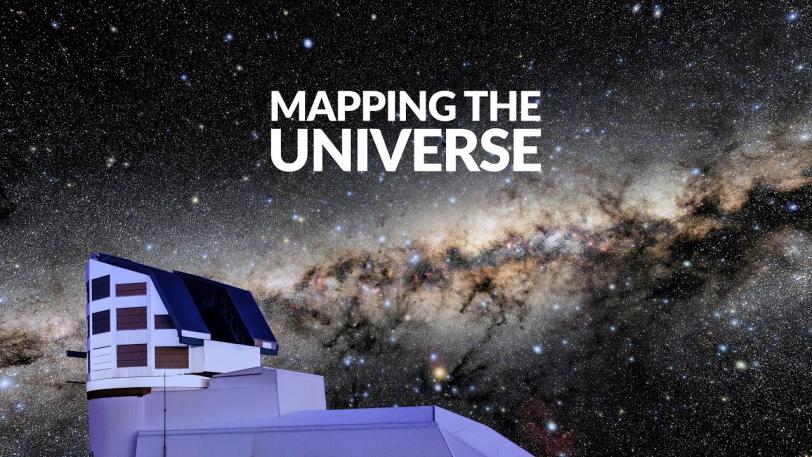
Mapping the universe
Video
This video breaks down how NSF–DOE Vera C. Rubin Observatory will conduct the Legacy Survey of Space and Time and build a 10-year time-lapse of the entire southern sky. (NSF–DOE Vera C. Rubin Observatory/NOIRLab/SLAC/AURA. Acknowledgement: Written and produced by Olivier Bonin | SLAC. Presenter: Phil Marshall | Deputy Director of Operations | Rubin Observatory/SLAC)

About SLAC

SLAC National Accelerator Laboratory explores how the universe works at the biggest, smallest and fastest scales and invents powerful tools used by researchers around the globe. As world leaders in ultrafast science and bold explorers of the physics of the universe, we forge new ground in understanding our origins and building a healthier and more sustainable future. Our discovery and innovation help develop new materials and chemical processes and open unprecedented views of the cosmos and life’s most delicate machinery. Building on more than 60 years of visionary research, we help shape the future by advancing areas such as quantum technology, scientific computing and the development of next-generation accelerators.

SLAC is operated by Stanford University for the U.S. Department of Energy’s Office of Science. The Office of Science is the single largest supporter of basic research in the physical sciences in the United States and is working to address some of the most pressing challenges of our time.

Dig Deeper

Related stories

News Brief

The team is the first to directly observe a unique property in an altermagnetic candidate material, key evidence of a new phase of magnetism.

Three mirrors displaying colorful diagrams with arrows, lines, and circular patterns, positioned above a smooth white rectangular base on a dark background.
News Release

The candidate orbits our sun beyond Pluto, and may be among the largest and brightest objects discovered in this region of the solar system.

Field of stars with a line tracing the path of a dwarf planet through the night sky.
Feature

The machine learning program SPINE has become a backbone of neutrino experiments worldwide, decoding complex detector images to help scientists unlock the secrets of...

ICARUS
News Brief

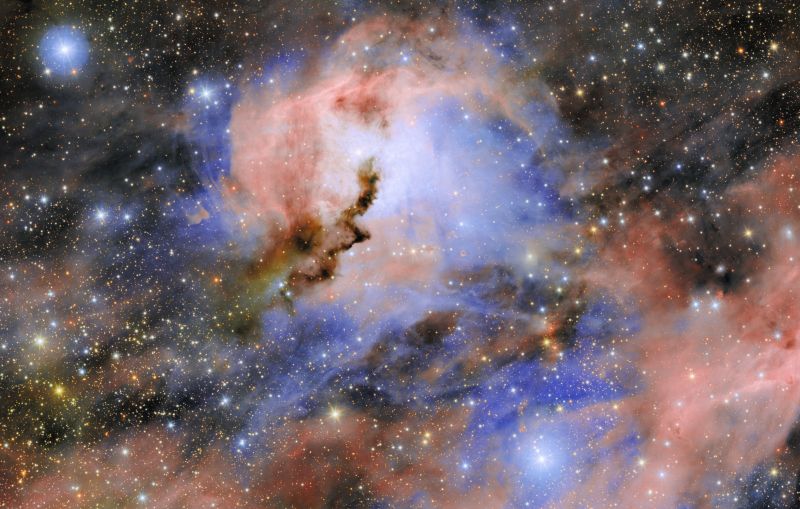
Star formation populates this image of the Seagull Nebula taken in Fall 2024 by Rubin Observatory’s engineering test camera.

Blue and pink swirls against a starry black background
News Release

The LUX-ZEPLIN experiment observed a particle interaction that could be interpreted as a signal from WIMPs, a dark matter candidate – but researchers will...

A researcher in protective gear works near a tall, cylindrical scientific instrument with visible wiring. The visible walls surrounding it are reflective Teflon.
News Brief

The deep-underground experiment could produce early-scientific results in the search for one of nature’s most elusive substances even, before reaching optimal sensitivity when the...

SuperCDMS shield