


SLAC topics

LCLS Resonant Inelastic X-ray Scattering (chemRIXS/qRIXS) RSS feed

The high repetition rate of LCLS-II combined with advanced instrumentation for time-resolved resonant inelastic X-ray scattering (RIXS) will map the energy distribution and evolution of occupied and unoccupied molecular orbitals of model complexes and functional photo-catalysts in liquid environments. Understanding the fundamental processes of photo-chemistry is essential for directed design of photo-catalytic systems for chemical transformation and solar energy conversion that are efficient, chemically selective, robust, and based on earth-abundant elements. The beamline will have two separate instruments with fixed interaction points – qRIXS and chemRIXS.  In the hutch the qRIXS endstation will be situated upstream, while the chemRIXS endstation will be located downstream.

Browse tagged content below

Feature

With a suite of reimagined instruments, researchers take up scientific inquiries that were out of reach just one year ago. 

Large metallic machine in a lab, featuring valves, circular bolts, and digital displays with surrounding wires and tubing.
Multimedia

Researchers used the upgraded LCLS to better understand what makes Xanthone – a powerful photocatalyst used in cancer therapies –  so efficient.  

close up of instrumentation in the TMO hutch
Multimedia

Now 10,000 times brighter and thousands of times faster, LCLS sheds light on the formation of free radicals in nature. 

a closeup of the target chamber of the RIXS experimental hutch
News Release

The high-energy upgrade will keep the U.S. at the forefront of X-ray science and technology, allowing researchers to advance fields such as sustainability, human...

LCLS-II-HE
Feature

Teams at SLAC installed new experimental hutches with cutting-edge instruments that will harness the upgraded facility’s new capabilities and expand the breadth of research...

SLAC's linac at sunrise, looking east.
News Release

With up to a million X-ray flashes per second, 8,000 times more than its predecessor, it transforms the ability of scientists to explore atomic-scale...

LCLS-II first light
Photograph

Kayla Ninh at LCLS’s ChemRIX Hutch 2.2 in Near Experimental Hall. 
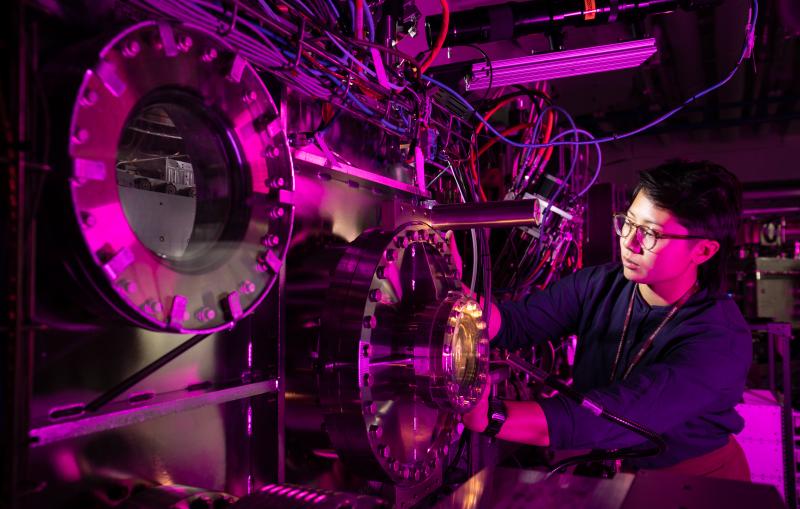
Kayla Ninh at LCLS’s ChemRIX Hutch 2.2 in Near Experimental Hall.