SLAC topics

Fundamental physics RSS feed

SLAC fundamental physics researchers study everything from elementary particles produced in accelerators to the large-scale structure of the universe. 

Browse tagged content

Fundamental physics concept illustration
Feature

The distant universe looks a little clearer, thanks to tens of thousands of citizen scientists who classified more than 6 million images over the...

Using an entire galaxy as a lens to look at an object in the far distance, researchers are learning more about powerful jets emitted...

Feature

Editors of the journal Science, published by the American Association for the Advancement of Science, have selected their annual Top 10 Science Breakthroughs of...

Image - Artist's illustration of a supernova, with a shockwave spreading out from it.

A panel met at SLAC National Accelerator Laboratory to look for promising routes to the study of dark matter, dark energy and other phenomena.

VIA Symmetry Magazine

The Universe's Earliest Moments

How is it possible to look at the earliest moments of the universe?

The Early Universe
Feature

SLAC's Kavli Institute for Particle Astrophysics and Cosmology (KIPAC) recently hosted many of the top scientists in the field to discuss the most important...

KIPAC mosaic
Feature
VIA Symmetry Magazine

Mock Data, Real Science

In scientific circles, “mock” is not always a four-letter word. To test that they’re interpreting their massive amounts of data correctly, astrophysicists create even...

Feature

SLAC and Stanford physicists played a key role in monitoring and analyzing the brightest gamma ray burst ever measured, and suggest that its never-before-seen...

Image - Collapsing star shooting out jet of gas
Feature

On Dec. 2-4, scientists from around the United States will meet at SLAC to discuss some of the most pressing scientific questions in particle...

Steve Ritz at Fermilab Town Hall
Feature

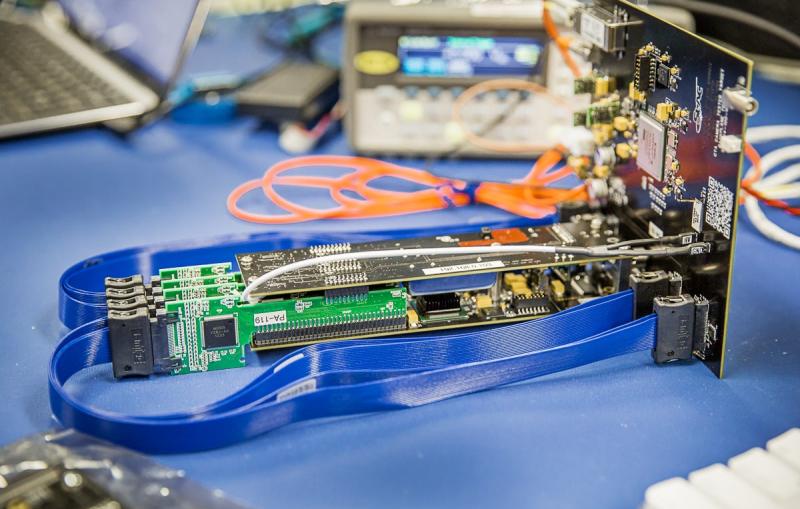
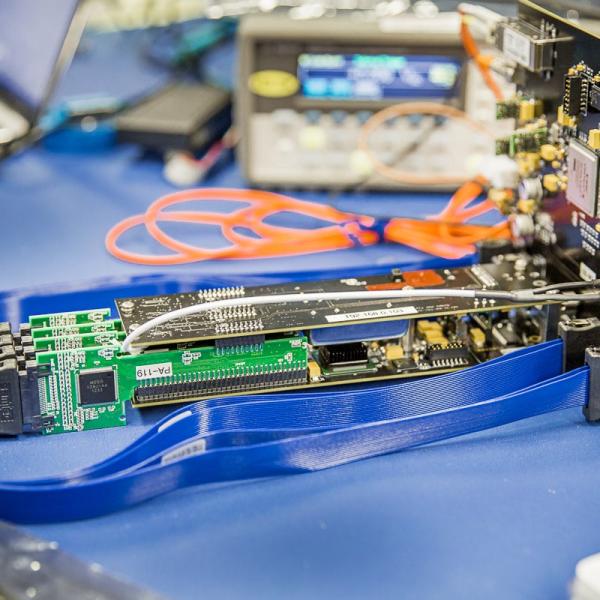
Scientists in SLAC's Integrated Circuits Department reach a new frontier in ultrafast X-ray science with intricately designed signal-processing chips that translate particles of light...

Four ePix100 prototype chips bonded in a test setup. (Brad Plummer/SLAC)
Feature

Particle astrophysicists are helping illuminate the dark side of the universe for a new show at the American Museum of Natural History in New...

Feature

Traces of iron spread smoothly throughout a massive galaxy cluster tell the 10 billion-year-old story of exploding supernovae and fierce outbursts from supermassive black...

Image: Illustration of some markers of the universe's turbulent youth, such as supernova explosions and active galactic nuclei (Akihiro Ikeshita).