SLAC National Accelerator Laboratory
    • About

      Learn about our science, people, facilities and partners. Discover our history and vision for the future.

    • OUR STORY
      • Mission, vision, values
      • History
    • LAB OVERVIEW
      • SLAC at a glance
      • Lab organization
      • Our partnerships
    • OUR PEOPLE
      • Leadership
      • Meet our teams
      • Faculty
    • VISIT SLAC
      • Public tours
      • Contact us
    • Resources
      • Images, videos & more
      • Brochures & fact sheets
    • Connect With Us
      • Facebook
      • Flickr
      • Instagram
      • LinkedIn
      • Twitter
      • YouTube
    video

    Who we are

    We explore radically new ideas with an entrepreneurial mindset.

    Science and User Support Building to the left and Arrillaga Science Center building to the right from above the Main Quad at SLAC's campus.
    • Research

      Get an overview of research at SLAC: X-ray and ultrafast science, particle and astrophysics, cosmology, particle accelerators, biology, energy and technology.

    • X-ray and Ultrafast science icon X-ray & ultrafast science

      Revealing nature’s fastest processes with X-rays, lasers and electrons

    • Physics of the universe science icon Physics of the universe

      Studying the particles and forces that knit the cosmos together

    • Advanced Accelerators science icon Advanced accelerators

      Building smaller, faster, more powerful accelerators for all

    • Science of life science icon Science of life

      Understanding the machinery of life at its most basic level

    • New technologies science icon New technologies

      Inventing new tools for science and society

    • Energy sciences science icon Energy sciences

      Finding clean, sustainable solutions for the world’s energy challenges

    Spotlight

    SLAC science explained

    Cut through the jargon while exploring our research.

    SAGE campers have fun experimenting with a Van de Graff generator
    • Facilities & Centers

      Learn more about the places where science happens at SLAC: our major facilities, institutes and centers.

    • SCIENTIFIC FACILITIES
      • LCLS website

        Linac Coherent Light Source

      • SSRL website

        Stanford Synchrotron Radiation Lightsource

      • FACET-II website

        Facility for Advanced Accelerator Experimental Tests

      • CryoEM website

        Cryogenic Electron Microscopy

    • JOINT INSTITUTES & CENTERS
      • SIMES website

        Stanford Institute for Materials & Energy Science

      • KIPAC website

        Kavli Institute for Particle Astrophysics & Cosmology

      • PULSE website

        Stanford PULSE Institute

      • SUNCAT website

        Center for Interface Science & Catalysis

      • SLAC-Stanford Battery Center

    NSF-DOE Vera C. Rubin Observatory LSST

    SLAC & Stanford build the world’s largest digital camera for the Legacy Survey of Space and Time (LSST).

    A drone photo of Rubin Observatory while taking pictures during the First Look observing campaign
    • Work with Us

      Find a career, partner with us or apply to use our tools and facilities.

    • PARTNER WITH US
      • For industry partners
      • Research partnerships & tech transfer
      • Technology Innovation
    • CAREERS AT SLAC
      • Job openings
      • Internships
      • Life at SLAC
    • USE OUR FACILITIES

      Apply to become a user of our scientific research facilities and instruments.

    • COMING TO SLAC
    • BECOME A SUPPLIER

    Careers at SLAC

    Join our united workforce.

    SLAC staff in main quad
    • News & Events

      Get the latest news about the lab, our science and discoveries. Explore SLAC events and learn how to participate.

    • NEWS CENTER
      • News archive
      • Media resources
      • Images & videos
    • SLAC EVENTS
      • Public lectures
      • Scientific seminars
      • Community events
    • SYMMETRY MAGAZINE

      This joint publication of SLAC and Fermilab is your view into the world of particle physics.

    • EDUCATIONAL PROGRAMS
      • Educational tours
      • Resources for students & educators
    • Connect With Us
      • Facebook
      • Flickr
      • Instagram
      • LinkedIn
      • Twitter
      • YouTube
    Upcoming public lecture

    Reinventing the way we break down plastic waste

    Thursday, March 26, 2026
    7:00–8:00 p.m. PDT

    Public Lecture: Ozge Bozkurt
Filter search by
Staff portalStanford directoryComing to SLACResources for…
  1. Home
  2. …
Filter by research area
  • X-ray and ultrafast science (179)
  • Physics of the universe (127)
  • Energy sciences (43)
  • Science of life (28)
  • New technologies (22)
  • Advanced accelerators (10)
Filter by Type
  • (-) News (1774)
  • Image (387)
  • Video (227)
  • Event (157)
  • Page (67)
  • Person (66)
  • resource (64)
  • News Collection (4)
Sort by
1774 results
Display Grid Display List
Clear all
Feature

First direct look at how light excites electrons to kick off a chemical reaction

Light-driven reactions are at the heart of human vision, photosynthesis and solar power generation. Seeing the very first step opens the door to observing...

May 1, 2020  ·  4 min read
Illustration showing electron orbitals ballooning in response to light
Feature

Flickr: Laser Proton Acceleration

Siegfried Glenzer's team and collaborators from Tel Aviv University are working on a method that could make proton accelerators 100 times smaller without giving...

May 6, 2020
Glenzer-LaserProtonAcceleration
News Brief

Computer vision helps SLAC scientists study lithium ion batteries

New machine learning methods bring insights into how lithium ion batteries degrade, and show it’s more complicated than many thought.

May 8, 2020  ·  3 min read
Particles in a nickel-manganese-cobalt cathode are highlighted using a new computer vision algorithm.
Feature

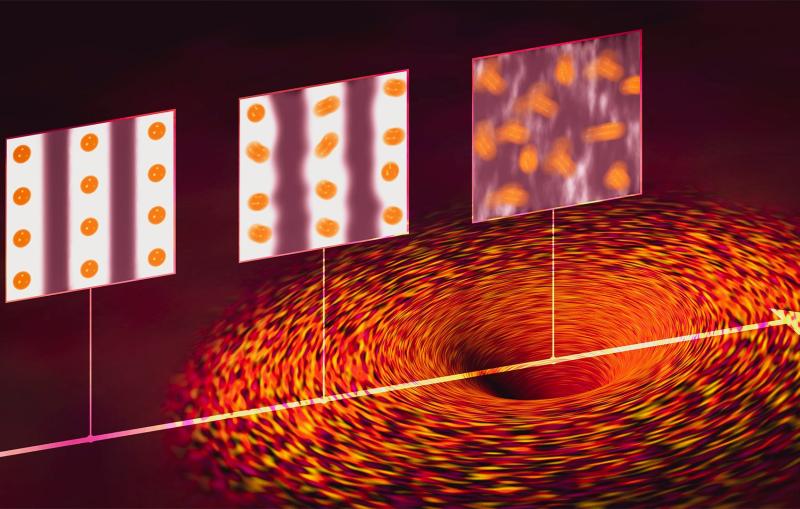
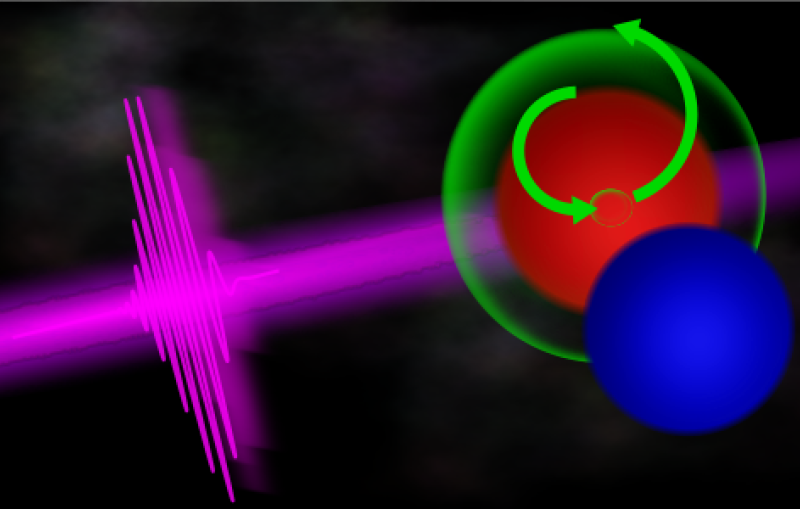
In a step forward for orbitronics, scientists break the link between a quantum material's spin and orbital states

The advance opens a path toward a new generation of logic and memory devices that could be 10,000 times faster than today's.

May 15, 2020
Fanciful illustration based on electron orbitals
Feature

Untangling a key step in photosynthetic oxygen production

Understanding nature’s process could inform the next generation of artificial photosynthetic systems that produce clean and renewable energy from sunlight and water.

May 20, 2020  ·  6 min read
How electrons flow in the oxygen-evolving complex of Photosystem II.
Feature

To decipher Earth’s evolutionary tale, researchers probe materials at deep-Earth conditions

Learning how liquid silicates behave at these extreme temperatures and pressures has been a longstanding challenge in the geosciences.

May 18, 2020  ·  4 min read
atomic arrangements of liquid silicates at the extreme conditions found in the core-mantle boundary.
Feature

Researchers capture the coordinated dance between electrons and nuclei in a light-excited molecule

Revealing both sides of the story in a single experiment has been a grand scientific challenge.

May 21, 2020  ·  5 min read
nuclear and electronic
Feature
VIA Stanford News

Cosmic rays may have left indelible imprint on early life

Physicists at SLAC and Stanford propose that the influence of cosmic rays on early life may explain nature’s preference for a uniform “handedness” among...

May 26, 2020
Chirality graphic
Feature

Scientists marry two powerful techniques to pinpoint locations of individual molecules in their cellular neighborhoods

Researchers expect the new method to answer fundamental questions in biology and materials science. First up: Images showing molecules that help guide cell division...

June 8, 2020  ·  7 min read
cryo-EM image of Caulobacter bacterium
VIA Stanford News

Roger Blandford awarded $1.2M Shaw Prize for far-reaching contributions to astrophysics

Blandford’s major contributions range from energetic jets ripping forth from colossal black holes to cosmic “magnifying” glasses to gravitational waves.

June 1, 2020
Roger Blandford
Feature

Now complete, DESI is poised to begin its search for answers about dark energy

The Dark Energy Spectroscopic Instrument, which will map millions of galaxies in 3D from a mountaintop in Arizona, has reached its final milestone toward...

June 4, 2020  ·  3 min read
Mayall Telescope Star Trails
Feature

Shock waves created in the lab mimic astrophysical particle accelerators powered by exploding stars

In experiments at the National Ignition Facility, a SLAC-led team found new details about how supernovas boost charged particles to nearly the speed of...

June 5, 2020  ·  5 min read
A computer simulation of the turbulent magnetic fields in two plasma shock waves, which were created in the lab to mimic astrophysical shocks.
  • Go to previous page
  • Page 1
  • …
  • Page 83
  • Page 84
  • Page 85
  • Page 86
  • Currently on page 87
  • Page 88
  • Page 89
  • Page 90
  • Page 91
  • …
  • Page 148
  • Go to next page

SLAC National Accelerator Laboratory 
2575 Sand Hill Road  
Menlo Park, CA 94025-7015  
650.926.3300

  • Coming to SLAC
  • Connect with us
  • Contact us
  • Facebook
  • Flickr
  • Instagram
  • LinkedIn
  • Twitter
  • YouTube

Sign up for our email

Monthly newsletter for cutting-edge science, SLAC milestones and events.

Sign up

Bold People
Visionary Science
Real Impact

We explore how the universe works at the biggest, smallest and fastest scales and invent powerful tools used by scientists around the globe.

  • About
    • Our story
    • Our people
    • Lab overview
    • Visit SLAC
    • Resources
    • Connect with us
  • Research
    • X-ray & ultrafast science
    • Advanced accelerators
    • New technologies
    • Physics of the universe
    • Science of life
    • Energy sciences
    • SLAC science explained
  • Facilities & centers
    • Scientific facilities
    • Joint institutes & centers
  • Work with us
    • Partner with us
    • Become a supplier
    • Use our facilities
    • Careers at SLAC
  • News & events
    • News center
    • Symmetry Magazine
    • Media resources
    • Events
    • Educational programs
    • Connect with us
  • Staff portal
  • Privacy policy
  • Accessibility
  • Vulnerability disclosure
  • A–Z index
  • Website feedback
Home
  • SLAC home
  • Maps & directions
  • Emergency info
  • Careers

© 2026 SLAC National Accelerator Laboratory is operated by Stanford University for the U.S. Department of Energy Office of Science.

Stanford University U.S. Department of Energy
Top Top
Back to top Back to top